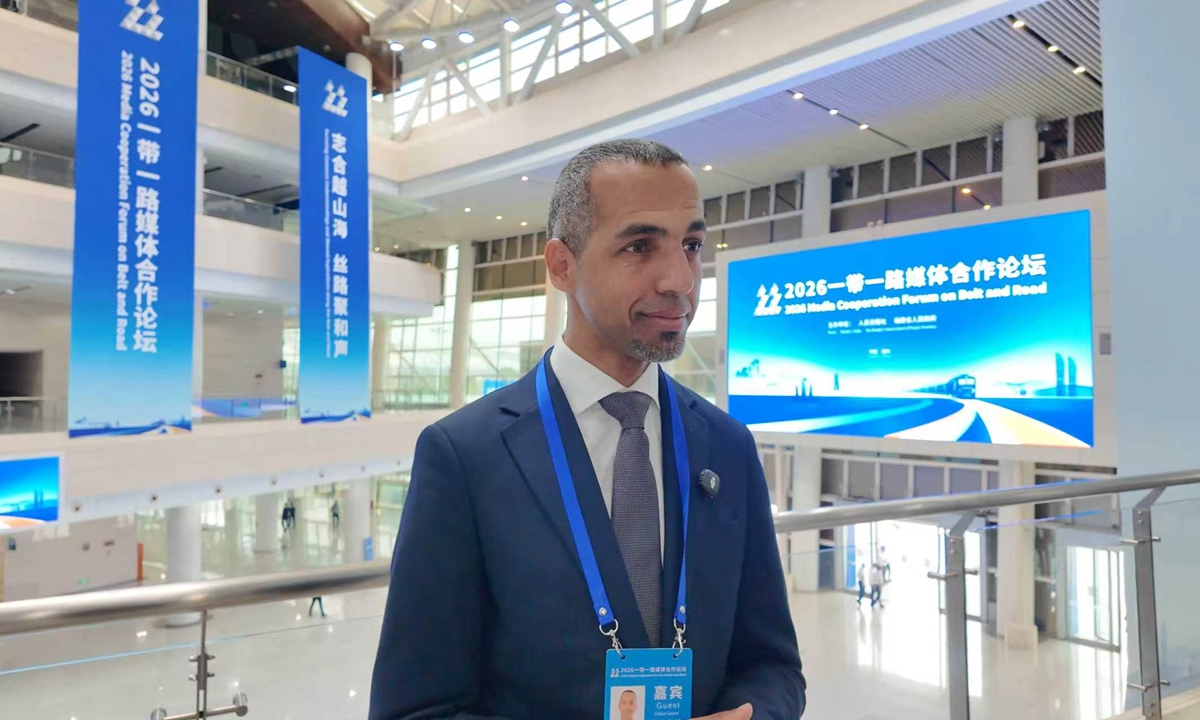
The Bridge That Speaks Mandarin: How One Egyptian Guide Is Reshaping China’s Global Narrative
“I don’t want to be just an ordinary tour guide, or an ordinary bridge between people. I want to be a bridge that truly connects them,” Abbas Saeed told the Global Times. The Egyptian speaker, born in 1984, spoke at the podium during the 2026 Belt and Road Media Cooperation Forum in Fuzhou this week, addressing over 200 foreign delegates from 182 media outlets and institutions in 100 countries. He delivered his remarks in clear English and fluent Mandarin.
His presence at the 2026 Belt and Road Media Cooperation Forum, which opened Tuesday in East China’s Fujian Province, highlights the initiative’s human dimension. Rather than focusing solely on ports and high-speed railways, Saeed emphasized the “human dimension” of the Belt and Road Initiative, calling media and cultural exchanges the real arteries connecting people. At the 2026 Belt and Road Media Cooperation Forum in Fuzhou, East China’s Fujian Province, more than 200 foreign delegates from 100 countries gathered, with Egyptian tour guide Abbas Saeed emphasizing media and cultural exchanges as the human dimension of the Belt and Road Initiative.
From Cairo to Fuzhou: A Two-Decade Linguistic Odyssey
Saeed’s journey with the Chinese language began in 2002 when he enrolled in the Department of Chinese Language at Ain Shams University in Egypt. Just three months into his studies, he made a drastic decision that few language learners would dare: he stopped speaking Arabic, his native tongue, at least for a while. “I spoke Chinese with my classmates at school, but Chinese was so difficult that they didn’t want to speak it with me. That was fine. I just talked to myself,” he recalled. “Learning Chinese taught me to listen to myself and gave me a way to communicate with the world.”

The depth of his mastery became evident during a recent Global Times interview, when a reporter playfully asked his age using an old-fashioned Chinese expression that even native speakers rarely use in everyday conversation. Saeed understood immediately and replied without hesitation that he was born in 1984, leaving the reporter genuinely impressed by his command of the language.
After graduating, Saeed spent three years working as a tour guide before dedicating another three years to deepening his understanding of Chinese culture and gaining experience in diplomatic exchanges. Throughout this period, he refined a distinctive method of bridging civilizations: when introducing Egyptian historical sites to Chinese tourists, he relates them to periods of history that Chinese people are familiar with, making the distant world of the pharaohs feel accessible. Conversely, when introducing China to Egyptian audiences, he draws on their own cultural perspectives so that Chinese stories become easier to understand and relate to.
Saeed Highlights Cultural Exchanges as BRI’s Lasting Impact
At the Fuzhou forum, Saeed deliberately pivoted away from the grand projects and figures that typically dominate Belt and Road discourse. “When people talk about the Belt and Road Initiative, they often think of major projects, trade routes, ports and high-speed railways,” he told delegates. “But today, I want to talk about its human dimension—the real arteries that connect the hearts and minds of people in our two countries: media and cultural exchanges.”
More than a tour guide, he wants to be a bridge between #China and #Egypt. Meet Abbas Saeed, whose passion for the Chinese language has taken him from the classroom to the podium of the 2026 #BeltandRoad Media Cooperation Forum. For him, the real power of cultural exchange lies… pic.twitter.com/p3KXxUy021
Saeed argues that the BRI’s deeper and more lasting impact in Egypt lies not merely in high-speed railways, ports, and construction projects that have helped drive economic development and create jobs, but in the connections forged between people and the dialogue between civilizations.
He offered a concrete illustration of this bridge-building: when a Chinese tourist with little knowledge of Egyptian civilization learns about the history behind the pyramids through his explanations, “a conversation between two civilizations has already begun.” That, he emphasized, is a bridge built through direct human interaction.
Competing for Hearts and Minds
The 2026 forum’s attendance—more than 200 delegates representing 100 countries—demonstrates the impressive scale of this outreach effort.
Indeed, the Belt and Road Initiative remains fundamentally a state-driven project, and cultural exchanges can function as vehicles for political influence.
Saeed Demonstrates Language Mastery to Redefine Bridge Roles
The precision of Saeed’s Mandarin was such that, had the forum audience heard only his voice without seeing him, they might barely have realized that he was not a native Chinese speaker.
“Everyone in my family said Chinese was the most difficult language in the world,” Saeed recalled. “I was determined to prove them wrong—that if you dare to try and believe in yourself, there is no obstacle you cannot overcome.”
His insistence that he does not want to be just an ordinary bridge perhaps says it all about the strategy at work. A bridge does not need to stand out or draw attention to itself. Its genuine aim is to draw people on either side nearer, until the gap between them no longer appears so wide.
Worth a look

James Talarico wins Texas Senate seat in upset of Ken Paxton
For the first time since Lloyd Bentsen won in 1988, a Democrat has captured a U.S. Senate seat...

Democrats reclaim House and Senate in nationwide midterm election
Texas turned blue long before midnight in an election that surprised Washington. James Talarico shattered decades of precedent...

ESCAP CSD9 Session Tackles Poverty and Social Protection in Asia-Pacific
Ministers and ESCAP Convenes Ninth Session on Social Development As Mirage News noted, top policymakers, ministers, and specialists...

Duct Tape Outperforms Sandbags in Flood Protection Lab Tests
University of Hull Lab Tests Reveal Duct Tape Outperforms Sandbags in Flood Defense In controlled laboratory trials conducted...