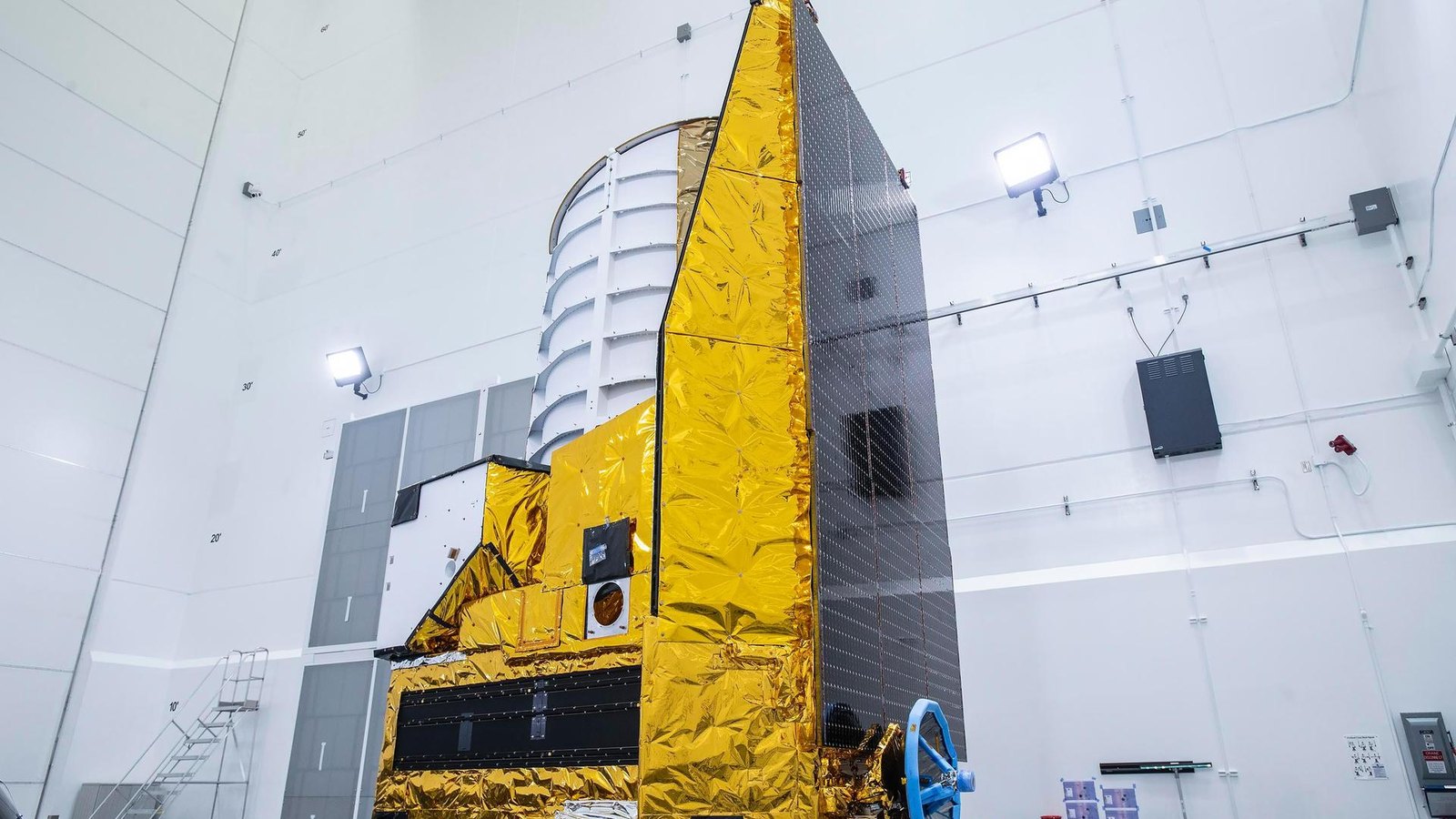
ESA’s Euclid telescope has found the most distant quasar known, pushing the cosmic frontier back to 630 million years after the Big Bang.
The object, formally designated J1504+6252 and nicknamed Dún Aonghasa, carries a supermassive black hole of about 360 million solar masses. This scale strains current formation models because the black hole appears to be feeding well below the Eddington limit.
- Quasar J1504+6252 (Dún Aonghasa) sits at redshift z = 8.13, seen 630 million years after the Big Bang.
- Its black hole weighs roughly 360 million Suns, yet accretes far below the Eddington limit.
- The discovery beats the previous record by about 40 million years.
- Follow-up data came from Keck, Hubble, the Large Binocular Telescope, and JWST.
Euclid finds record-breaking quasar
On 24 November 2026 the European Space Agency announced that Euclid’s Wide Survey had picked out J1504+6252. A multi-observatory campaign then confirmed it: Keck Observatory, Hubble, the Large Binocular Telescope, and the James Webb Space Telescope revealed a redshift of z = 8.13. That corresponds to a cosmic age of 630 million years, moving the quasar frontier earlier by 40 million years.
The study, led by Julien Wolf and published in Astronomy & Astrophysics, reports that Dún Aonghasa harbors a supermassive black hole with a mass of 360 million solar masses.
A black hole that grows slowly
Despite its enormous mass, Dún Aonghasa is accreting well below the Eddington limit. This is the self-regulating threshold where radiation pressure halts infall.
If this slow rate were constant, the black hole would need an implausibly massive seed at birth. This challenges standard growth scenarios.

“Finding quasars at ever-increasing distances teaches us something about how the black holes in their centres grew. The closer to the Big Bang we find them, the faster their black holes must have grown or the more massive they must have been at birth — or both,” Wolf said.
Wolf said the record “could fall again in a few months or it could stand for years.”
“About 630 million years after the Big Bang, its black hole had already grown to about 360 million times the mass of the sun. But how?” Wolf told AP said
Euclid’s accelerating finds
Launched in 2023 to map dark matter and dark energy, Euclid has flagged 31 quasars in 1.5 years, including 12 beyond redshift 7. Dún Aonghasa is the first quasar with a redshift greater than eight.
The previous record holder was EUCL J172902.75+641018.1 at z = 7.77, seen within the first 670 million years after the Big Bang. Astronomers expect Euclid to find multiple more quasars beyond redshift 8 in the coming years.
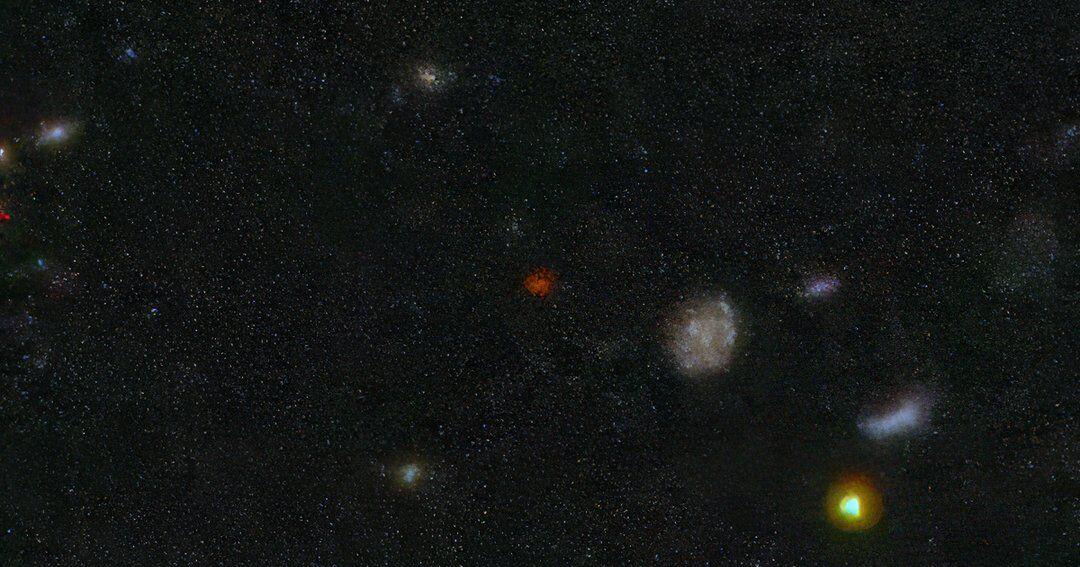
Wolf said the new quasar gives researchers a new deadline for the early universe.
Earlier quasar discoveries
Dún Aonghasa is the first beyond redshift 8. Astronomers expect the telescope to find multiple more quasars past that threshold in the coming years. Each will test whether the slow-feeding, rapid-growth pattern is common among the earliest supermassive black holes.
The team behind the discovery
The quasar that held the record before Dún Aonghasa was EUCL J172902.75+641018.1 at redshift z = 7.77, announced in July 2026. A second quasar from that July announcement, EUCL J125308.55+705432.3 at z = 7.69, also fell within the first 670 million years.
The discovery team was led by Julien Wolf, a postdoctoral researcher at the Max Planck Institute for Astronomy (MPIA) in Heidelberg, Germany, who is now at the European Southern Observatory in Garching bei München, Germany. The team nicknamed the quasar Dún Aonghasa to honor its age and location, referencing the prehistoric clifftop fort in Ireland overlooking the Atlantic Ocean.
The findings are published in Astronomy & Astrophysics on 24 November 2026 in the paper by J. Wolf, S. Belladitta, et al., titled Euclid: Discovery of Dún Aonghasa, a quasar at z = 8.13 hosting a 360-million-solar-mass black hole. The paper’s DOI is 10.1051/0004-6361/202662243.
Keep reading

Tampa General COO Cites GLP-1 Use, Evidence Gaps at Oncology Summit
About 12% of U.S. adults now take a GLP-1 drug, and oncology leaders say patients are arriving for...
Indonesia Won’t Move Javan Rhinos Until Studies Complete
Indonesia's government says it will not move Javan rhinos from Ujung Kulon National Park until scientific studies are...

Mercury at Greatest Western Elongation, Visible Pre-Dawn
Mercury reached its greatest western elongation on 20 November, placing the innermost planet far enough from the Sun's...

Ottawa Tables Motion to Expand Expropriation Powers for Alto Rail
Ottawa moved Friday to strip away the remaining standard expropriation rules for the Alto high-speed rail project, posting...