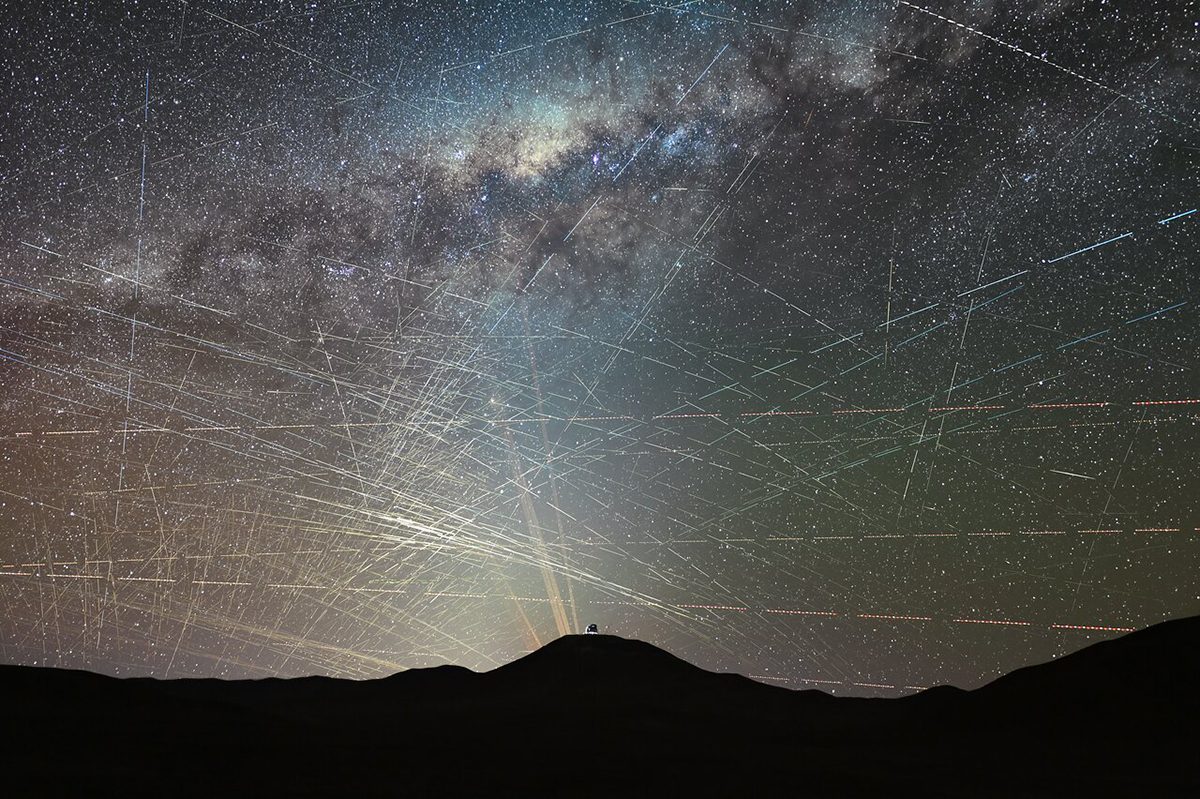
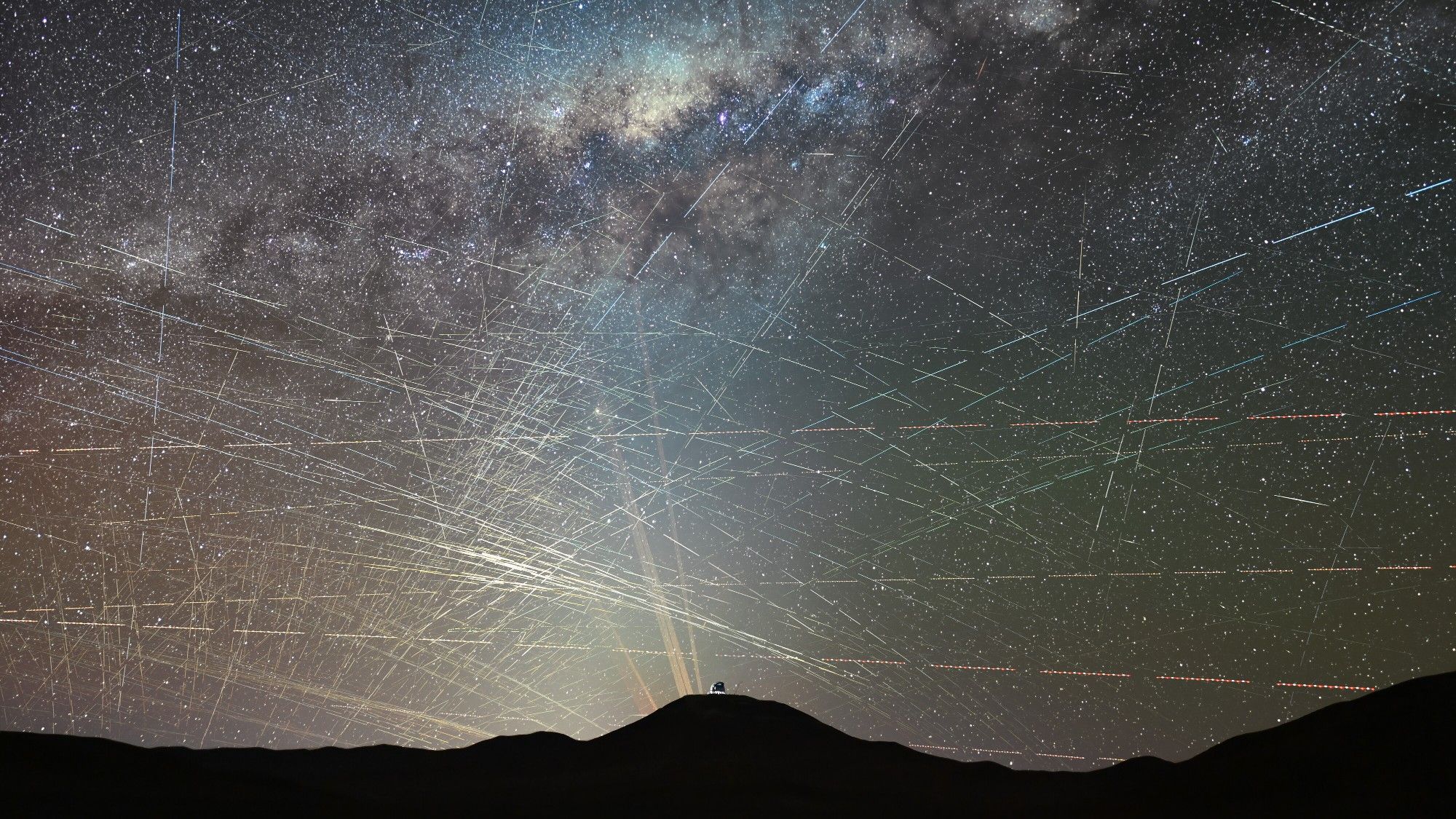
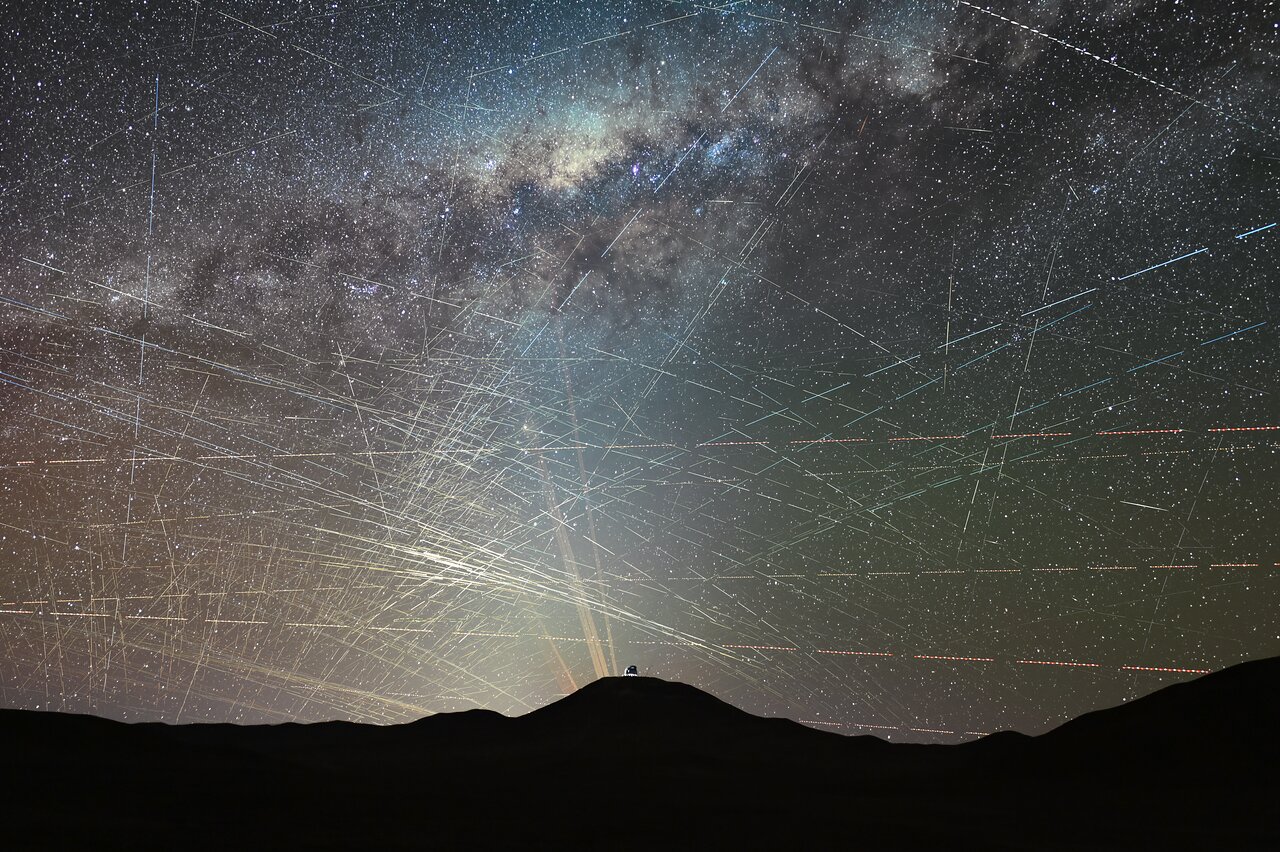
A new study from the European Southern Observatory warns that proposals to launch over 1.7 million satellites into orbit would have “devastating consequences for astronomy.” Researchers report that current satellite constellations and planned mirror-like satellites already threaten to brighten the night sky, potentially rendering ground-based telescopes obsolete by obscuring deep-space observations.
The Existential Threat to Ground-Based Astronomy
The number of artificial satellites orbiting Earth has surged since 2019, growing to more than 14,000 active units today, largely driven by SpaceX’s Starlink telecommunications program. According to research conducted by the European Southern Observatory (ESO), this rapid expansion is now colliding with the operational needs of global observatories.
Olivier Hainaut, the lead author of the study and an astronomer at the ESO for over 30 years, notes that while satellite operators have implemented some brightness-reduction measures, the scale of proposed constellations goes “beyond the limit” of what the field can sustain. The study suggests that to protect the integrity of astronomical research, no more than 100,000 satellites—specifically those faint enough to remain invisible to the naked eye—should be in orbit at any given time.
“We can reach conditions where basically, there is no point in operating the telescopes anymore because all the data will be corrupted. All. 100 percent,” Hainaut told Space.com.
Brightness and Data Loss: How Satellites Obscure the Sky
The impact of these satellites is two-fold: they create physical streaks across telescope images and increase the overall background brightness of the night sky, a form of orbital light pollution. Hainaut’s modeling indicates that for every 10 percent increase in light pollution, astronomers must increase exposure times by 10 percent to maintain data quality. This scaling effect makes scientific discovery increasingly expensive and time-consuming.
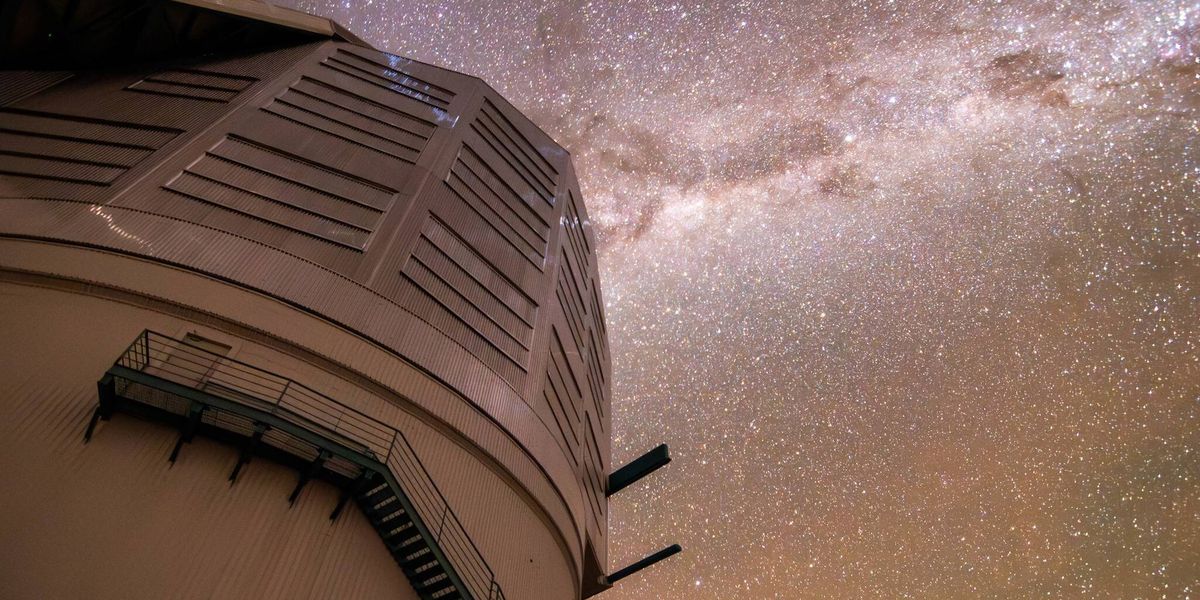
For high-precision instruments like the Very Large Telescope (VLT) at the Paranal Observatory in Chile, the presence of these constellations could result in field-of-view losses of up to 28 percent during images taken two hours into the night. Other facilities, such as the US National Science Foundation’s Vera C. Rubin Observatory, face even more severe disruptions, with the potential for most images to be rendered unusable for several hours each night.
“Satellites, illuminated by the Sun, are much brighter than distant galaxies. When a satellite crosses what we observe, it makes a bright streak on our image, zapping whatever is behind it,” Hainaut explained via the ESO.
The Challenge of Mirror-Like Satellites
Beyond telecommunications, the industry is seeing proposals for specialized hardware that could fundamentally alter the appearance of the night sky. The US startup Reflect Orbital has announced plans to launch a constellation of “very large mirror-like satellites to provide sunlight at night,” designed to deliver solar energy to Earth’s surface.
The ESO study highlights that these satellites would be the brightest objects in orbit. If observed from within a reflected beam, a single satellite would appear four times brighter than the full Moon. Even outside the direct beam, each satellite would shine with the intensity of Venus.
Reflect Orbital has stated that it takes these concerns seriously. “Not only do we take this seriously, but we are committed to seeking out engagement and dialogue, are excited to listen and receive feedback, and are eager to improve our early designs and future service,” the company noted on its website, as reported by BBC Sky at Night Magazine.
Regulatory Uncertainty and Future Stakes
The future of these constellations now rests with the Federal Communications Commission (FCC), which is currently reviewing multiple filings from companies including SpaceX, E-Space, and Reflect Orbital.
Betty Kioko, an institutional affairs officer at the ESO, emphasized that the scientific community is waiting on the commission to act. “The ball is now in the FCC’s court, and we wait to see the determinations they make on both filings. For optical astronomy, this is an existential threat, and we hope that the regulators will share that view,” she said.
As of July 2026, the scientific community remains in a state of high alert. With plans in place to increase satellite populations significantly by 2035, the tension between the global demand for increased connectivity and the preservation of a dark, observable night sky has reached a critical juncture.
Find more reporting in our News section.
- US Evacuates B-1 Bombers From UK Base Over Suspected Iranian Plot
- Singapore Authorities Catch 67 Travellers for Border-Related Offences
- Met Office warns UK households to stockpile food for severe winter weather (newsarchyuk.com)
- SBP Warns: Excessive Whey Protein Risks for Children and Adolescents (archyde.com)
US Evacuates B-1 Bombers From UK Base Over Suspected Iranian Plot
The United States evacuated a dozen long-range B-1 bombers from RAF Fairford in the United Kingdom following security...

Singapore Authorities Catch 67 Travellers for Border-Related Offences
During a week-long border operation from September 22 to 28, Singapore authorities checked nearly 13,000 travellers and detected...

Robert De Niro Slams Trump and Republicans Over Voting Access
Actor Robert De Niro delivered a profanity-laced speech at an election-protection event in New York City on October...

Flávio Bolsonaro Edges Lula in Brazil Election First Round
Thomas Caldwell With 97 percent of ballots counted, Flávio Bolsonaro led with 47.45 percent of valid votes compared...