In a broadcast on WUWM 89.7 FM – Milwaukee’s NPR, NPR science correspondent Geoff Brumfiel detailed how SpaceX successfully caught a returning spacecraft with mechanical arms at its Starbase facility in Boca Chica, Texas.
Employees and others watching the event were ecstatic as the spacecraft made history by returning from orbit.
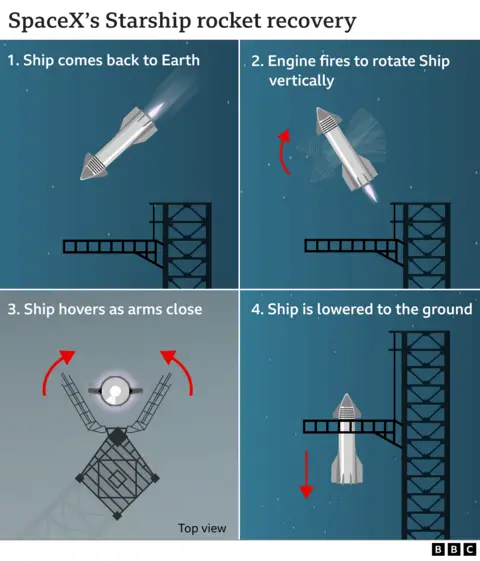
Describing the flight, Geoff Brumfiel said that the spacecraft re-entered Earth’s atmosphere glowing red, flew over Mexico’s Baja Peninsula, Mexico, and Texas, and returned to the launch pad on the Gulf Coast near Brownsville. On a gray and cloudy day, the spacecraft burst through the clouds, flipped vertically, fired its engines, and lowered itself to the launch tower where two mechanical arms named Mechazilla grabbed it.
An unidentified person said in an archived recording,
“Can you believe it? Mechazilla has caught the Starship.”
Geoff Brumfiel said that the Starship was moving at 26,000 kilometers per hour, or 16,000 miles per hour, making its way back to Earth to burn off energy and land precisely, adding that nothing like that has ever been done before.
Regarding the business importance of the rocket, Geoff Brumfiel said that SpaceX wants to use Starship to launch potentially thousands of satellites for its Starlink internet constellation, noting that it deployed 26 satellites on this flight. Someday, the company also wants to launch orbital data centers into space, and both products are key to rapid revenue growth if Starship can be made rapidly reusable.
Explaining the reusability goal, Geoff Brumfiel said that the booster and the rocket will both fly back to the tower, get caught, stacked, refueled, filled up with satellites or other cargo, and launched again very quickly.
However, Geoff Brumfiel pointed out that not everything went smoothly, as Starship’s super heavy booster rocket was supposed to return to the pad after launch yesterday, but it aborted, landed in the Gulf, and self-destructed. The company needs to get both the booster and Starship back for the system to really work, leaving more work to be done.
Discussing financial pressures facing SpaceX, Geoff Brumfiel said that the company is under enormous pressure, noting that it spent over $1 billion on Starship in the first nine months of the year. While SpaceX revenue is up from renting out artificial intelligence infrastructure on Earth, the company has not turned a profit overall, meaning investors need to see rapid progress.
Related reading

Phoenix Areas of Rain Expected to End Saturday Evening
Phoenix areas of rain expected to end Saturday evening across the Valley after a brief weekend storm system...

Spartans to Face Alabama State on Sunday Night at Home – SJSU Athletics
The San José State men's basketball team will host Alabama State on Sunday, November 15, at 6 p.m....

Drone Attacks on Power Stations Plunge Sudan’s Cities Into Darkness
Sudan faces a severe energy crisis as a wave of targeted drone strikes drives down electricity generation and...

Author Questions Colleague Taking Four Days’ Leave to Play World of Warcraft
In a column for Region Canberra, the publication reported that a worker took four days of annual leave...