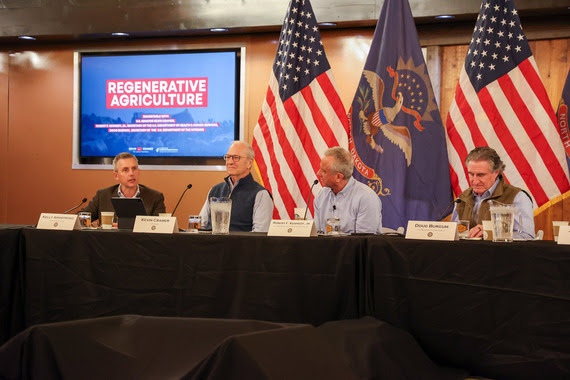
Governor Kelly Armstrong met with U.S. Secretary of Health and Human Services Robert F. Kennedy Jr. at Black Leg Ranch near McKenzie to discuss the intersection of soil health, regenerative agriculture, and the long-term wellness of the American population. The visit, which included a roundtable discussion, centered on how agricultural practices directly influence the food supply and, by extension, public health outcomes.
The meeting served as a platform for North Dakota officials to showcase state-led initiatives designed to link land stewardship with economic and physical health. According to a report from the Governor’s office, the discussions highlighted the importance of soil productivity to the future of Americans’ well-being.
Regenerative agriculture and the Governor’s Legacy Soil Health Program
During the roundtable, Governor Armstrong emphasized the progress of the Governor’s Legacy Soil Health and Habitat Program. Launched last January, this voluntary working lands program provides incentives for North Dakota farmers to implement practices that strengthen cropland resilience. By utilizing perennial grass cover, the program aims to improve soil health and water retention while simultaneously creating wildlife habitats and increasing access for hunters.
The program is a collaborative effort between the state Game and Fish Department and the North Dakota Association of Soil Conservation Districts. Data released by the Governor’s office shows that the two-year, $6.5 million pilot project is already fully subscribed. For the 2026 cycle, more than 9,000 acres have already been funded under the initiative.
“We appreciate Secretary Kennedy coming to North Dakota to discuss ag practices that improve soil health and farmland productivity and profitability, which will strengthen America’s food supply and support health in the long term,” Armstrong said.
Armstrong noted that as the state looks toward expanding the program, the goal is to work alongside federal, state, and local partners to capture the economic benefits for farmers, ranchers, and sportsmen alike.
A broad agenda for North Dakota’s rural and tribal health
While the discussion at Black Leg Ranch focused on the land, Secretary Kennedy’s visit to the Bismarck area covered a wider range of systemic challenges. As reported by Yahoo News, the Secretary participated in three separate roundtable discussions involving state and tribal leaders. These sessions addressed the Rural Health Transformation Program, tribal health initiatives, and the regulatory burdens currently facing long-term care providers.
The visit drew significant attention from North Dakota’s congressional delegation. U.S. Senator Kevin Cramer, who hosted the Secretary at the ranch, expressed gratitude for the administration’s engagement with the state’s agricultural sector. Cramer noted that the Secretary would have the opportunity to observe the “innovative stewardship” being practiced by local producers and to hear directly from tribal leaders regarding the unique challenges facing their communities.
U.S. Senator John Hoeven also participated in the discussions, framing the visit as a vital opportunity to support the state’s healthcare infrastructure. Hoeven specifically pointed to the necessity of strengthening health systems within rural and tribal areas.

Federal and state leaders coordinate on land and health
The high-level nature of the discussions was reflected in the roster of attendees. Joining Governor Armstrong and Secretary Kennedy were U.S. Secretary of the Interior Doug Burgum, U.S. Senator John Hoeven, U.S. Representative Julie Fedorchak, and State Agriculture Commissioner Doug Goehring. Secretary Burgum, North Dakota's former governor, showed the coordination between the Department of the Interior and the Department of Health and Human Services regarding land use and public welfare.
By linking soil health to “farmland productivity and profitability,” as Armstrong stated, the administration is positioning regenerative agriculture not just as an environmental concern, but as a cornerstone of economic stability for the agricultural sector. This approach attempts to bridge the gap between environmental stewardship and the financial viability of family farms and ranches.
As the Governor’s Legacy Soil Health and Habitat Program moves forward, the focus remains on whether these voluntary, incentive-based models can be expanded.

James Gates sues OpenAI alleging ChatGPT assisted wife’s plot
A North Carolina man has filed a lawsuit against OpenAI, alleging that its ChatGPT chatbot was used to...

Wyoming girls state swimming championships begin this Thursday
The Wyoming High School girls’ state swimming and diving championships kick off Thursday, Friday, and Saturday in Gillette....

Mitchell Robinson takes on new role as Celtics face early slump
Robinson's Rebound: A New Role for Boston's Center Seven games into the season, the Boston Celtics have their...

WVU Injury Update: Sieg, Weaver-Bomar Trending to Play at Texas Tech
West Virginia Mountaineers Get Key Injuy Boost: S Matt Sieg, WR Armoni Weaver-Bomar Trending to Play at Texas...