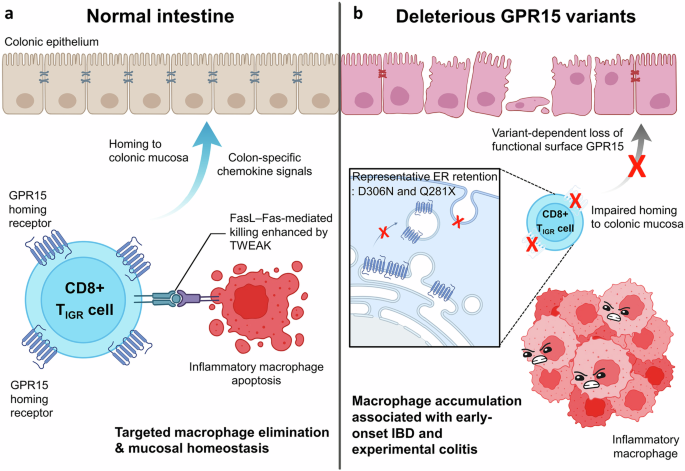
Researchers have identified a distinct population of regulatory CD8+ T cells that homes to the colonic mucosa and keeps inflammatory macrophages in check, and they have linked rare, damaging variants in the homing receptor GPR15 to severe early-onset inflammatory bowel disease.
The work, published in Nature by Cui and colleagues, defines these cells as GPR15-guided regulatory CD8+ T cells — CD8+ TIGR cells — and shows they are molecularly and functionally separate from the peripheral KIR+CD8+ regulatory T cells described in other settings.
A Distinct Mucosal Regulator
Single-cell transcriptomics revealed an innate-like phenotype marked by NK-associated receptors including KIR2DL4, KIR3DL2, KLRC2 and KLRC3. In four unrelated families with severe early-onset IBD, whole-exome sequencing uncovered rare deleterious GPR15 variants.
Patient-derived cells showed variant-specific defects: D306N and Q281X were largely retained in the endoplasmic reticulum, Y215X showed minimal receptor expression, and Y132S and Y132S/F159I had reduced surface expression, while F159I alone localized normally to the Golgi and cell surface. Except for F159I, these defects reduced functional surface GPR15 and impaired GPR15L-directed chemotaxis.
Intestinal biopsies from these patients showed reduced CD8+ T cell frequencies in both epithelial and lamina propria compartments, a specific loss of the GPR15+ CD8+ TIGR cluster by scRNA-seq, and preserved FOXP3+ Treg frequencies — evidence of a non-overlapping regulatory layer. Patient tissue also accumulated activated macrophages.
Mouse Models Confirm the Causal Chain
Complementary mouse work identified a conserved murine CD8+ TIGR population expressing Ly49-family NK receptors such as Klra6 and Klra7. CD8+ T cell-specific Gpr15 deletion (Gpr15fl/flCd8cre), but not Treg-specific deletion (Gpr15fl/flFoxp3cre), selectively depleted colonic CD8+ TIGR cells and markedly worsened DSS-induced colitis. In Gpr15-deficient mice, inflammatory macrophages accumulated in the colon, and macrophage depletion attenuated colitis, supporting their pathogenic role.
Co-culture experiments showed that activated CD8+ TIGR cells directly eliminated inflammatory macrophages through a contact-dependent mechanism predominantly mediated by FasL and enhanced by TWEAK.
Relevance Beyond Monogenic Disease
The authors extended the findings to sporadic IBD cohorts. Colonic biopsies from ulcerative colitis patients showed a 42 percent decline in the CD8+ TIGR population, and terminal ileal biopsies from Crohn’s disease patients showed a significantly reduced population as well. The mechanism driving this reduction in sporadic disease remains unclear and cannot be solely attributed to impaired GPR15 signaling; other rate-limiting factors may be involved.
Unknowns Persist About Antigen Targets and Extra-Intestinal Roles
Several unknowns remain. GPR15-associated IBD shows incomplete penetrance — some carriers of deleterious variants remain asymptomatic — suggesting modulation by age, genetic background, or environment. The antigens recognized by CD8+ TIGR cells during inflammation are unknown despite a restricted T-cell receptor repertoire; it is unclear whether they recognize self, dietary, or microbial antigens. The study focused on intestinal tissue, so potential roles in extra-intestinal organs are unexplored.
Because GPR15 is also expressed by other intestinal T-cell populations, including γδ T cells, and has been implicated in pro-inflammatory CD4+ effector T-cell homing, non-selective systemic modulation could influence both protective and pathogenic lymphocyte trafficking. The authors suggest that cell-selective or mucosa-targeted approaches, guided by biomarkers identifying patients in whom GPR15-dependent CD8+ TIGR cell deficiency is rate-limiting, may be needed to safely restore intestinal immune homeostasis.
Related reading

Bancroft Claims Whole Team Knew of Sandpaper Plot, Cummins Denies Knowledge
Australian cricket’s oldest wound reopened this week when Cameron Bancroft declared the entire 2018 team knew about the...

WHO: DRC Ebola Outbreak Still Not Under Control, Over 11,000 Cases
Six months after the Democratic Republic of Congo declared its 17th Ebola outbreak, the Bundibugyo virus is still...

EU Diplomats Closing Door to Long-Term UK Talks Until PM Burnham Decides on Brexit, Guardian Reports
European diplomats are closing the door on long-term talks with Britain until Prime Minister Andy Burnham decides whether...

Eczema Tied to 28% Higher Odds of Sleep Disturbance in Children
Children with eczema face a 28% higher likelihood of diagnosed sleep disturbance, according to a study presented at...