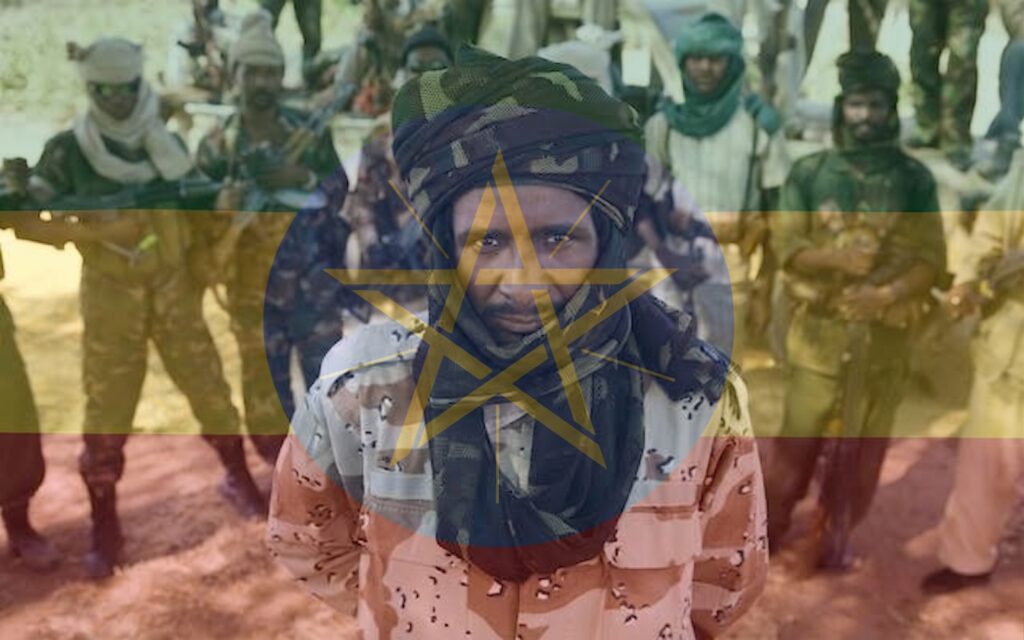
Sudan’s Rapid Support Forces Commander Mohamed Hamdan “Hemedti” Dagalo arrived in Addis Ababa for unannounced talks on August 26, 2026, amid a military buildup at an Ethiopian army installation. The cross-border corridor is fueling regional security concerns as fighting intensifies along the Blue Nile front.
Hemedti Touches Down in Addis Ababa as Border Fronts Rage
Rapid Support Forces Commander Mohamed Hamdan “Hemedti” Dagalo quietly arrived in the Ethiopian capital for unannounced discussions on August 26, marking his second known visit since Sudan’s civil war erupted. His first trip in December 2023 was a formal affair that produced a political declaration with former Prime Minister Abdalla Hamdok.
This quiet return comes as operations and troop movements along the shared border take center stage in the ongoing conflict, according to an RSF leadership source and an Ethiopian government source who spoke to Mada Masr. For Addis Ababa, the immediate diplomatic priority centers on containing the spillover from Sudan’s war, as an Ethiopian source noted. Sudanese intelligence, however, views the outreach through a wider lens, suggesting Ethiopia may factor the paramilitary force into its own military arrangements as it manages conflicts with domestic opponents, particularly amid renewed tensions with Tigray.
Inside the Ethiopian Military Base Arming the RSF Front
Behind the diplomatic meetings lies a heavily scrutinized logistical hub. A comprehensive evidentiary assessment published by African Narratives consolidates investigations from multiple outlets, including Reuters, the Yale School of Public Health, Le Monde, and Middle East Eye, to evaluate Ethiopia’s role in the conflict’s eastern front.
“The evidence establishes with high confidence that Ethiopian territory, including an active military installation, has functioned as the rear base for RSF operations on Sudan’s eastern front. It does not yet establish the level at which this was authorised … The principal obstacle to closing that gap is Ethiopia’s documented refusal to respond to international inquiry.”
African Narratives, Rear Base, September 2026
The assessment distinguishes between two distinct sites operating thirty kilometers apart. The camp at Menge district, established as new construction carved from forest 32 kilometres from the Sudanese border near the South Sudanese tri-point, features hundreds of tents. Clearing at the Menge site began in April 2025, tents went up from late October, and imagery by 24 November showed more than 640 of them providing accommodation for at least 2,500 people. Internal security notes reviewed by Reuters indicate that as of early January, 4,300 RSF fighters were in training at the site, and that their logistical and military supplies are being provided by the UAE. A diplomatic cable dated November 2025 further described a facility built for up to 10,000 fighters with the arrival of dozens of Land Cruisers, heavy trucks, RSF units, and Emirati trainers.
More severe are the findings regarding the functioning Ethiopian army installation on the western edge of Asosa, capital of Ethiopia’s Benishangul-Gumuz region, where the Yale School of Public Health’s Humanitarian Research Lab documented ongoing manufacturing operations. Commercial pickup trucks arriving at the fenced compound in factory white emerge painted in matte, non-reflective dark green with heavy machine guns bolted to their beds.
Blue Nile State Pressures and Military Reinforcements
The Sudanese military finds itself in an increasingly exposed position following the loss of strategic border towns like Geisan and Kurmuk in Blue Nile State. Forces are now trying to stop the advance from the border toward Blue Nile’s capital, Damazin.
A significant military buildup observed since July at the Ethiopian military base in Asosa has local intelligence officers on high alert, as the corridor could facilitate the unimpeded movement of supplies and forces to the RSF and its allies while making the cross-border corridor into Kurmuk and Geisan harder for the military to penetrate. Having secured key border positions, allied forces captured Bakori in the Geisan locality and Sirkum in Kurmuk last week, prompting a rush of military reinforcements into the state capital and the positions around it.
Shifting Lines Across Darfur and Kordofan
While the eastern front intensifies, the western theater sees heavy fortification. The RSF is digging sand berms and extensive trenches around Geneina, the capital of West Darfur, as a defensive measure against a possible surprise attack following an offensive that has been underway since July. This week, the RSF brought in large numbers of fighters in preparation for attacks on military positions in West Darfur and neighboring North Darfur.
Meanwhile, the critical fault line in North Kordofan witnessed a notable blow to paramilitary ranks as Abu Bakr Dahloub, the RSF’s intelligence chief for special missions in North Kordofan’s Hamra al-Sheikh and the Egypt-Sudan-Libya border triangle, defected to the military with around 200 fighters. In response to these shifting dynamics, military aircraft struck several fuel and ammunition depots and RSF gatherings in neighboring West Kordofan this week, destroying supplies that had just arrived to reinforce positions in the area.
Related reading
Daily_Brief: #Sudanese drone strike kills 153 in disputed #Abyei market, #South_Sudanese official
A drone strike on the Amiet Market fuel depot in the disputed border region of Abyei killed at...

Italy’s Cabinet Approves Measures in Response to Protests in Northern Italy
Italy approved sending 500 troops to Milan alongside stricter legal penalties on Tuesday, responding to weekend cost-of-living protests...

Teresa Kok wins RM250,000 defamation payout from Akmal over halal certification dispute
Seputeh MP Teresa Kok has won a RM250,000 defamation payout from Umno Youth chief Dr Muhamad Akmal Saleh...
Macron Seeks Oil Supplies from UAE
French President Emmanuel Macron began a four-nation Gulf tour in Kuwait and Abu Dhabi on Monday, October 19,...