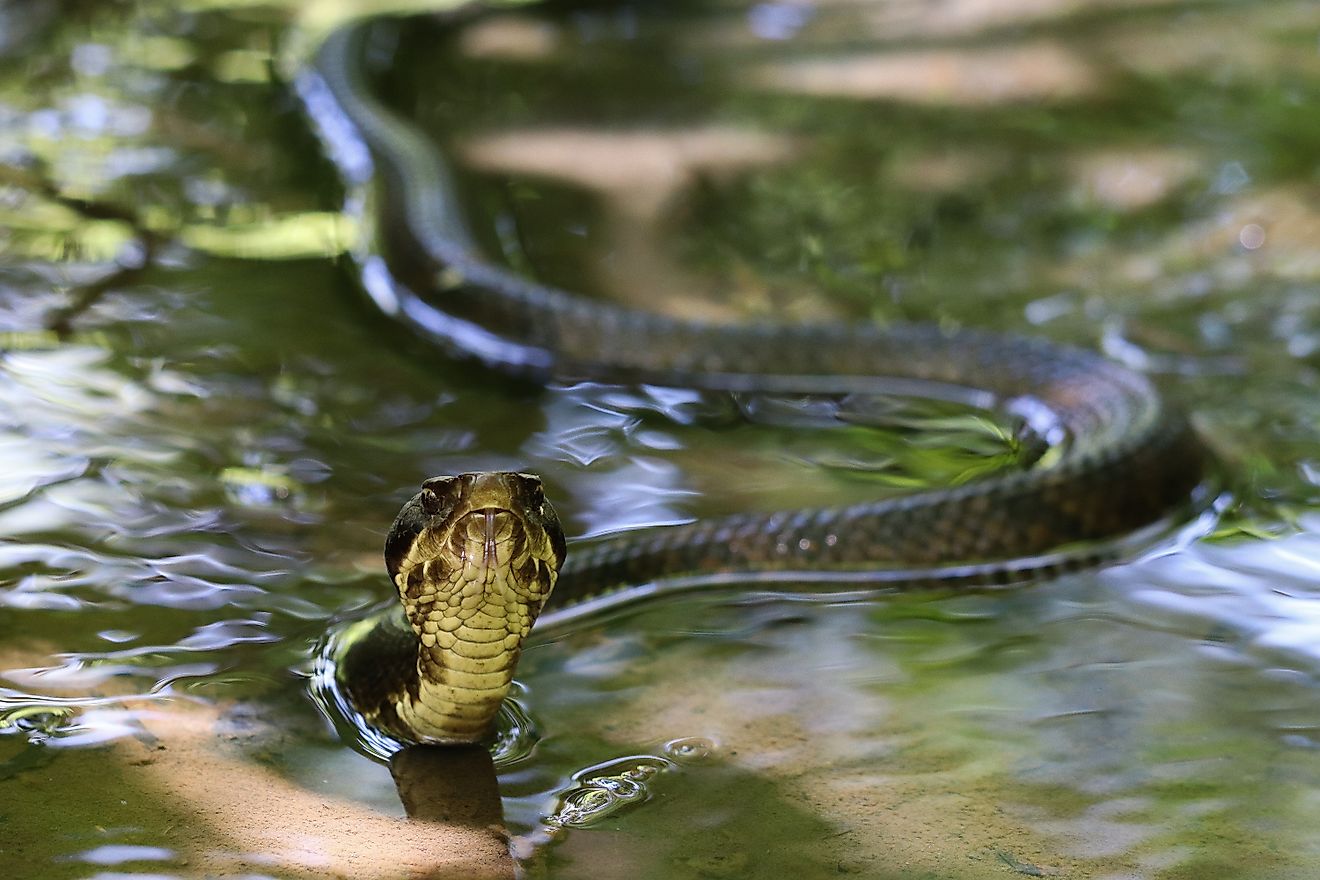
Illinois closes a gravel road twice a year so snakes can cross it safely, a ritual that has played out on Snake Road since 1972.
The shutdowns — March 15 to May 15 and September 1 to October 30 — protect a migration between limestone bluffs and LaRue Swamp, an old channel of the Big Muddy River. The 2.5-mile stretch of Forest Road 345 cuts through the LaRue–Pine Hills/Otter Pond Research Natural Area in Shawnee National Forest, where roughly 35 snake species and 59 percent of the state’s reptiles have been documented.
A Shawnee National Forest wildlife biologist has called the cottonmouth the most common snake seen during the migration.

That venomous watersnake — the only one in Illinois — lives almost exclusively in the swamps and sloughs of the state’s southern tip. Far more common along the rivers are harmless watersnakes, especially the diamond-backed watersnake, which the Illinois Natural History Survey says is killed in large numbers because people mistake it for a cottonmouth.
No agency counts snakes river by river, but state and federal biologists point to five waterways where populations are strong or unusual.
Big Muddy River
The swamp at the base of Snake Road traces the Big Muddy’s former meander before the Mississippi’s Grand Tower bend cut across it. Limestone bluffs rise directly above the water, giving reptiles winter crevices and summer hunting grounds.
The Forest Service first closed the road for three weeks each season in 1972; today the closure runs six weeks in spring and eight in fall, with dates shifting for weather. Visitors may walk the road but cannot touch, herd, or collect snakes.
Mississippi River
Where the Big Muddy meets the Mississippi, Horseshoe Lake — an ancient oxbow in Alexander County — holds the state’s only known site for the southern watersnake, a state-endangered species documented from just eight specimens, the most recent in 1951.
Extensive searches by the Illinois Natural History Survey have turned up no new encounters. Anglers are far more likely to see diamond-backed watersnakes, which the Survey describes as one of the most pugnacious snakes in Illinois, or copperheads that stay mainly on the bluffs above the river.
Cache River
East of Horseshoe Lake, the Cache River winds through a valley the Ohio River abandoned. Glacial floodwaters carved the floodplain, and when the Ohio shifted course it left the Cache to meander through wetlands now protected as a Wetland of International Importance under the Ramsar Convention since 1996.
The area shelters more than 1,000-year-old bald cypress, including the state champion. Cottonmouths, copperheads, and timber rattlesnakes are listed as reclusive, non-aggressive residents. The floating boardwalk at Heron Pond and the canoe trail through Buttonland Swamp both pass through cottonmouth habitat.

Wabash River
The lower Wabash hosts a snake many people have never heard of: the plain-bellied watersnake, which in Illinois appears as the yellowbelly and the copperbelly. The copperbelly averages 30 to 48 inches with a dark back and a red or orange-red belly.
Its northern population in Indiana, Michigan, and Ohio is federally threatened, but in Illinois it persists in southeastern counties including Gallatin and White along the lower Wabash. A 2011 survey for the Illinois Department of Natural Resources confirmed copperbellies in seven southeastern counties, yet found only two in Gallatin County and none farther upriver in Wabash County, suggesting dry, low-water conditions limited the count.
Kaskaskia River
The Kaskaskia’s story is about scarcity. The river was dammed in 1967 to create Carlyle Lake, flooding bottomland habitat that Illinois Natural History Survey biologists call one of the biggest threats to the eastern massasauga, a small, state-endangered rattlesnake.
A 2017 estimate put the largest remaining subpopulation at only 26 to 69 snakes, clustered in wet prairies riddled with crayfish burrows. Downstream, the Kaskaskia River State Fish and Wildlife Area spreads more than 20,000 acres from Fayetteville to the Mississippi, with oxbows, sloughs, and bottomland timber that fall within the mapped range for diamond-backed and plain-bellied watersnakes.
Adjacent to the Clear Springs Wilderness, the LaRue–Pine Hills/Otter Pond Research Natural Area is a National Natural Landmark noted for a large and diverse population of snakes. The zone has also been listed as an Important Bird Area of Illinois.
The pattern holds
Across all five rivers, venomous snakes are real but local, and the cottonmouth stays in the far southern swamps. Biologists cannot say exactly how many snakes these rivers hold.
Worth a look

Tallahassee, Doral Reconsider ICE Deals as GOP Lawmakers Link Enforcement to Losses
After November midterms where two South Florida Republican incumbents barely survived districts they once dominated, city leaders in...

Senate Passes Bipartisan American Affordability and Jobs Act, Sending Permitting Overhaul to House
The Senate passed the Bipartisan American Affordability and Jobs Act on Thursday in a 62‑33 vote, sending the...

Avalanche Host Ducks in Back-to-Back After Utah Loss
The Colorado Avalanche return to Ball Arena on Thursday night to face the Anaheim Ducks at 7 p.m....

NYISO Warns of Statewide Power Shortfalls by 2033; Hochul Releases Nuclear Study
ALBANY — New York's electric grid operator warned Wednesday that unless substantially more energy development occurs, the state...