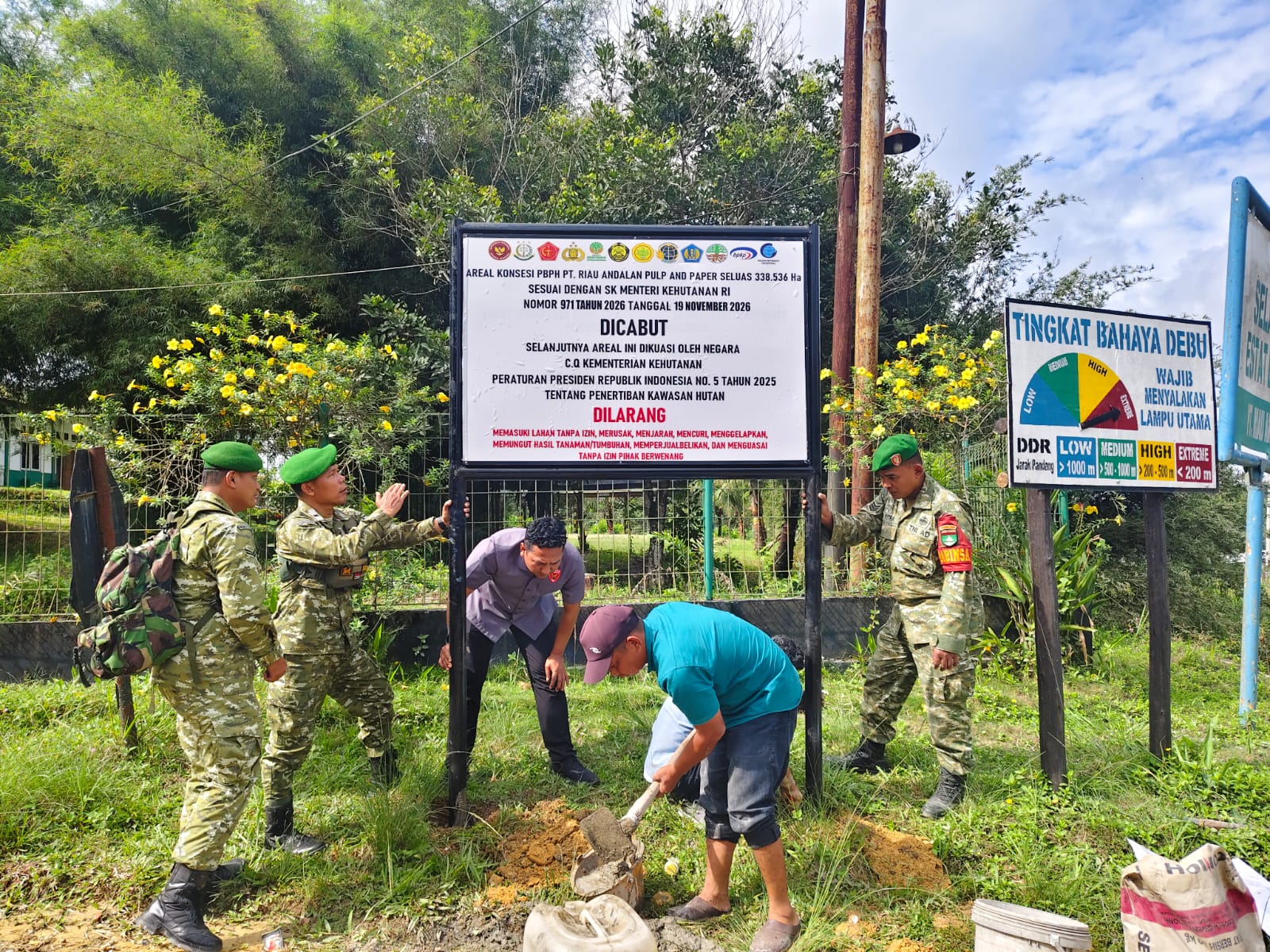
Indonesia’s Forest Area Enforcement Task Force, known as Satgas PKH, revoked the forest utilization license of pulp and paper giant PT Riau Andalan Pulp and Paper on Friday, returning 338,536 hectares of land in Riau to state control, Kompas.com reported.
The revocation, formalized through Forestry Minister Decree No. 971 dated November 19, marks one of the largest single enforcement actions in the country’s recent forestry sector history. It halts all operations inside the massive concession held by PT RAPP, a flagship unit of the Royal Golden Eagle group controlled by tycoon Sukanto Tanoto, and leaves the company on the hook for environmental restoration and legal liability.
“Based on the Decree of the Minister of Forestry of the Republic of Indonesia Number 971 of 2026, dated November 19, 2026, the government has imposed an administrative sanction in the form of revocation of the Business License for Forest Utilization (PBPH) on behalf of PT RAPP for an operational area of approximately 338,536 hectares,” Satgas PKH spokesperson Barita Simanjuntak said in a press release Friday, according to Nadariau.
The move shows a hardening state posture on concession compliance, coming on the heels of a similar license revocation for Toba Pulp Lestari earlier this year. For Riau, a province long defined by the tension between industrial plantation expansion and the collapse of its peatland ecosystems, the decision rewrites the economics of a region where PT RAPP has operated for more than three decades.
The violation ledger
Satgas PKH cited a cascade of violations uncovered during its investigation. Recurring peatland fires topped the list, a persistent driver of the transboundary haze that periodically chokes Southeast Asia. Investigators also documented an illegal oil palm plantation spanning 18,362.74 hectares inside the forest concession — an area larger than many standalone commercial estates.
Beyond the plantations, the task force found unpermitted mining clearance covering 541.46 hectares and damage to protected forest zones totaling 211.54 hectares. The concession also encroached on the buffer zone of Tesso Nilo National Park, threatening habitat critical to the endangered Sumatran elephant.
“With the revocation of this license, all activities within PT RAPP’s licensed area are halted, and the land will revert to state control,” Barita said. “However, the obligation for environmental recovery and legal responsibilities remain with the company.”
A second front in Kuantan Singingi
The enforcement sweep did not stop at the pulpwood concession. In a coordinated action, Satgas PKH also seized a palm oil mill and 42 hectares of associated plantation owned by PT Gemilang Sawit Lestari (PT GSL) in Kuantan Singingi Regency.
Investigators allege the “non-estate” mill — a facility without its own planted supply base — was purchasing and processing fresh fruit bunches sourced from illegal plantations inside forest areas, effectively acting as a market engine for encroachment.
“The presence of this mill has further encouraged massive encroachment of nearby forest areas for oil palm plantations,” Barita said, describing a dynamic where processing capacity drives land clearing rather than the reverse.
Economic shockwaves in Pelalawan
PT RAPP responded Friday with a statement acknowledging it learned of the revocation through media reports. The company said it respects government authority and will engage constructively with regulators while awaiting formal notification.

“We respect the authority of the government and will continue to communicate constructively with the relevant authorities. Currently, we are awaiting official notification and further explanation,” the company told Kompas.com.
The statement leaned heavily on the company’s economic footprint. PT RAPP and the wider APRIL Group employ more than 41,000 workers directly and support hundreds of local suppliers. A previously commissioned economic impact study estimated operations underpin roughly 170,000 jobs in Riau and 300,000 nationally.
Between 2016 and 2025, the company claimed contributions exceeding Rp 350 triliun to Riau’s gross regional domestic product and Rp 970 miliar in community empowerment investments across five regencies, including stunting reduction programs in 138 villages.
Pangkalan Kerinci, the district hosting the company’s main operations, has grown from a settlement of roughly 200 people in 1993 to the Pelalawan regency capital of 250,000 today, with an estimated 20 percent of residents linked to PT RAPP’s supply chain. Over 85 percent of production is exported to more than 100 markets, generating significant foreign exchange.
The accountability gap
Environmental advocates welcomed the enforcement but warned it addresses the symptom, not the systemic cause. Riau-based activist Abdul Aziz, speaking to ANTARA News Riau, questioned why the Ministry of Forestry — which originally gazetted and reclassified the forest areas later exploited — escapes sanction.
“The company is punished, but the Ministry of Forestry which made that damage legal escapes sanctions,” Aziz said. “If it is said to receive palm oil from forest areas, which forest area? Prove first that it is indeed a forest area. If it is said to receive from forest areas, why is only PT GSL seized?”
Aziz argued that the ministry’s own land-use decisions — particularly the delineation and release of forest zones — created the legal pathway for industrial conversion that subsequently fueled ecological degradation across the Tesso Nilo landscape. He demanded transparency on the boundary demarcation process that preceded concession grants.
The critique points to a structural tension: enforcement targets the permit holder, but the permitting authority retains discretion over the maps that define where the forest ends and the concession begins.
State takes control of seized assets, wood supply chain uncertain
Satgas PKH emphasized the operation involved multi-ministerial coordination, showing a whole-of-government approach to asset recovery. The seized PT GSL mill and plantation are now under state control. For PT RAPP, the immediate priority is the fate of the wood supply chain feeding its massive pulp mill — one of the world’s largest — and the thousands of contract farmers and logistics operators orbiting it.
The company has pledged to minimize disruption to contractors, customers, and suppliers. But with the concession legally extinguished, the ministry must now decide whether to re-tender the land, designate it for restoration, or place it under direct state management. That decision will determine whether the 338,536 hectares become a recovery story or a vacuum for new encroachment.
Founded by Sukanto Tanoto in 1967 as a spare-parts supplier, the Royal Golden Eagle group grew after the 1973 oil crisis when he opened a plywood mill and diversified into palm oil in 1979, planting 30,000 acres annually across Sumatra to reach 160,000 hectares.
Barita confirmed the task force’s mandate extends beyond revocation. “This step is expected not only to return state asset control, but also to restore forest area functions and ensure Indonesia’s natural wealth is managed for the greatest prosperity of the people,” he said.
Related reading

PAHO Revokes US Measles Elimination Status; CDC Counts 5,400+ Cases
The Pan American Health Organization has revoked the United States’ measles elimination status, ending a run that began...

Judge Tells Joshua Allen It Is ‘Decision Time’ on Nine Charges
Joshua Allen was supposed to decide his plea in September. He showed up at Midleton District Court on...

Ebola Kills 46 in One Family as Outbreak Spreads Unchecked
Six months after an Ebola outbreak was declared in the Democratic Republic of the Congo, the virus is...

DPWH Orders Inspection After Gandara Bridge Girders Collapse in Samar
Two massive concrete beams crashed to the ground in Samar on Tuesday, November 17, after two girders gave...