
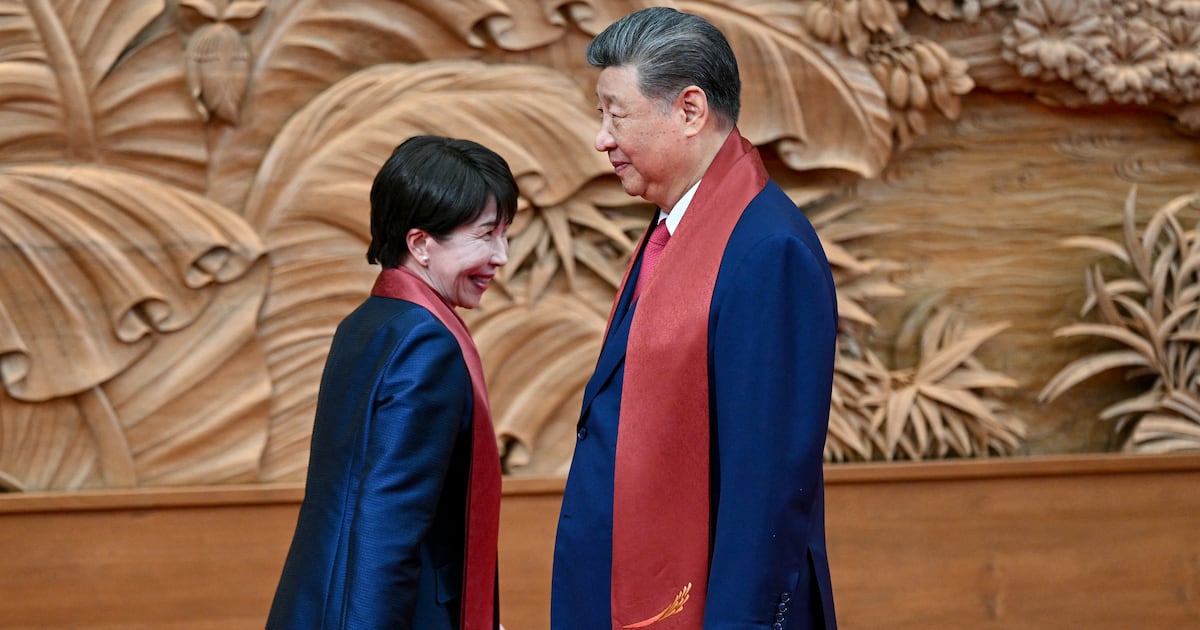
The Japanese prime minister arrived in Shenzhen on November 18 for the APEC summit and left without a formal bilateral meeting with Chinese President Xi Jinping, her only contact a brief handshake at the leaders’ banquet.
Protocol signals the freeze
China rolled out military bands, cheering children, and senior officials for other leaders. Takaichi was met at Shenzhen Bao’an International Airport by retired diplomat Zhang Qiyue and Japan’s ambassador Kenji Kanasugi — no bands, no crowds, a guard of honour only. The Guardian noted Zhang’s rank was below those who greeted counterparts from South Korea and the United States.
In the group photo, Takaichi was placed toward the back row, several positions from Xi. Briefs Finance reported Eurasia Group analyst Jeremy Chan said Beijing sought to “downgrade her official status to that of a head of government rather than a head of state.”
South Korean President Lee Jae-myung, arriving hours earlier, received a full ceremonial welcome with military bands and flower-waving children. U.S. President Donald Trump was greeted personally by Xi on the tarmac. Japanese media highlighted the contrast, with NHK and TBS broadcasting side-by-side footage of the two arrivals.
Maeil Business Newspaper reported that Takaichi’s aircraft stairs were set too low, forcing her to descend carefully with a hand on the fuselage wall, while Lee’s jet had stairs at the correct height.
The Taiwan remark that triggered the chill
The rupture dates to November 2025, when Takaichi told a parliamentary committee that a Chinese attack on Taiwan could constitute a “survival-threatening situation” for Japan, potentially justifying deployment of the Self-Defence Forces. Beijing denounced the remarks as “wrongful and dangerous” and accused her of reviving prewar militarism.
China then discouraged its citizens from travelling to Japan, halted Japanese seafood imports, and restricted rare-earth exports critical to Japanese manufacturing. Mainichi Shimbun reported that Japanese prime ministers had held face-to-face talks with Xi on APEC sidelines for four consecutive years since 2022; the streak ended in Shenzhen.
At a press briefing on November 19, Takaichi said Japan’s position on Taiwan remains unchanged from the 1972 Japan-China Communique, under which Tokyo “fully understands and respects” Beijing’s stance that Taiwan is an inalienable part of China. She added her administration has been engaging Chinese counterparts on rare-earth export controls.
CNBC quoted Nanyang Technological University associate professor Kei Koga saying Takaichi’s extended conversation with Xi at the greeting line — she tried for several minutes to speak without an interpreter — was an effort to “project the image that she could still communicate with him despite the ongoing tensions.”
Song choice sparks debate at banquet
At the welcome banquet on November 18, an ensemble played “Ue o muite arukou” — the 1961 hit known internationally as Sukiyaki — as Takaichi entered. The song, rooted in protests against the U.S.-Japan Security Treaty, drew varied readings. Hudson Institute senior fellow Ken Moriyasu called it an “intriguing musical choice” that could signal hope or political irony.
Chinese social media users debated whether it mocked Japan’s alliance with Washington or expressed a wish for Tokyo to “drop their obsession with militarism.” Takaichi smiled and bowed slightly to the musicians. South China Morning Post described the moment Xi shook her hand and smiled but said nothing.

Putin meeting contrasts with Xi snub
While Xi offered only a handshake, Russian President Vladimir Putin held a 30-minute sit-down with Takaichi — the first Japan-Russia leaders’ meeting in seven years. They discussed the detention of a Hokkaido Shimbun journalist in Moscow and Russia’s seizure of Japan Tobacco assets.
News On Japan reported the conversation addressed urgent disputes but produced no agreements. UkrMedia noted the contrast: with China, even a handshake drew scrutiny; with Russia, a half-hour talk was a rare opening despite no broader reconciliation.
South Korea leaves with an FTA upgrade
The diplomatic asymmetry was sharpened by South Korea’s outcome. President Lee secured a concluded upgrade of the China-South Korea free trade agreement and, by Seoul’s account, Xi’s endorsement of renewed North Korea-U.S. dialogue. Chinese customs data show bilateral goods trade at $331.7 billion last year, already ahead of China-Japan trade at $322.5 billion.
Yahoo News reported that Lee has accepted an invitation to visit Japan in January, and the two countries mark 35 years of diplomatic ties in 2027. For Takaichi, a handshake without words is a start; turning it into a meeting will cost something she has so far declined to pay.

China’s official line and what comes next
Chinese Foreign Ministry spokesperson Guo Jiakun said Beijing made “appropriate protocol arrangements for all participants in line with international practice.” The APEC secretariat did not respond to requests for comment on why the leaders’ “Shenzhen Outlook” statement disappeared from the official website before reappearing on Xinhua.
Takaichi’s Liberal Democratic Party faces a leadership election next September; potential challengers including Defence Minister Shinjiro Koizumi and policy chief Kobayashi Takayuki have signaled support for her continuation, calculating they have a better chance of succeeding her after a fresh three-year term. That is a long wait for a thaw between Asia’s two largest economies.
Keep reading

European Leaders at Berlin Summit Ready for Talks With Russia on Ukraine War
European leaders in Berlin declared themselves ready to negotiate with Russia on ending the war in Ukraine, presenting...

European Leaders Ready to Negotiate With Russia on Ukraine War, Berlin Summit Says
European leaders declared themselves ready to negotiate with Russia on ending the war in Ukraine at a Berlin...
ICJ Finds Myanmar Had Genocidal Intent Against Rohingya
The International Court of Justice ruled Thursday that Myanmar committed genocide against the Rohingya, the first time in...

Iran Struck U.S. Military Facilities in Bahrain and Kuwait With Drones This Week
Iran struck U.S. military facilities in Bahrain and Kuwait with drones this week while a U.S.