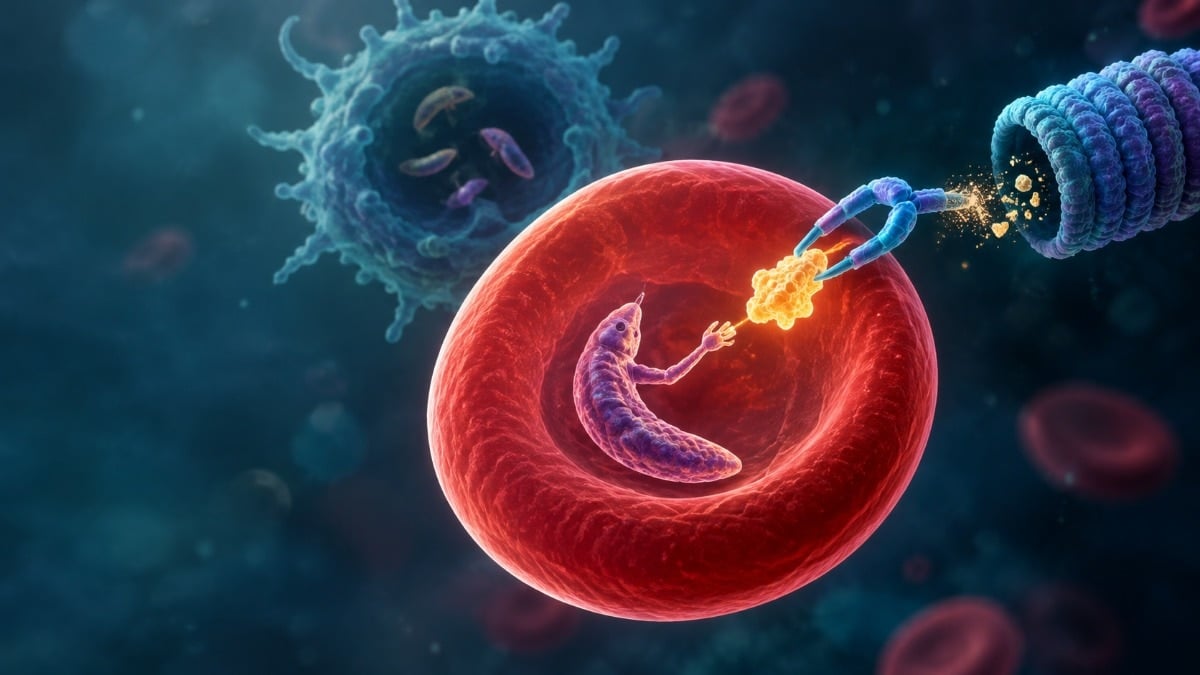
Researchers at Jawaharlal Nehru University have targeted the human protein p38-MAPK to weaken both malaria and kala-azar parasites in laboratory cells, offering a potential host-directed alternative as drug resistance mounts globally against traditional treatments.
How Jawaharlal Nehru University Scientists Targeted a Shared Human Protein
As single-celled Plasmodium parasites continue to shrug off once-reliable treatments like chloroquine, scientists are shifting their strategic focus away from the parasite itself. A research team at Jawaharlal Nehru University in Delhi has investigated what happens when medicine targets a human protein that these pathogens rely upon instead. Professors Anand Ranganathan and Shailja Singh head the group, having previously examined this host-centric approach in a 2022 investigation of kala-azar that focused on SUMOylation.
Think of p38-MAPK as an internal alarm system, carrying news of injury and infection from the cell surface inward while helping control the chemical signals that immune cells use to communicate. Kala-azar parasites hide inside big-eating immune cells known as macrophages, while malaria parasites take shelter inside red blood cells. By studying these interactions, the research team found that parasites lean heavily on this host messenger to thrive. Almost every drug for these diseases attacks the parasite itself, and parasites evolve.

Laboratory Results for Malaria and Kala-Azar Parallels
When the team removed roughly half of the p38-MAPK in human macrophages and red blood cells while leaving a close cousin called ERK1/2 untouched, both malaria and kala-azar parasites struggled significantly in laboratory dishes. In infected macrophages, the treatment cut parasite levels by up to roughly 16-fold without poisoning the parasite directly or harming the host cells. The damage came entirely through altering the cellular environment. Professor Ranganathan noted that removing the protein altogether did the work.
On their own, both the drug and the protein removal cut the parasite load by roughly 70 per cent.
Parallel Breakthroughs in Plasmodium Vivax Vaccine Research
Researchers including Ganesh R.R. Visweswaran, Pooya Mahdavi, Kamalakannan Vijayan, Francis B. Ntumngia, Bart L. Staker, Samantha J. Barnes, Pradeep A. Subramani, Andrew Raappana, Nicholas Dambrauskas, Elizabeth K.K. Glennon, Surendra K. Kolli, Madison M. Ogbondah, Alexander Watson, Nelly Camargo, Banumathi Sankaran, Pongsakorn Thawornpan, Rachaneeporn Jenwithisuk, Peter J. Myler, Stefan H.I. Kappe, Wanlapa Roobsoong, and D.
Preclinical Testing Must Precede Human Trials
Despite the promising laboratory results in human cell cultures, clinical application remains distant. No animal or human patient has been treated with the p38-MAPK removal technique yet, and researchers emphasize that rigorous preclinical testing must precede any human trials. Because laboratory and animal evaluations must happen first and will take several years, followed by an even longer clinical development phase, forecasting an exact schedule at this stage remains impossible.
Globally, an estimated 282 million cases of malaria and 610,000 deaths were reported in 2024 according to World Health Organization figures, with drug resistance now confirmed or suspected across at least eight African countries as kala-azar continues to threaten endemic regions.
Related reading

Seven Mycobacterium fortuitum Post-Procedural Wound Infections Identified in India
During a one-year period at a tertiary care center in Eastern India, seven patients with post-procedural wound infections...

Kyoto University Researchers Find Olive Oil Blunts Blood Sugar Spikes in Mice
Researchers at Kyoto University discovered that administering olive oil before carbohydrates blunts early blood sugar spikes in mice...

Plague Risk Remains Low in Europe Despite Siberian Lab Death
Plague has returned to global headlines following a researcher's fatal pneumonia in Siberia, prompting World Health Organization scrutiny.

MSKCC Study Finds Age-Based Testing Misses Substantial Proportion of Genetic Variants
Universal germline genetic testing across nearly 40,000 cancer patients at Memorial Sloan Kettering Cancer Center revealed that standard...