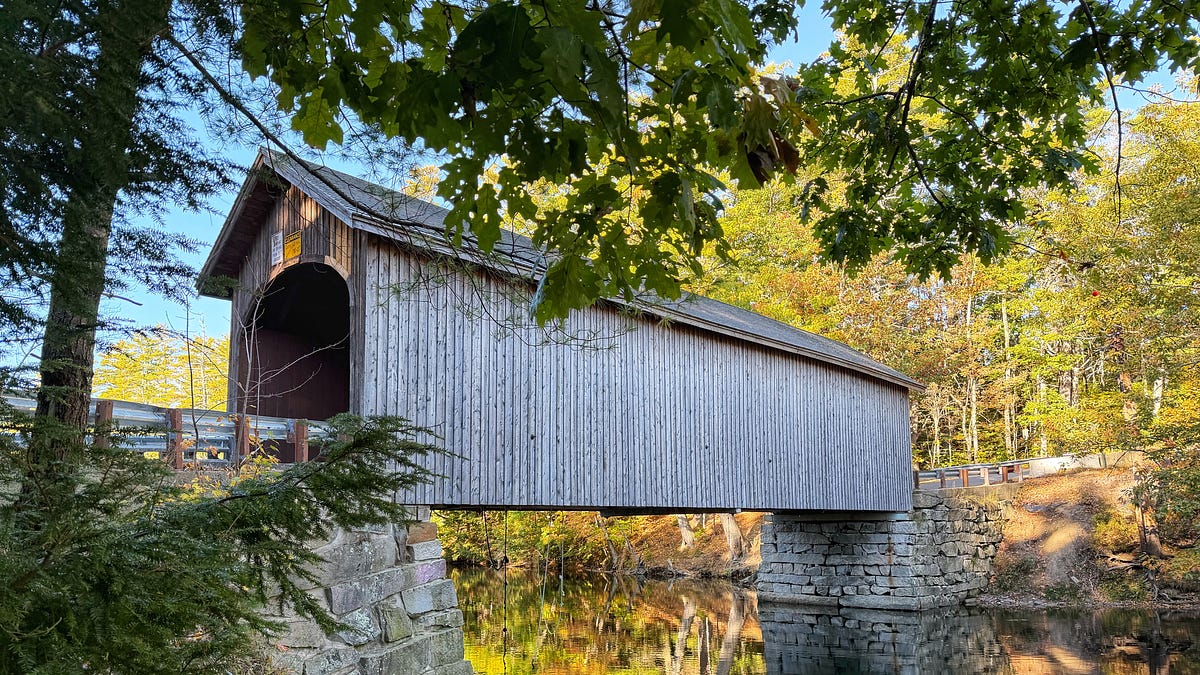
When the conversation turns to covered bridges, the collective imagination of New England usually drifts toward Vermont. It is easy to see why: the classic tableau of red-painted timber, vibrant autumn foliage, and white-steepled churches has become a foundational element of the Green Mountain State’s tourism identity. But as Lauren Partan recently detailed, Maine holds its own collection of these historic structures, and they offer a far more secluded, rugged experience for those willing to look past the well-trodden paths.
There were once roughly 120 covered bridges scattered across Maine. Today, that number has dwindled to just eight. These survivors are not clustered together for easy viewing; they are tucked into the corners of quiet country roads, often far from the nearest gift shop or tourist center. For the traveler, this geography means the hunt requires a bit more effort—and a lot more map-reading—than a typical weekend excursion.
The Resilience of the Queen-Post Truss
The history of these bridges is often as dramatic as the landscape they cross. Take, for instance, Babb’s Bridge in Gorham and Windham. Originally built in 1840, it held the title of Maine’s oldest covered bridge before it was lost to arson in 1973. It was painstakingly reconstructed in 1976 using traditional techniques, but its challenges didn’t end there. In August 2024, a dump truck weighing six times the bridge’s three-ton limit crashed through the wooden deck. Following a significant restoration effort, the bridge reopened in February 2025, proving that some of these structures possess a stubborn, nine-lives quality.

These bridges serve as a reminder that their “charming” aesthetic was an accidental byproduct of engineering necessity. The roofs and walls were never intended for photographers; they were built to shield the wooden framework from Maine’s harsh winters and heavy snow loads, extending the lifespan of the timber. While modern infrastructure relies on steel and concrete, these historic trusses—whether Queen-post or Paddleford—represent a period of American craftsmanship where durability was synonymous with local ingenuity.
Infrastructure and the Rural Divide
Not every bridge has fared as well as those maintained for modern traffic. The Porter-Parsonsfield Bridge, for example, has been closed to vehicles since 1960. It stands as a silent monument to local disputes of the past; legend holds that a selectman from Parsonsfield once drove his jackknife into the wooden deck to physically mark the boundary of his town’s financial responsibility for the structure. It is a stark contrast to the state-funded, standardized projects that define modern transportation.

The logistical reality of these bridges forces a choice: preserve them as static museums or adapt them to the demands of the 21st century. The Lovejoy Bridge in South Andover faced this exact dilemma after a sand truck crashed through its deck in 1983. Rather than abandoning the site, the state opted to reinforce the structure, allowing it to remain a functional part of the local road network. This approach highlights a broader civic tension: balancing the preservation of historic, narrow-gauge infrastructure with the safety requirements of modern, heavy-duty logistics.
The Hunt for the Remaining Gems
For those interested in tracing this history, the journey is as much about the backroads as it is the destination. The six bridges visited by Partan—Babb’s, Porter-Parsonsfield, Hemlock, the famous “Artist’s Bridge” in Newry, Lovejoy, and the remote Bennett Bridge—offer a masterclass in Maine’s rural geography. The Bennett Bridge, located in the Lincoln Plantation near the New Hampshire border, represents the pinnacle of this “off the grid” experience. It is a quiet, isolated reminder of the logging and farming industries that once drove the state’s economy.

There are still two bridges on the list for the truly committed: the Lowe’s Bridge in Guilford and Sangerville, which was famously swept away by a flood in 1987 and rebuilt in 1990, and the Robyville Bridge in Corinth. The latter holds the unique distinction of being the state’s only completely shingled covered bridge. These sites remain scattered, uncrowded, and largely untouched by the commercialization that has overtaken other historic landmarks in the region.
Whether or not these bridges survive another century depends on a mix of local stewardship and the state’s ability to maintain these aging wooden frames. For now, they remain open—not as relics of a forgotten era, but as active participants in the quiet life of Maine’s interior.
Keep reading

Boise State vs. Colorado State: How to Watch, Time, and Game Info
Boise State University travels to Fort Collins this Friday, November 7, to face Colorado State University at Canvas...

Central Florida Faces heavy rainfall and school closures on Election Day
Central Florida Faces Election Day Deluge November is historically one of the driest months in Central Florida, a...

NY Rangers Reverse Roster Move: Jaroslav Chmelař Recalled, Taylor Raddysh Reassigned
Rangers Reverse Course: Chmelař Returns to New York as Raddysh Heads to Hartford The New York Rangers have...

Four standout dishes define the current Denver food scene
A French Staple and New Denver Flavors The Denver food scene is currently defined by a restless energy,...