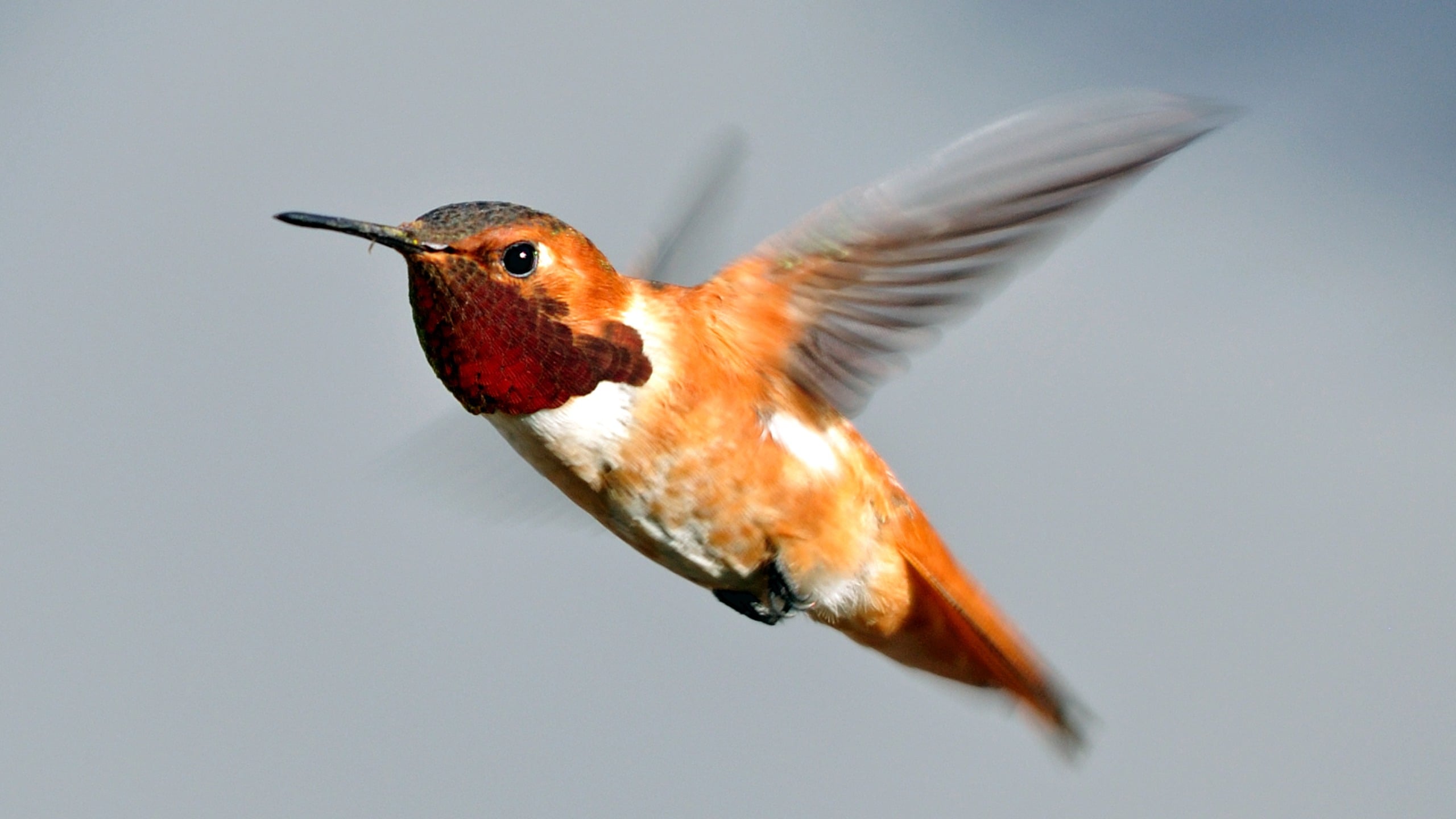
A male rufous hummingbird flew 6,526 kilometres from Alabama to Alaska in 38 days, the longest migration track ever recorded for the species, researchers reported November 16 in Ecology and Evolution.
The journey was captured by a solar-powered Bluetooth transmitter weighing 0.06 grams — about the weight of a grain of rice — that rides on the bird’s back and relays its position through any nearby smartphone, Technology Org reported. Eleven hummingbirds tagged along the northern Gulf Coast in spring 2025 produced 23,784 location points across 23 U.S. states, Mexico and Canada.
- A 0.06-gram solar tag enabled the first fine-scale track of a hummingbird’s full migration.
- The record flight covered 6,526 km from Lillian, Alabama, to Juneau, Alaska, in 38 days.
- Eleven birds tagged in March–April 2025 returned 23,784 locations across three countries.
- Individuals of the same species, tagged at the same site, took markedly different routes.
How the BlūMorpho tag works
Conventional satellite transmitters are too heavy for birds that weigh less than five grams. The BlūMorpho sidesteps the weight problem by broadcasting a Bluetooth signal every three seconds instead of reaching a satellite, according to the study led by Emma M. Rhodes of the University of Memphis. Any phone or computer within roughly 200 metres that runs the project’s software picks up the beacon and passes the location to the research team, creating a continent-scale receiver network at no operating cost, phys.org reported.
The tag carries no battery; a tiny solar cell powers it directly, and the whole package stays under 3 percent of the bird’s body weight, the threshold a yellow-rumped warbler study found imposed no extra flight cost, ScienceAlert reported.
The study included researchers from the College of Health and Human Sciences at the University of Memphis in Tennessee, Cellular Tracking Technologies in Cape May, New Jersey, the Departamento de Ecología y Recursos Naturales‐IMECBIO at Universidad de Guadalajara‐CUCSUR in Autlán de Navarro, Jalisco, Mexico, and the Banding Coalition of the Americas in Orange Beach, Alabama.
Cellular Tracking Technologies (CTT), based in Cape May, New Jersey, funded the research for the BlūMorpho tag project in 2025. The organization also provided the 0.06-gram solar-powered transmitters, which were attached to the hummingbirds to capture their migration data. These units broadcast a Bluetooth signal every three seconds, allowing any nearby smartphone or computer with the project’s software to pick up the location and relay it to the research team.
This created a continent-scale tracking network with no operating cost, utilizing the lightweight design to minimize impact on the birds. CTT’s role was crucial in enabling the study of fine-scale movement ecology in hummingbirds, as the tag’s weight stayed under 3% of the bird’s body weight, a threshold found to impose no extra flight cost in previous studies.
Routes that do not match
The record-setting male was released at Lillian, Alabama, on March 27, 2025, and last detected at Juneau, Alaska, on May 3. The previous best came from a female rufous banded in Florida in 2010 and recovered roughly 3,500 miles away in Alaska — two points on a map, not a route, Technology Org reported.
“Currently, it is not longevity of the unit itself that is a limitation but retention time on the individual,” the authors wrote in the study. Across the eleven birds — four rufous and seven ruby-throated — tracks diverged in ways banding data never showed. One rufous hummingbird completed a 345-kilometre loop into Tennessee and Missouri before turning east. Another flew southeast into Florida instead of north.
Two ruby-throated males banded the same day moved north in near-parallel paths separated by about 83 kilometres, ScienceAlert reported. “Birds of the same species, tagged in the same place within weeks of each other, took routes that would have looked like errors in a dataset with fewer points,” Technology Org reported, quoting the study’s description of patterns not previously documented.
The authors caution that eleven birds is a small sample, but the variation itself is the finding: individuals of one species do markedly different things.
The study, “Ultralight Solar Transmitter Enables Fine‐Scale Movement Ecology in North American Hummingbird Migration,” appears in Ecology and Evolution (DOI: 10.1002/ece3.74624).
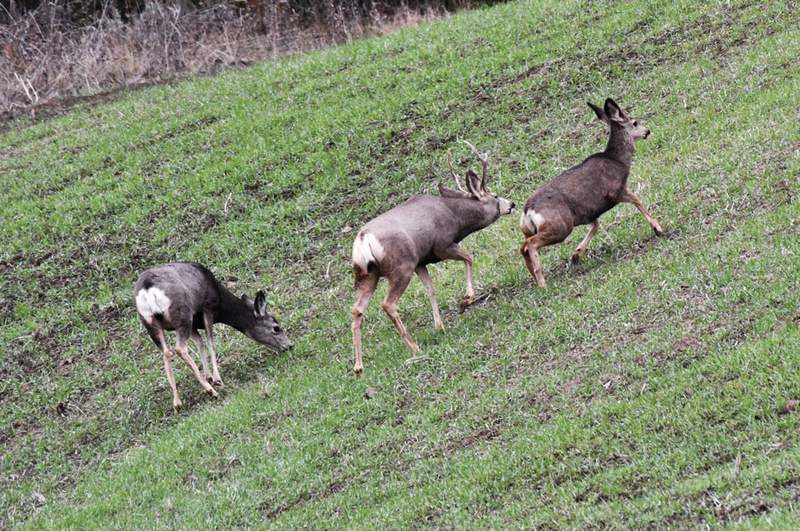
Deer Shift to Feeding, Rest After Peak Rut in Eastern Idaho
Deer across eastern Idaho have shifted from the frantic chase of the rut to a period of heavy...

West Virginia Fires DC Zac Alley After Worst Power 4 Defense; Rich Rodriguez Begins Search
West Virginia fired defensive coordinator Zac Alley on Sunday after the Mountaineers fielded the worst defense in Power...

Iowa Physician Associates Sanctioned: One Surrenders License Over Prison Inmate Sex Allegations, Other Disciplined for Unapproved Drug Prescriptions
The Iowa Board of Physician Associates sanctioned two licensees in unrelated cases, one surrendering his license after allegations...

DNC Scaled Creator Signal Chat to 700 by Election Day 2025
The Democratic National Committee scaled a Signal group chat from roughly 20 creators in summer 2025 to nearly...