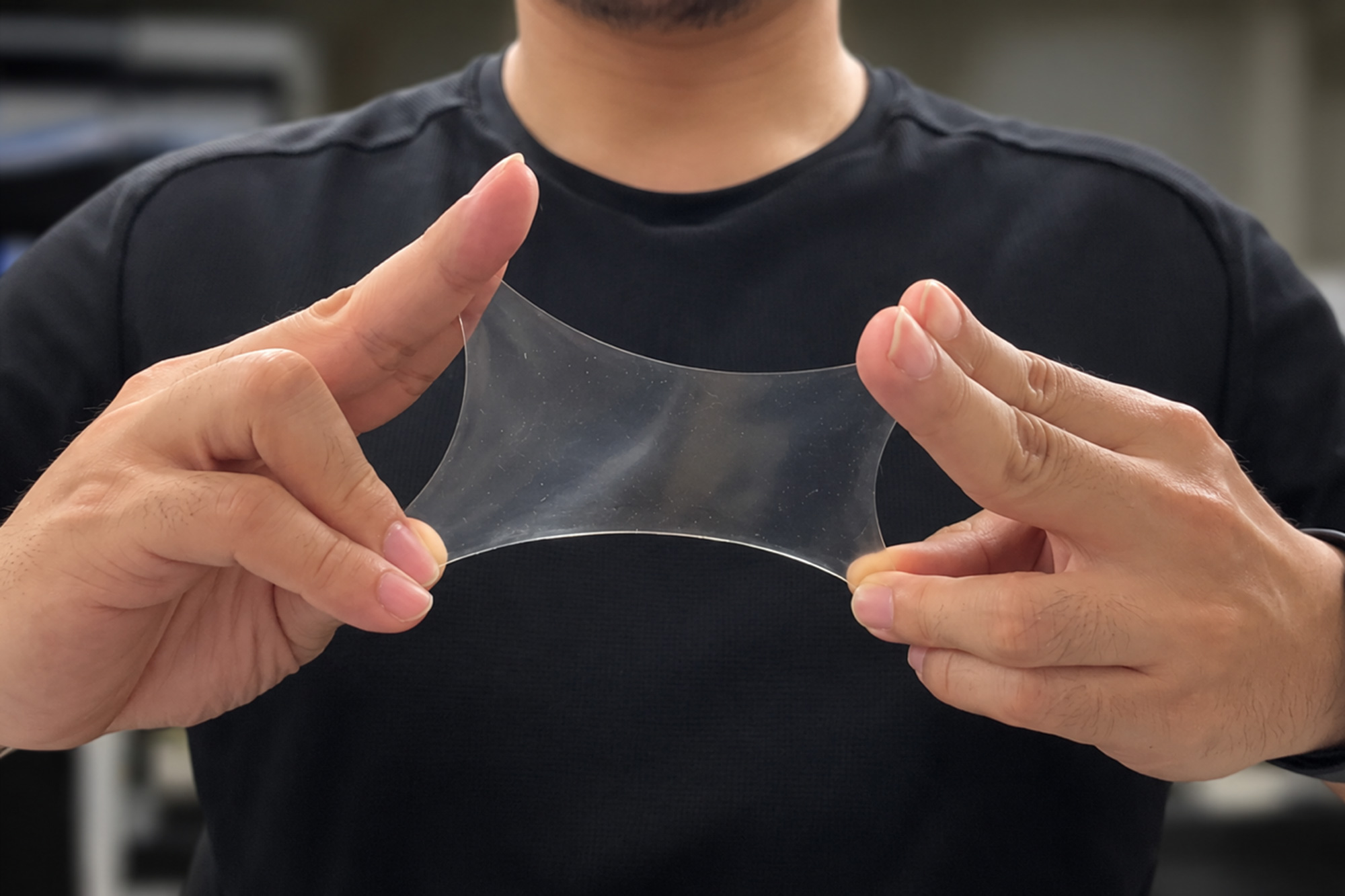
Mechanical engineers at the Massachusetts Institute of Technology have developed a dry and stretchy material that eliminates the need for wet, sticky gel during ultrasound scans, MIT News | Massachusetts Institute of Technology reported on Nov. 20, 2026.
Traditional ultrasound technicians routinely spread a cold, water-based gel across a patient’s skin before applying an acoustic probe. This substance bridges microscopic air gaps between the transducer and the human body, allowing high-frequency sound waves to penetrate tissue without scattering.
While effective in clinical offices where staff can reapply fluid as it dries, the medium evaporates within a day or two, creating a major hurdle for wearable diagnostic patches designed to monitor patients continuously at home or on the move.
The newly engineered polymer offers a liquid-free alternative that maintains stable acoustic properties over long periods. In laboratory evaluations, the solid, rubbery material enabled wearable devices to capture clear imaging continuously for roughly nine days.
Molecular engineering creates a bottlebrush network
Fluids such as water serve as ideal conductors for acoustic energy because their small, loosely bound molecules slide past one another with minimal friction, letting waves travel without losing intensity. Standard rubbery solids, by contrast, possess dense, tangled molecular chains that generate high friction and dissipate sound waves upon contact.
To overcome this limitation, researchers from MIT’s Zhao Lab adopted a molecular design strategy. They constructed a polymer entirely out of a bottlebrush architecture, featuring a central molecular backbone with smaller side chains branching outward like pipe cleaner bristles.
“These hairy extensions don’t easily penetrate other bottlebrush molecules,” Shu Wang, a postdoc in MIT’s Department of Mechanical Engineering, told Medical Express. “They can easily move around at the ultrasound frequencies, and that’s why there is less friction between them.”
Initial samples proved fragile and crumbly, resembling tofu. The team reinforced the substance by chemically fusing the primary bottlebrush network with a second, loosely connected polymer framework that held the fragile structure in place without sacrificing its low-friction acoustic traits.
Strenuous tests and field trials
To evaluate mechanical durability, the team adhered a patch to a volunteer’s chest as they ran on a treadmill. For comparison, the volunteer also wore a sample of a conventional silicone rubber. During a 10-minute treadmill session, perspiration soaked the silicone rubber entirely, whereas the novel material successfully cleared away any accumulated sweat. These tests suggest that the new material can hold up over strenuous exercise.
As a field demonstration, researchers attached a key fob-sized patch containing a small ultrasound probe and the dry interface layer directly to a volunteer’s neck. Linked to a portable tablet, the system captured an uninterrupted visual record of blood flow while the cyclist pedaled on a 30-minute round trip between MIT’s campus in Cambridge, Massachusetts, and Bunker Hill in nearby Charlestown.
“We are really aiming to address a material challenge in ultrasound imaging,” Wang told EurekAlert.
“If you don’t have a good interface, that will definitely stop you from developing this wearable imaging field,” added Runze Li, a co-lead author and MIT postdoc.
“This is a very good solution that enables a longer time for imaging,” Li said.
The Massachusetts Institute of Technology, founded in 1861 by William Barton Rogers to accelerate American industrialization through scientific knowledge, moved from Boston to its Cambridge campus along the Charles River in 1916.
Its transformation into a major research enterprise began during World War II, when projects such as the Radiation Laboratory made it the nation’s largest non-industrial R&D contractor, a legacy continued in later decades through initiatives including the Apollo Guidance Computer and the LIGO project.
The research group was supported by the Singapore-MIT Alliance for Research and Technology and the MIT Health and Life Sciences Collaborative. Investigators now plan to streamline fabrication methods to advance wearable health monitoring outside traditional clinical settings.
Keep reading
NOAA Forecast Predicts Light Winter With Warmer Temperatures for Michigan
Michigan is bracing for a light winter marked by well-above-average warmth and significantly lower snowfall totals, according to...

Second Chances Distributes 1,000 Backpacks, Serves Meals at 7th Annual OKC Event
OKLAHOMA CITY — Second Chances, a ministry and thrift store in Oklahoma City, is preparing to serve warm...

Stetson Falls to No. 23 Louisville 83-69 After Early Lead
The Stetson men's basketball team gave No. 23 Louisville a tough early test on Thursday evening, jumping out...

Secured Quantum Services Deploys Toshiba QKD Systems in New Mexico
Secured Quantum Services has deployed Toshiba quantum key distribution systems and Celestica network switches in Albuquerque, New Mexico,...