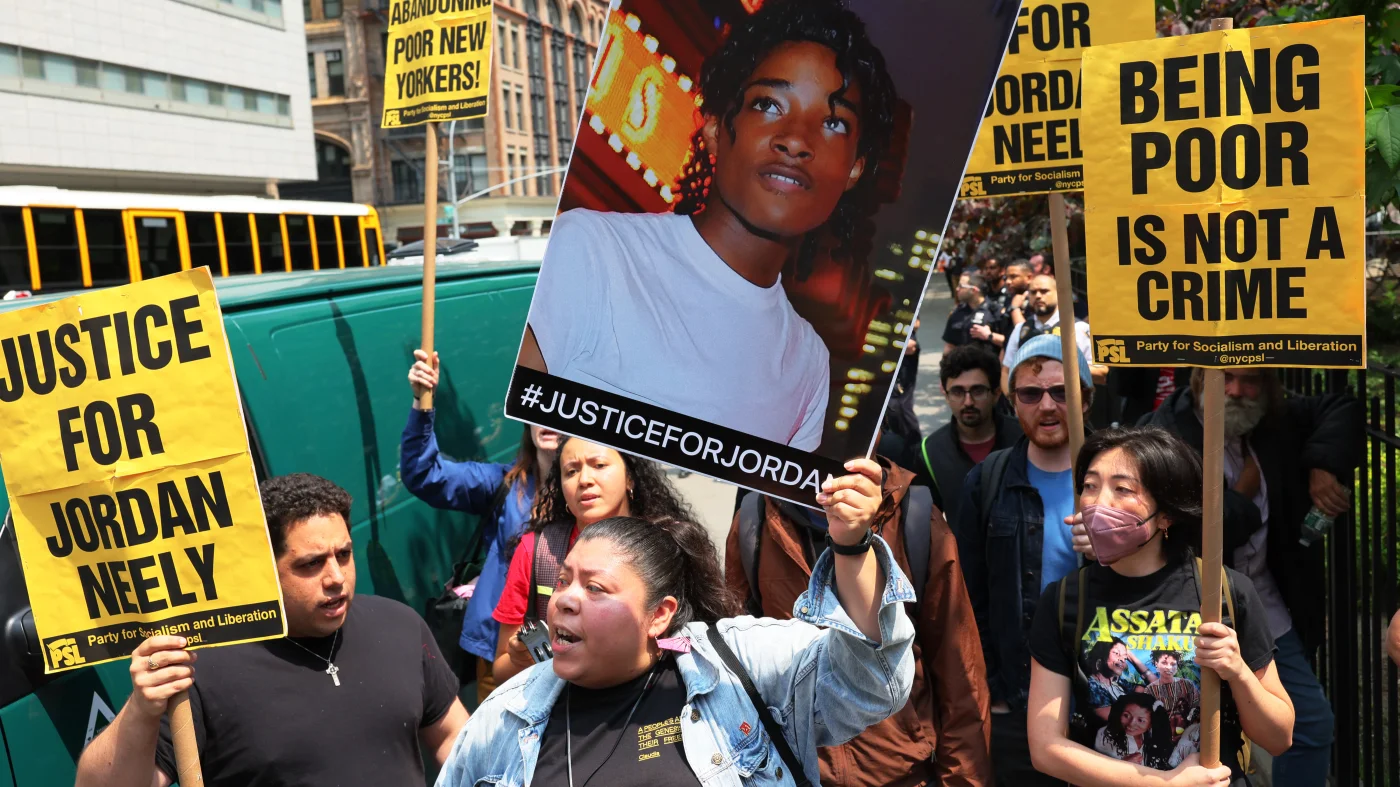
When Daniel Penny stepped onto a New York City subway car and placed Jordan Neely in a fatal chokehold, he ignited a fierce national divide over public safety, systemic failure, and who deserves protection. After that May 1, 2023, encounter, a new book by journalist Anand Giridharadas reexamines the tragedy not as an isolated flashpoint, but as the inevitable collision of two men who each felt profoundly abandoned by the state.
From Subway Crisis to National Polarization
On that spring day, Neely boarded the train in acute crisis. An unhoused Black man who had spent years performing as a Michael Jackson impersonator, Neely began shouting threats and frightening passengers. Penny, a white former Marine, intervened. He held Neely in a chokehold for six minutes until he died. A smartphone video of the incident instantly cleaved the country in two. To supporters, Penny was filling a dangerous void left by an absent police force. To critics, Neely was another vulnerable Black man whose life was discarded.
No one is coming to save us.Today in @nytimes, an essay based on my new book, MAN IN THE MIRROR, on a subway killing that divided America — and revealed what it has in common:Abandonment.https://t.co/TCWkEDxke0
As NPR reported, Giridharadas spent more than two years investigating what the viral video could not capture. In his book, Man in the Mirror: Hope, Struggle, and Belonging in an American City, the author argues that both men shared a common undercurrent of institutional neglect. Neely had cycled through a decade of minor offenses tied to homelessness before his struggles escalated into violent assaults.
Weeks later, he was acting erratically on a Coney Island subway platform. Outreach workers and police interacted with him, but nobody recognized that he was a fugitive with an active warrant for abandoning his program. Short weeks after that missed intervention, he was dead on the floor of a different subway car.
Penny Grew up in a Community Shaped by White Flight
Penny’s background offers its own window into urban anxieties. Growing up in West Islip, Long Island, he hailed from a community shaped by white flight and a complicated, often tense relationship with New York City. Giridharadas compares these commuter towns to middle-class refugee camps, populated by residents who fled urban squalor yet retained a barely concealed contempt for the very metropolis they left behind.
“I think it behooves us to think about the condition in which we’ve left people, this sense of abandonment that we’ve allowed to be so pervasive that decent people feel like maybe there’s no other route for folks besides just DIYing it,” Giridharadas told NPR.
Legal fallout from the killing concluded in December 2024, when a jury deadlocked on a second-degree manslaughter charge, prompting the prosecution to dismiss it. Penny was acquitted of criminally negligent homicide. The aftermath moved swiftly. Within days, Vice President-elect JD Vance and President-elect Donald Trump invited Penny to the Army-Navy game. Shortly after that, venture capital firm Andreessen Horowitz hired him as a partner on their American dynamism team, investing in defense startups and drones.

Parallel Grievances Across the Political Spectrum
The cultural resonance of the case extends far beyond the courtroom. During jury deliberations, a striking parallel emerged with the assassination of Brian Thompson, of United Health Care, by Luigi Mangione. In both instances, figures on different sides of the political spectrum formulated identical justifications: individuals stepping into fatal voids left by broken, unresponsive systems.
Black Lives Matter activist Hawk Newsome voiced a similar sentiment in New York, arguing that if society relies on vigilantes, communities must build their own independent institutions, schools, and media. Whether viewed from the perspective of suburban transit fears or urban survival, the underlying thread remains unchanged. A pervasive sense that nobody is listening has pushed individuals to take matters into their own hands. What remains entirely open, however, is whether any city or institution is prepared to fix the fragile systems that left both men stranded in that subway car.
VIDEO – Anand Giridharadas: Jordan Neely ‘Was an Embodiment of Someone Who Tried to Make Art and Pursue Art’ @AnandWrites @TheRevAl https://t.co/CYT15kdyBo
More on Jordan Neely
Bestseller Anand Giridharadas delivers an outstanding revisitation of the fatal May 1, 2023, incident where white ex-Marine Daniel Penny choked to death Jordan Neely, a Black unhoused and mentally ill former Michael Jackson impersonator, on a New York City subway. This is an…
Related reading
NM Climate Goals Push: Environment Secretary Urges Lawmakers
New Mexico’s environment secretary is urging state lawmakers to lock in the climate goals of outgoing Michelle Lujan...
Cardinal Joseph Tobin to Undergo Surgery for Kidney Mass
Cardinal Joseph W. Tobin of Newark, New Jersey, is scheduled for surgery on October 29, 2026, to remove...

Broadband Forum PON Plugfest: UNH-IOL to Host October Event
Broadband infrastructure is only as strong as its weakest connection, and for the engineers building the next generation...

Maine Department of Labor reports 4,720 approved paid leave claims
Thousands of Maine workers are now accessing paid time off for childbirth, serious illness, and family care thanks...