Valley City State University (VCSU) is currently prioritizing “student voice” through the launch of a new Student Advisory Council, while simultaneously acting as a hub for the revival of statewide science education. According to the university’s Hotline publication, this shift is designed to integrate student perspectives into the hundreds of daily administrative decisions that shape campus culture and long-term academic outcomes.
Interim President ties campus outcomes to student input
Interim President Dr. Allen Burgad recently convened the first meeting of the VCSU Student Advisory Council, a group of ten student leaders drawn from academic programs, extracurriculars, and campus organizations. The move comes as the administration acknowledges that without the “why” and the “purpose” behind university decisions, it becomes difficult to build the collective will necessary to move the institution forward.
Dr. Burgad noted that over 100 decisions—ranging from minor operational tweaks to significant policy shifts—are made on a daily, weekly, or monthly basis. By bringing students like Richard Sheppard, Robbie Kastengren, and Vanessa Oase into the room, the university aims to use their lived experiences to identify what they do well and where they can continue to advance.
“Their voices are an important part of our decision-making and our continued efforts to enhance student experiences and success,” Burgad stated regarding the council’s role in shaping the university’s future.
Science educators return to VCSU after seven-year gap
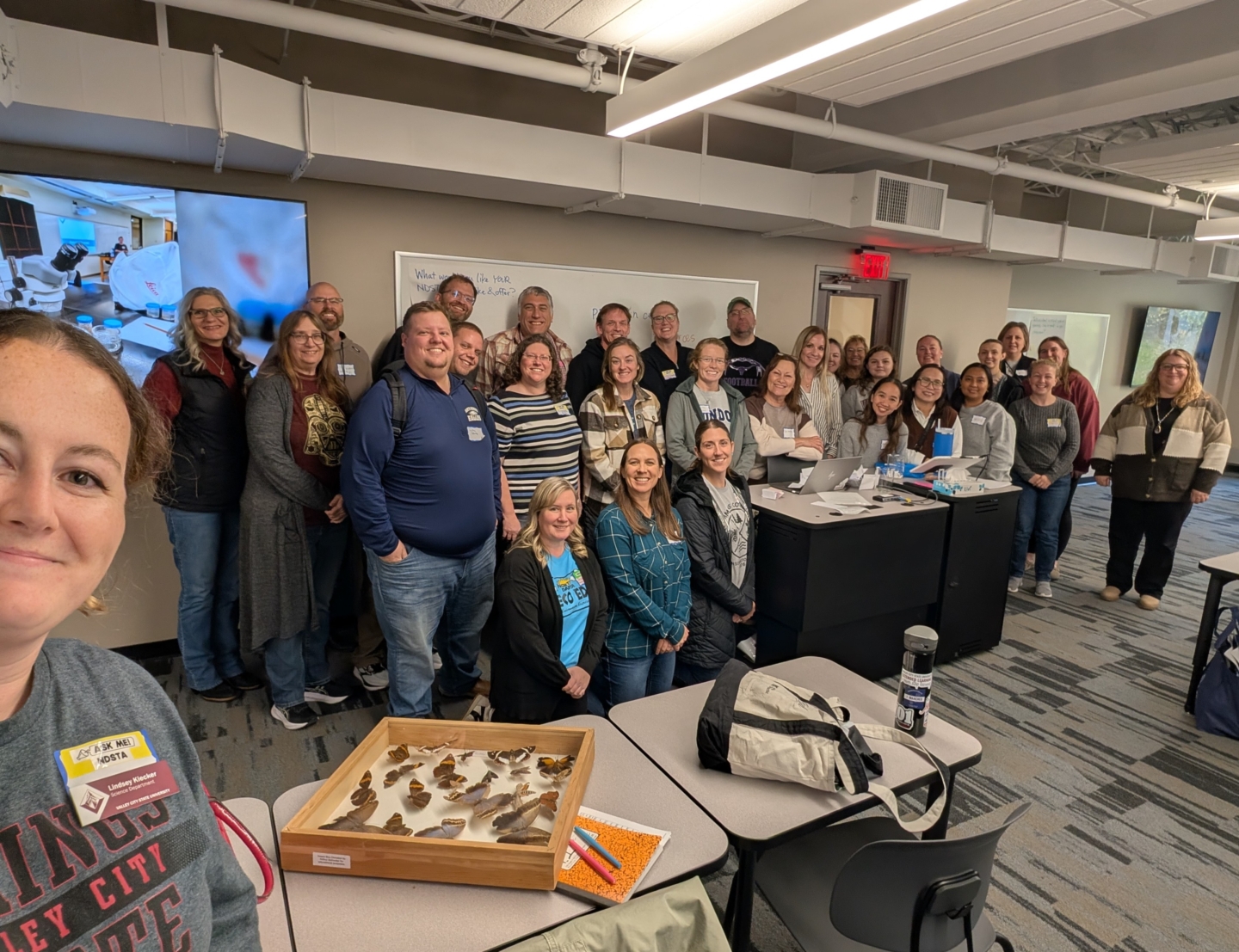
While the administration focuses on internal governance, the campus recently served as the site for a professional reconnection. On October 24, the North Dakota Science Teachers Association (NDSTA) held its first conference at VCSU since 2018, drawing nearly 70 educators from across the state.
The conference focused on practical, classroom-ready tools. The event also provided physical resources, including 15 insect collections donated by Dr. Laura Munski, executive director of the Dakota Science Center, which were distributed to teachers to use as instructional tools.

Undergraduate research yields data on species of concern
The university’s commitment to STEM isn’t limited to K-12 outreach. VCSU student Ezekiel Luchi presented findings from his work regarding aquatic insect populations.
Ezekiel Luchi is documenting species to identify aquatic insect populations for addition to lists of Species of Greatest Conservation Need and Species of Greatest Information Need.
Ezekiel Luchi’s research focuses on Mayflies (Ephemeroptera), specifically identifying populations for addition to the Species of Greatest Conservation Need (SGCN) and Species of Greatest Information Need (SGIN) lists. Currently, five Mayfly species are on the SGCN list and eight are on the SGIN list.
Cultural and professional outreach expands campus footprint
Beyond the labs and boardrooms, VCSU has focused on regional pipeline building. On October 14, the university hosted its annual Spanish Day, bringing in over 90 high school students from Lisbon, Central Cass, and Valley City high schools. The event combined cultural immersion—such as Mexican lucha libre mask design—with academic exposure to the Language and Literature Department.
Research and instruction librarian Hannah Beebe represented the university at a conference where she networked with librarians across the state. Beebe presented at the conference and attended sessions on important topics in librarianship.
Viking sports face mixed results across the board
Conversely, the volleyball team struggled during a Montana road trip, dropping matches to Carroll College and Rocky Mountain College to finish the weekend with an 8-17 overall record. Meanwhile, the football team suffered a 24-3 loss to Dickinson State on October 24, with Walker Brondos providing the only points via a 30-yard field goal. The football team now enters a bye week before they host Montana State-Northern on November 7.
The overarching theme at Valley City State this October is one of reconnection—whether it is reconnecting science teachers after a seven-year hiatus, reconnecting administration with the student body, or reconnecting undergraduate research with global biodiversity databases.
Related reading
Nebraska presents new military spouse service ribbon to five spouses
Governor Jim Pillen and First Lady Suzanne Pillen hosted a ceremony at the Governor’s Residence to present the...
Carol Jean Marsh Billings Warden Dies at 84 in Crumpler, NC
Mrs. Carol Jean Marsh Billings Warden, an 84-year-old resident of Crumpler, North Carolina, died in peace on the...
FEMA Approves More Than $86 Million for Southeast Disaster Recovery
Federal disaster relief efforts in the Southeast received a massive infusion this week as the Federal Emergency Management...

Scott Fitzpatrick: GOP Auditor Defends Independent Record for Reelection
Auditor Fitzpatrick Touts GOP Independence in Missouri's 2026 Statewide Race “And my record, going all the way back...