Waking-Brain Treatment Clears Dementia-Linked Proteins in Finnish Trial
“Now that we can safely enhance the brain’s own clearance system, which gradually becomes less effective with age, while people are still healthy, it may be possible in future to prevent these diseases, or at least slow their progression,” said Vesa Kiviniemi, a professor at the University of Oulu.
Researchers in Finland have demonstrated that a novel vasomechanical treatment can flush harmful proteins linked to dementia from the brain while people are awake, News-Medical reported. The study, published Tuesday, November 3, in Nature Communications, provides the first evidence in living humans that brain-derived proteins can be cleared directly into the large veins at the back of the brain during wakefulness, opening what the team calls an entirely new avenue for the early diagnosis, prevention, and treatment of neurodegenerative diseases that cause dementia.
The breakthrough comes from the University of Oulu and Oulu University Hospital, where scientists tested the combined therapy on 29 healthy adult volunteers in a randomized crossover trial. The participants—15 women and 14 men ranging from 27 to 61 years old, with a mean age of 44—underwent two interventions on separate days: whole-body vibration alone and a combined protocol of blood pressure-lowering medication with vibration. Alzheimer’s disease and other dementias are characterized by the gradual accumulation of harmful proteins like beta-amyloid over decades, and the brain’s natural clearance mechanisms gradually weaken with age. The Finnish team set out to see if they could safely boost that clearance system while people were still healthy and fully awake.
Mimicking Sleep’s Cleanup Cycle While Awake
The brain’s own waste clearance system is most active during sleep, when blood pressure normally drops and slow vasomotor and respiratory pulsations strengthen, increasing the flow of cerebrospinal fluid through brain tissue and promoting the removal of waste products. The new treatment recreates this physiological state without requiring sleep. Researchers combined a medication that temporarily lowers blood pressure with Piezo1-targeted whole-body vibration stimulation.
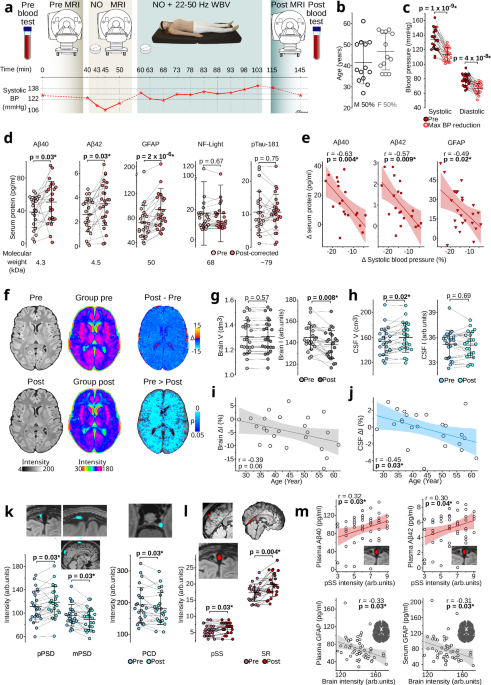
The medication induces transient, nitric oxide-mediated dilation of blood vessels, which strengthens the slow brain pulsations that drive fluid flow through the brain. “The effect largely resembled the physiological changes we have previously observed during sleep,” said Johanna Tuunanen, the study’s lead researcher and a doctoral researcher at the University of Oulu. “This makes the finding particularly interesting as a way of enhancing the brain’s own clearance mechanisms.”
Additionally, rhythmic whole-body vibration engages mechanosensitive Piezo1 channels in the vasculature, which help govern blood vessel function, especially constriction. Earlier mouse research showed that temporarily reducing blood pressure enhances the clearance of cerebrospinal fluid and the large molecules within it, and that Piezo1 activation corresponds to greater meningeal lymphatic flow and diminished beta-amyloid burden in the brain.
Tracking Proteins From Brain to Blood
To measure the effect, the team used multimodal magnetic resonance imaging alongside a wearable, MRI-compatible device incorporating fNIRS and dcEEG technology—the same technology used in the Glymphometer—to assess cerebrospinal fluid circulation in real time. They also tracked physiological measurements and blood-based biomarkers originating in the brain. The results showed that blood levels of harmful proteins implicated in dementia—including beta-amyloid 40 and 42, and GFAP proteins—increased significantly in the bloodstream after treatment.
“The results suggest that harmful proteins were cleared from the brain more efficiently than usual,” Tuunanen said.
MRI scans revealed clear changes in brain fluid flow and protein concentrations, particularly around the brain’s large veins, as well as in overall fluid content. According to the full study published in Nature Communications (DOI: 10.1038/s41467-026-78894-y), blood samples analyzed on the Quanterix Simoa HD-X platform confirmed the increased efflux of low molecular weight brain proteins following the combined intervention.
“For the first time, we obtained evidence that brain-derived proteins passed directly into the large veins at the back of the brain, something that has not previously been observed even in animal models,” Kiviniemi said. “We can now also remove proteins while they are still soluble, before they form solid deposits. This is extremely important, as removing proteins from the brain once they have formed solid deposits in tissue may be virtually impossible.”
A New Window for Prevention
The trial’s crossover design, where 27 participants underwent vibration alone and 26 underwent the combined nitric oxide-mediated vasodilation-plus-vibration protocol, helped isolate the specific effect of the nitric oxide-mediated vasodilation on the clearance of harmful proteins from the brain.
Still, the research remains in early stages. The study involved only healthy adults and measured protein clearance over a short window, not long-term cognitive outcomes. Whether the treatment is safe or effective for older adults, or for those already showing early memory impairment, remains unknown. Kiviniemi said the next step is to investigate what benefits the treatment might offer patients with early-stage memory impairment, with follow-up studies currently being planned in collaboration with other leading experts in the field.
Keep reading

Hackers Target French Blood Storage Freezers in Remote Attack
Hackers remotely changed the temperature settings on freezer units holding blood plasma at French Blood Establishment facilities in...

ZFX Gene Identified as Key to Female Protection Against Autism
Four to five times. Autism is four to five times more common in males than females, a well-known...

Indonesia to Press for Climate Financing and Fair Transition at COP31
In the remote seaside village of Liagu, North Kalimantan, women lay out milkfish beside aquaculture ponds dotted with...

Santa Monica Studio Delays God of War Laufey to May 20, 2027
Santa Monica Studio has delayed God of War Laufey, its PlayStation 5 spin-off starring Kratos' late wife Faye,...