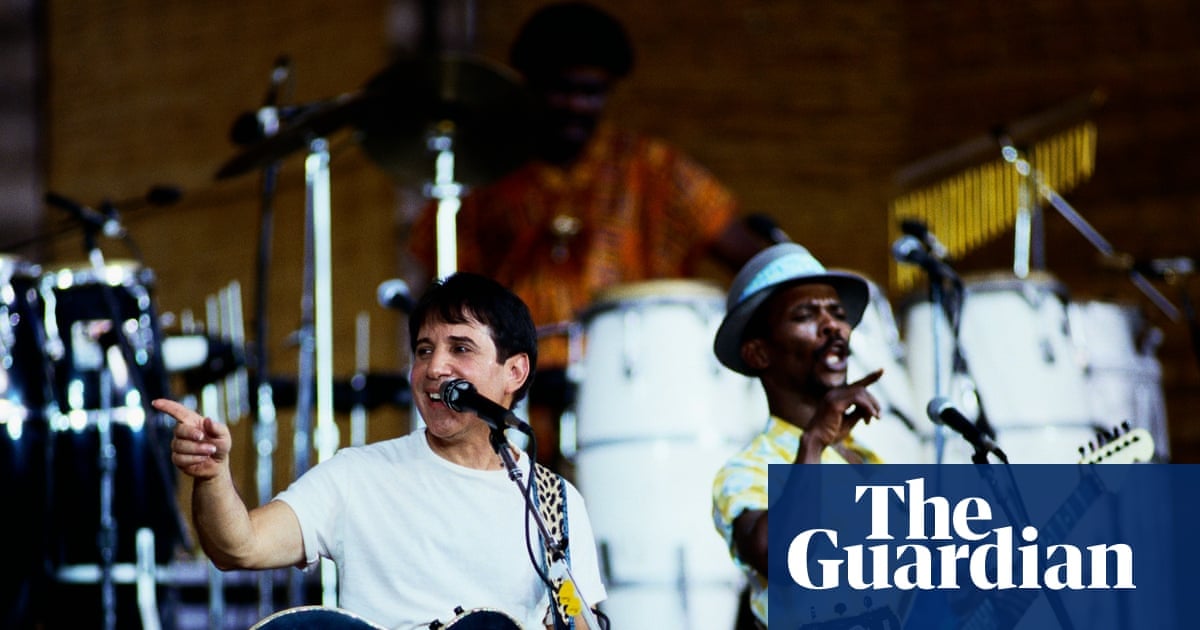
Forty years after its 1986 release, Paul Simon’s Grammy-winning album Graceland remains a landmark of cross-cultural collaboration and a lightning rod for political controversy. Recorded during the height of apartheid, the project fused South African mbaqanga rhythms with Western pop, revitalizing Simon’s career while igniting fierce global debates.
In the summer of 1984, Paul Simon was professionally adrift. A blockbuster tour with Art Garfunkel had ended in acrimony, his recent solo albums had underperformed commercially, and his marriage to Carrie Fisher was coming apart. Seeking solace during solitary drives from Manhattan out to Long Island, the 43-year-old musician found himself obsessed with a bootleg cassette of accordion-heavy mbaqanga, a South African township jive style driven by bright guitar chords and jazz rhythms.
That tape planted the seeds for Graceland, an album that music historian Ashley Kahn explores in his new book, Days of Miracle and Wonder: Paul Simon and the Trials and Triumphs of Graceland. As Kahn notes, the record emerged from an era when music lovers experienced deep self-reflection on long road trips.
“Many of us, in that day and age, found a moment of self-reflection – of being able to go deep inside ourselves – when we were in the car on these road trips. If it wasn’t the radio, it was cassettes.”
Ashley Kahn, author
Building From the Rhythm Up in Johannesburg Studios
Determined to track down the source of the music, Simon traveled to Ovation Studios in Johannesburg in February 1985. Warner Bros. label executives had put him in touch with South African producer Hilton Rosenthal, who helped coordinate sessions with local acts including the Boyoyo Boys, General MD Shirinda and the Gaza Sisters, Tao Ea Matsekha, and Ladysmith Black Mambazo. Rather than arriving with completed songs, Simon abandoned his traditional acoustic guitar-first approach and began crafting tracks from the rhythm section up.
The creative shift mirrored modern production techniques. Kahn observed that Simon was finding a way of building from the rhythm up, comparing the process to starting with a beat and matching the words to it.
Beyond South Africa, the album expanded its sonic palette by incorporating zydeco from Louisiana group Rockin’ Dopsie and the Zydeco Twisters, and norteño fusion from Los Lobos on the track All Around the World or the Myth of Fingerprints
. Released in 1986, the genre-defying record left radio programmers initially struggling for categorization.
Apartheid Realities and the Global Boycott Backlash
The joyful sessions in Johannesburg took place under the suffocating restrictions of South Africa’s apartheid regime. Black musicians faced strict curfews, being barred from the city streets and public transportation after dark. Simon told Rolling Stone in 1986 that recording sessions reached an uncomfortable juncture when the players couldn’t concentrate until they knew there might be a car to take them home
.

Before entering the studio, Simon resisted advice from calypso legend and activist Harry Belafonte to consult with the African National Congress, believing that art should transcend political boundaries. That decision placed him in direct violation of the United Nations General Assembly’s Resolution 35/206, which instituted a cultural and academic boycott to isolate the apartheid government. The UN’s special committee against apartheid later censured Simon and planned to add him to a list of violators.

The project drew sharp criticism from activists and artists alike, including Steven Van Zandt’s Artists United Against Apartheid and The Specials AKA with their single “Nelson Mandela”. Critics also pointed to the involvement of country-rock singer Linda Ronstadt, who three years prior had accepted $500,000 to perform at the segregated Sun City luxury resort. Journalist Tris McCall articulated the ethical quagmire in the Star-Ledger, asking how Simon could approach South African musicians as equal partners when their government forced them to treat visitors as superiors.
Defending his actions at the time, Simon maintained that he was following his musical instincts rather than playing for the government or segregated audiences. Kahn emphasizes that Simon was attentive to the labor rights of his collaborators, paying them triple the daily rate of American union musicians and ensuring they received writing credits and compensation.
Global Legacy and the Modern Shift in World Music
Despite the fierce global firestorm, Graceland went on to sell over 16 million copies worldwide, peak at No. 3 on the Billboard 200, achieve five-time platinum status in the United States, and win the Grammy Award for Album of the Year. The title track, crafted alongside guitarist Ray Phiri, fretless bassist Bakithi Khumalo, and drummer Isaac Mtshali, used Elvis Presley’s mansion as a poetic motif for a journey through life and fatherhood.
Even amid ongoing debates over cultural appropriation and past songwriting disputes involving artists like Los Lobos and Ray Phiri, the album’s broader cultural footprint remains immense.
Related reading
Tom Cruise Surprises Fundraiser Lloyd Kembrey at Fake Interview
British facilities manager Lloyd Kembrey, who spent a year undertaking extreme athletic feats to raise funds for the...
Gillian Anderson Tells Repeat Fans Not to Sit in West End Front Row
Gillian Anderson sparked online debate after a viral TikTok video captured her telling repeat fans outside a London...

Space Marine 2 Anniversary Update Adds Chaos PvE and Crucible Mode
Saber Interactive has deployed Warhammer 40,000: Space Marine 2 Anniversary Update 2, officially launching the game's third year...

Kim Kardashian Spent Five Years Single Before Dating Lewis Hamilton
Kim Kardashian revealed in an interview published on October 3 that she spent five years being single to...