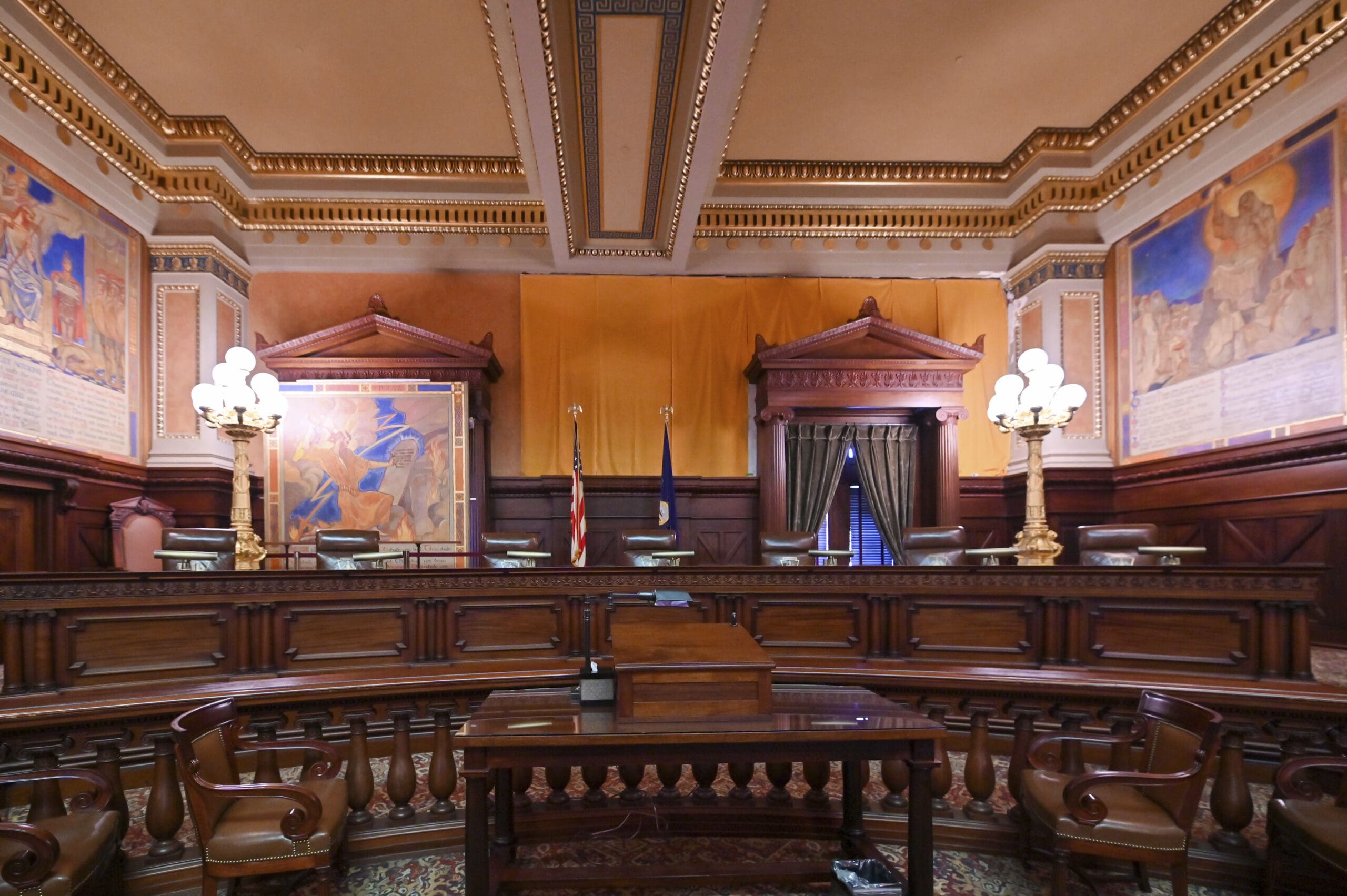
Pennsylvania’s Supreme Court could flip from a Democratic to a Republican majority in 2027, with one seat definitely open and a second likely to follow.
Justice Christine Donohue, elected as a Democrat in 2015, must step down when she reaches the mandatory retirement age of 75 next year. Chief Justice Debra Todd, the court’s first female chief justice and a Democrat elected in 2007, has told the Administrative Office of Pennsylvania Courts she does not plan to seek retention, though she has until Jan. 4 to file a declaration of candidacy if she changes her mind, WESA reported.
If both leave, Republicans would need to win two open seats and retain Justice Sallie Updyke Mundy, who faces a yes-or-no retention vote the same year, to claim a 4-to-3 majority.
The stakes are immediate. The court’s current 5-to-2 Democratic-backed majority — Justices Kevin Dougherty, Daniel McCaffery and David Wecht join Donohue and Todd — has shaped voting rights, abortion access and legislative maps for a decade. In 2018, the justices struck down a congressional map that favored Republicans as an unconstitutional gerrymander; the delegation shifted from a 13–5 Republican advantage to a 9–9 split that November, The Pennsylvania Independent reported.
Four years later, the court upheld Act 77, preserving no-excuse mail voting after a lower court had voided the law. In 2020, the justices rejected a Republican congressman’s suit seeking to discard roughly 2.5 million Pennsylvania ballots cast for Joe Biden.

“The phrase I keep going back to in my head is ‘Groundhog Day,’” joked Michael Quatrini, a Pittsburgh-area lawyer. “It seemed like nothing happened for 100 years until 2015. And this has been a 10-year period in which so many things have happened.”
Abortion rights are already on the docket. The Commonwealth Court ruled in April that Pennsylvania’s decades-long ban on using Medicaid funds to cover abortion is unconstitutional. Republican Attorney General Dave Sunday has appealed to the Supreme Court, and advocates read the justices’ 2024 decision allowing the case to proceed as a signal they may end the ban. Abortion remains legal in the state through the 23rd week of pregnancy.
Redistricting adds another layer. After each census, a five-member commission draws state House and Senate maps. The four caucus appointees deadlock along party lines, leaving the Supreme Court to pick the tie-breaking chair — a role that effectively decides the maps for a decade.
Data-center regulation may also land before the court. Local officials’ authority to restrict construction emerged as a flashpoint in this year’s midterms, and Quatrini said the issue could shape the 2027 race as well.
Commonwealth Court Judge Matthew Wolf, a Democrat, announced his candidacy shortly after the November midterms. Fellow Commonwealth Court Judge Michael Wojcik, a Democrat with roots in western Pennsylvania and a former Allegheny County solicitor, is widely expected to join the race, WESA reported. Additional candidates from both parties are rumored to be weighing bids, including jurists from the Superior Court.
“With at least one female justice and potentially a second coming off the court, I do think there will be a focus on protecting the right to choose,” Quatrini told WESA.
Todd’s Jan. 4 filing deadline will clarify whether one seat or two are truly open. Mundy’s retention vote proceeds regardless. The general election is set for November 2027.
Related reading

Maui Police Commission Keeps Chief on Leave, Widens Probe
The Maui Police Commission voted 6-1 on Wednesday to keep Chief John Pelletier on paid administrative leave, rejecting...

Judge Dismisses Musk Election Bribery Lawsuit Over Lack of Standing
A Brown County judge has dismissed a civil lawsuit accusing Elon Musk of election bribery tied to the...

Carbon County Approves Valar Atomics Nuclear Data Center Permit
Carbon County's planning commission approved a conditional use permit Thursday night for Valar Atomics' proposed Raceway Energy Campus,...

Washington Governor Ferguson Signs Executive Order for Maritime Strategy
On Friday, Washington Governor Bob Ferguson put his signature on an executive order that launches the creation of...