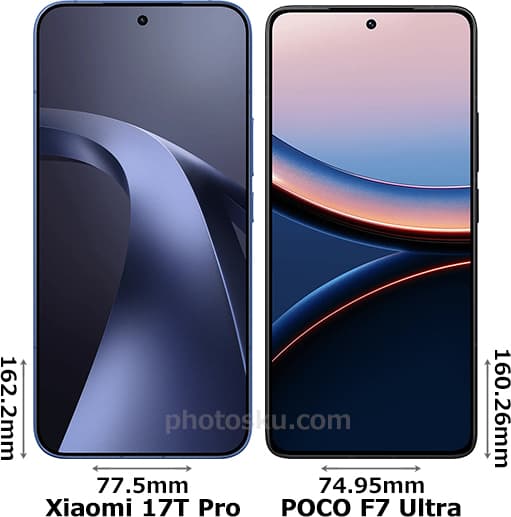
Two smartphones from the same company released months apart sit roughly €200 apart on paper, forcing buyers to weigh whether the POCO F9 Ultra’s larger silicon-carbon battery and Bose-tuned speakers justify paying more over the Xiaomi 17T Pro.
Xiaomi launched the Xiaomi 17T Pro on May 28, 2026, and its performance brand POCO followed with the POCO F9 Ultra on September 1, 2026. Both devices ran into the same review verdict: great phones at launch prices that are hard to justify, according to Memeburn. POCO operates as Xiaomi’s sub-brand focusing on speed and battery, whereas the T series serves as a cheaper, Leica-branded alternative to Xiaomi’s main flagships.
Pricing and Street Values for the POCO F9 Ultra and Xiaomi 17T Pro
At European list prices, the base 12GB RAM and 256GB storage model of the POCO F9 Ultra lists at €1,099.90 ($1,232), while the Xiaomi 17T Pro lists at €899 ($1,007), creating a €200.90 gap. Higher configurations show similar gaps: the 512GB POCO lists at €1,199.90 ($1,344) compared to the Xiaomi’s €999 ($1,119) for 12GB RAM, and the 1TB models list at €1,399.90 ($1,568) for the POCO versus €1,099 ($1,231) for the Xiaomi. POCO announced a global launch price of $799 for the 12GB and 256GB base model, though dollar prices were not announced for the higher tiers.
By late October 2026, street prices in Germany showed both devices selling well below list price. The POCO F9 Ultra (12GB + 256GB) traded around €819.90 ($918), while the Xiaomi 17T Pro (512GB) dropped to around €699 ($783), narrowing the actual store price gap to roughly the cost difference between the models.
Battery Tests and Hardware Differences Between the Xiaomi and POCO Models
Both smartphones utilize silicon-carbon batteries, which integrate silicon into the anode to hold more energy without increasing physical size. However, the POCO F9 Ultra features an 8,050mAh capacity, which is 1,050mAh or 15% larger than the 7,000mAh capacity inside the Xiaomi 17T Pro.
Independent lab testing reflects that extra capacity. The POCO F9 Ultra achieved an Active Use Score of 24 hours 35 minutes, outlasting the Xiaomi 17T Pro score of 21 hours 41 minutes by about 13%. The official EU energy label endurance ratings show a similar margin, with the POCO ahead by about 14% at 80 hours 44 minutes compared to the Xiaomi’s 70 hours 55 minutes.
Charging specifications are largely a draw. Both devices support 100W wired charging and 50W wireless charging. In lab testing, the Xiaomi reached a full charge in 44 minutes while the POCO took 54 minutes to fill its larger battery, resulting in comparable speeds of roughly 159mAh per minute for Xiaomi and 149mAh per minute for POCO. For power sharing, the POCO supports 27W wired and 22.5W wireless reverse charging, whereas the Xiaomi offers 22.5W wired reverse charging.
Audio Quality, Display Tech, and Verdict for Buyers
Beyond battery life, the POCO F9 Ultra incorporates a 2.1 speaker setup tuned by Bose, featuring two stereo speakers alongside a dedicated woofer on the back for bass. Independent testing described the POCO sound as excellent, while rating the Xiaomi speakers as disappointing with little bass and harsh highs at high volume, even though the Xiaomi measured slightly louder.
POCO also includes an ultrasonic fingerprint reader that maps fingers using sound waves, performing better with wet or greasy fingers, and adds a separate VisionBoost D8 chip for frame interpolation in supported games. Meanwhile, Memeburn notes that Xiaomi wins on camera hardware, video capabilities, software support, and comfort.
Ultimately, discounts make the Xiaomi 17T Pro the better purchase for most buyers because its 512GB model has fallen below the price of the base POCO. The POCO F9 Ultra remains recommended for power users when it nears its early-bird price.
Keep reading

Authentic Brands Group Sues Anthropic Over $41 Million
Owners of Elvis Presley's music rights have filed a $41 million federal lawsuit against AI company Anthropic, accusing...

Apple iPhone Duo Price Premiums Evaporate in China
Apple’s first foldable smartphone, the iPhone Duo, saw its resale premiums in China collapse this week as supply...

Tohoku University and University of Tokyo Launch Curated Hydrogen Database
Published online on September 4, 2026, in Applied Physics A, researchers at Tohoku University and the University of...

r/opensource Bans AI Projects, Restricts Solo Developers
Reddit’s massive r/opensource developer community enacted an immediate ban on all artificial intelligence projects on October 24, 2026.