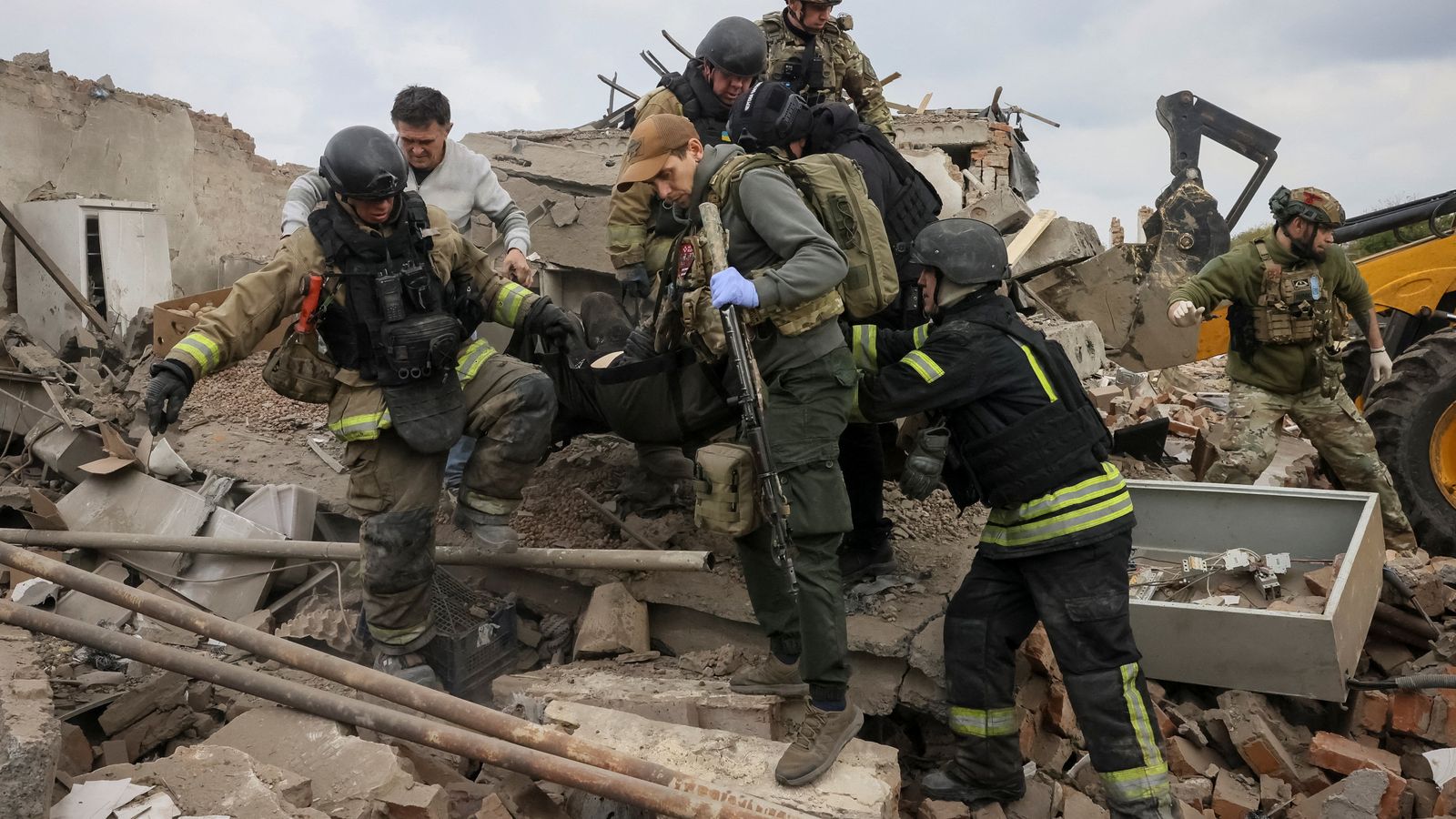
People had arrived to collect humanitarian aid. Instead, nine aerial bombs fell on a former school in the village of Komyshuvakha, in Ukraine’s southeastern Zaporizhzhia region, as civilians arrived for the building’s weekly humanitarian aid distribution, Ukrainian President Volodymyr Zelenskyy said. At least 40 people were killed and roughly 30 more are believed trapped under the rubble, making it one of Russia’s deadliest attacks on Ukrainian civilians since the full-scale invasion began.
The strike occurred one day after a six-day U.S.-brokered ceasefire expired, and the United States is scheduled to bring together Ukrainian and Russian delegations in Abu Dhabi. Rescue workers are still searching the underground shelter for survivors, and officials put the number of missing as high as 59.
Search and rescue operations have now been underway for three days at the site of the Russian strike on a school in the settlement of Komyshuvakha in the Zaporizhzhia region. The Russians used nine aerial bombs. They first struck people who had come to receive humanitarian aid,… pic.twitter.com/KaFinOorVy
A Shelter Turned into a Grave
Komyshuvakha sits near the front line, and classes at the school had long been suspended. The building had been repurposed as an underground shelter and handed out aid every Monday. According to Zelenskyy, Russian forces first dropped bombs on the school building as people gathered for aid, then struck the shelter itself with more munitions — a pattern in which emergency responders are targeted after the initial blast. Local governor Mykhailo Semikin told Ukraine’s national TV that Russia used KAB-500 and FAB-3000 bombs, with the FAB-3000 being a three-ton weapon carrying nearly 1.5 tons of explosive material, designed to destroy heavy concrete fortifications.
The toll among first responders was steep: Ukraine’s Ministry of Internal Affairs said two rescuers and four police officers were among the dead. Police described how a follow-up strike “trapped everyone who was trying to escape” the underground school. Officials in Zaporizhzhia, including Ivan Fedorov, co-head of the Regional Defense Council, wrote on Telegram that 59 people remain missing. The death count itself varies — some reports put confirmed fatalities at 40, while others reported a toll of 37 — but even the lower figure ranks among the deadliest single strikes on civilians this year.
Ceasefire Hopes Meet a Barrage
A six-day truce in the Russian-occupied town of Oleshky, brokered by U.S. First Lady Melania Trump, had allowed nearly 800 people to be evacuated, and Zelenskyy awarded her a state honor for her role. In his address, Zelenskyy said the Komyshuvakha strike showed Moscow was not building on that evacuation: “But it, like thousands upon thousands of other war crimes Russia has committed against Ukraine and Ukrainians, demands a strong response. Evil always goes further if it is left unanswered.” On X, he added: “Unfortunately, there has been very little reaction from the world to this insane attack.”
Moscow offered a competing account. Russia’s Defense Ministry claimed the attack targeted Ukrainian military units around Komyshuvakha and two other towns, and asserted that up to 25 Ukrainian servicemen were killed. Both governments deny deliberately targeting civilians. The strike also came before Russia launched a wider barrage of hundreds of drones and dozens of cruise and ballistic missiles at Ukraine’s energy infrastructure, and Moscow said it hit two power stations in the Kyiv and Zhytomyr regions.

What It Means for the Abu Dhabi Talks
For American readers, the stakes are concrete: U.S. envoy Steve Witkoff said the United States will bring Ukrainian and Russian delegations together in Abu Dhabi on November 10–11 to discuss ending the conflict, postwar security agreements, and de-escalation. The Komyshuvakha strike — coming as it does on the heels of an American-brokered evacuation — puts pressure on those talks before they begin, and it fits a bloodier pattern. The past few months have been exceptionally deadly for Ukrainian civilians: 33 people died when Russia hit two civilian buses in Kramatorsk, 38 were killed in August when a drone strike near Kyiv triggered explosions in a residential area, and 33 died in a July missile barrage on the capital.
Zelenskyy demanded a “strong response” from the world, noting there has been very little reaction to the attack.
Related reading

China and ASEAN to Deepen Cooperation in Earthquake Monitoring and Disaster Management
China and eight ASEAN member states convened in Nanning, capital of the Guangxi Zhuang autonomous region, to deepen...

CAF Announces USD 2.5B Ocean Financing at CBD COP 2026 Night; Women’s Caucus Report Highlights Five Engagement Pathways
Yerevan's Biodiversity Diplomacy: $2.5 Billion Ocean Pledge and First Women's Outlook Reshape Global Conservation During an ocean-themed night...

Arab-Israeli Party Recommends Gadi Eisenkot to Form Israel’s Next Government
Arab-Israeli Party Ra'am Endorses Eisenkot, Deepening Netanyahu's Political Crisis The largest Arab-Israeli political party has endorsed Gadi Eisenkot,...

Timothée Chalamet and Zendaya Begin Final Dune: Part Three Promo Run
Timothée Chalamet and Zendaya are making what looks like their final promotional run together for Dune: Part Three,...