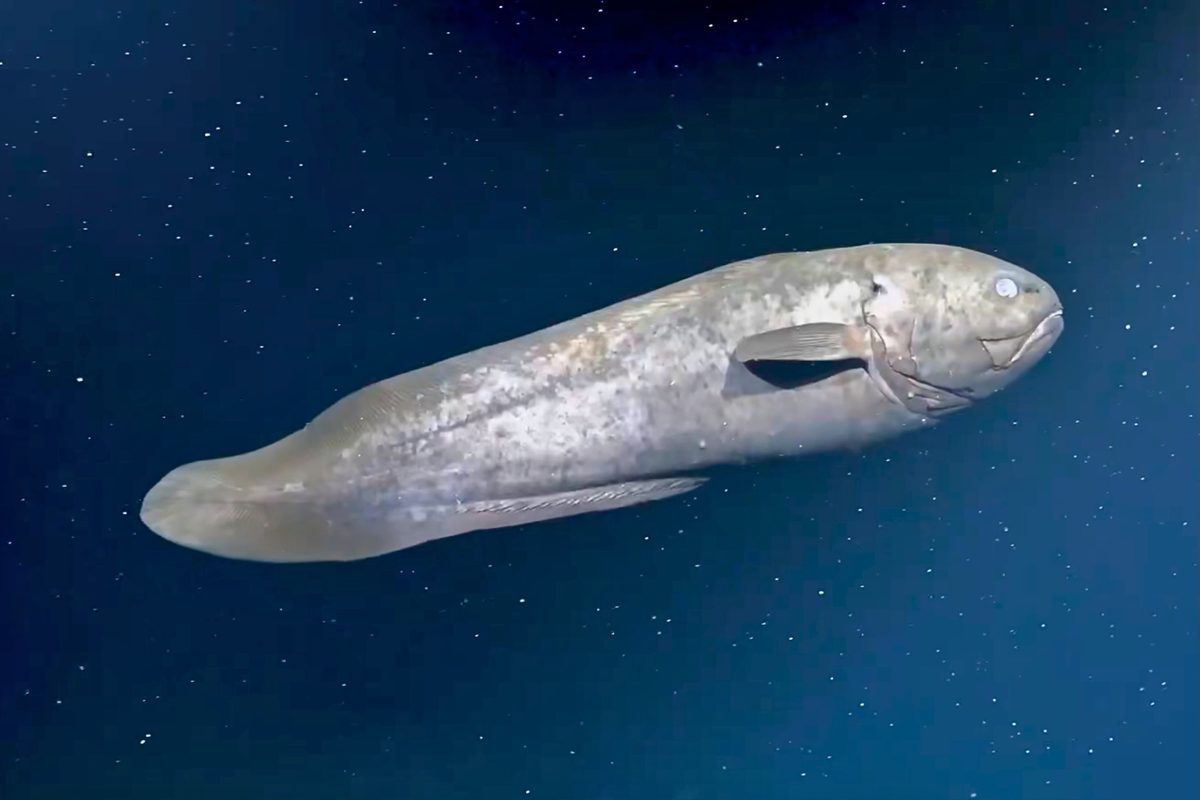
Scientists have found a 5-million-year-old sunken coral atoll, its peak nearly 3,000 feet beneath the Atlantic, thriving with life in a region where no atolls exist today.
The discovery, announced November 23 by the Schmidt Ocean Institute, confirms a 30-year-old hypothesis about ancient coral structures in the mid-Atlantic. The atoll, about 984 feet tall and made of fossilized coral, sits atop a volcanic ridge in the Romanche Fracture Zone. Its summit is capped by a bustling deep-sea garden of sponges and corals, a surprising oasis in the ocean’s depths.
A Geological Puzzle Solved
The Romanche Fracture Zone is the Atlantic’s longest geological fault, a place where two slabs of seafloor slide past each other. For decades, scientists suspected this area was once home to coral atolls, ring-shaped islands formed around volcanoes. But direct evidence was missing—until now.
The finding closes a chapter in a story that began with Charles Darwin’s theories about how atolls form. As volcanic islands sink over time, coral reefs grow upward, creating the ring-shaped structures seen in the Pacific. The sunken atoll in the Romanche Fracture Zone is a relic of that process, preserved and waiting to be found.
Life in the Dark
The expedition, led by Brazilian scientists aboard the research vessel Falkor (too), used an autonomous underwater vehicle to map the terrain and a remotely operated vehicle named SuBastian to explore the atoll up close. What they found was extraordinary.

Everywhere we looked, we saw stories emerging. While there are big stories like sponges living at depths that far exceed our expectations, there were also small ones that are just as important – like little animals hiding in the mud or dangling from coral branches. Every animal living in these ecosystems plays a vital role that we want to understand.
Dr. Paulo Sumida, a professor at the University of São Paulo
The team documented thriving ecosystems at multiple depths, including:
- A rare, 4,300-meter-deep garden of sponges and corals, deeper than scientists thought possible for such communities.
- Thousands of tiny pink zoanthids—relatives of anemones and corals—blanketing an area the size of a soccer field at 1,200 meters.
- Cold-water corals up to 1,000 years old, squids, octopuses, and other marine life.
A Call for Protection
The discovery isn’t just a scientific curiosity; it carries implications for ocean conservation. The Romanche Fracture Zone is where deep currents from the North and South Atlantic meet, creating a unique feeding ground for marine life. The data gathered during the expedition strengthens the case for protecting the area under the recently ratified High Seas Treaty.
We produced the first scientific evidence confirming the ecological and biological uniqueness of this region. Our data strengthens the importance of the Romanche Fracture Zone as an area to be considered for protection under the recently ratified High Seas Treaty.
Dr. Jose Angel Perez, expedition Chief Scientist
Schmidt Ocean Institute’s executive director, Jyotika Virmani, called the find a reminder of the ocean’s hidden wonders. “Finding thriving deep-sea ecosystems atop a prehistoric coral atoll is an extraordinary reminder that our ocean still holds monumental secrets,” she said.
Expedition Details and Findings
The 35-day expedition aboard the Schmidt Ocean Institute’s research vessel Falkor (too) concluded in October. During this mission, the mapping gear and an autonomous underwater vehicle named The Childlike Empress were the first to spot the atoll.
An AUV is an underwater drone, distinct from the ROV used for close-up exploration. The ROV SuBastian, weighing approximately 7,050 pounds and measuring about 9 feet long, was then deployed to provide the first visual record of these ecosystems in the Romanche Fracture Zone.
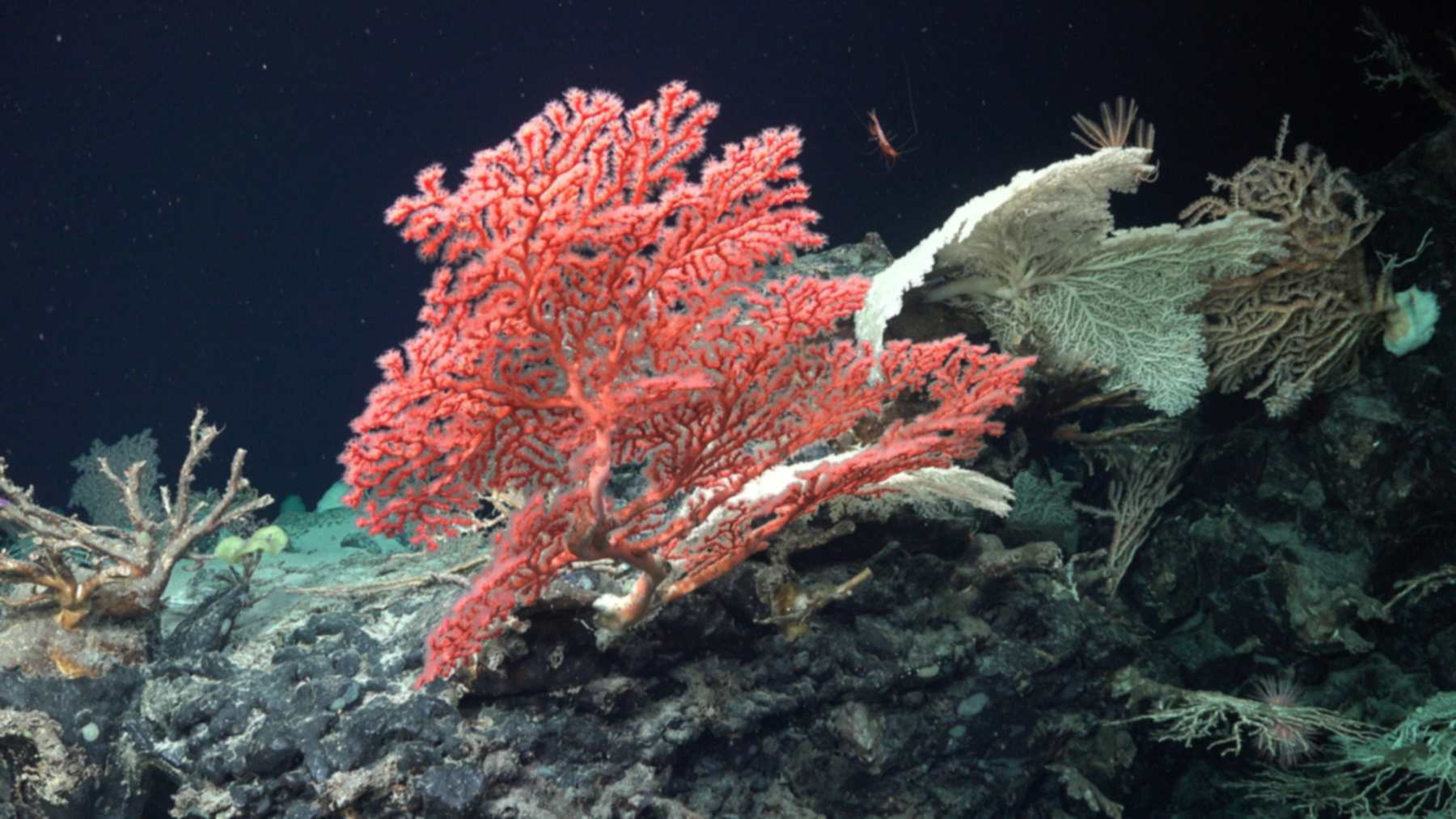
The expedition surveyed four distinct regions at depths ranging from 600 meters/1,968.5 feet to 4,000 meters/13,123 feet. These areas included ancient sponge gardens, rare meadows of zoanthids, and both squids and octopuses. A community of cold-water corals and sponges was specifically documented thriving at a depth of 1,683 meters.
This zone functions as a conduit where North Atlantic Deep Water and Antarctic Bottom Water converge and blend, and when this is paired with routine phytoplankton blooms at the surface, it provides sustenance to the life forms beneath.
The research team included Dr. Telmo Fernandes Morato Gomes, principal marine scientist at the University of the Azores’ Okeanos Research Institute and co-leader of the Azores Deep-Sea Ecology research group, who was present in Mission Control for the final remotely operated vehicle SuBastian dive.
Benthic ecologist Maurício Shimabukuro also highlighted video footage from an ROV dive while in Mission Control on the vessel. The volume of data gathered during the expedition is expected to keep researchers busy for decades.
The deepest standout documented was a garden of sponges and corals at a depth of roughly 4,300 meters, where Schmidt notes nobody expected large groups of these animals to exist. The four survey regions spanned from roughly 600 to 4,000 meters in depth; the 4,300-meter garden falls outside that defined range.
The Romanche Fracture Zone, located at the narrowest part of the Atlantic between Brazil and West Africa (2°N to 2°S, 16°W to 20°W), is the Atlantic’s longest geological fault, offsetting the Mid-Atlantic Ridge by 900 km. Its role as a deep-water conduit allows Lower North Atlantic Deep Water and Antarctic Bottom Water to flow between ocean basins, creating unique conditions.
Geologically, it hosts a transverse ridge capped by Miocene shallow-water limestones that reached sea level 20 Ma before subsiding, providing a relic platform for coral atoll formation. This fracture zone’s active transform boundary and historical uplift make it a critical site for studying ancient coral structures and deep-sea biodiversity.
For now, the sunken atoll shows how the ocean can surprise and sustain life in the most unexpected places.
Related reading

New Study Proposes Quantum-Resistant Hybrid Framework for Secure IoT Healthcare Systems
A new hybrid framework merges blockchain, software-defined networking, and post-quantum cryptography to secure medical device networks against current...

SNU Researchers Capture Mag 2 Earthquake Rupture Using Telecom Fiber
South Korean researchers captured the rupture of a magnitude 2 earthquake in millisecond detail by turning a buried...

Study Finds Denisovans, Unknown Lineage in South China
Scientists identified four ancient human teeth from two cave sites in southern China as belonging to Denisovans and...

Stanford Researchers Show NbP Nanoribbons Beat Copper Conductivity at Nanoscale
Stanford researchers have shown niobium phosphide nanoribbons just a few nanometers wide conduct electricity better than copper at...