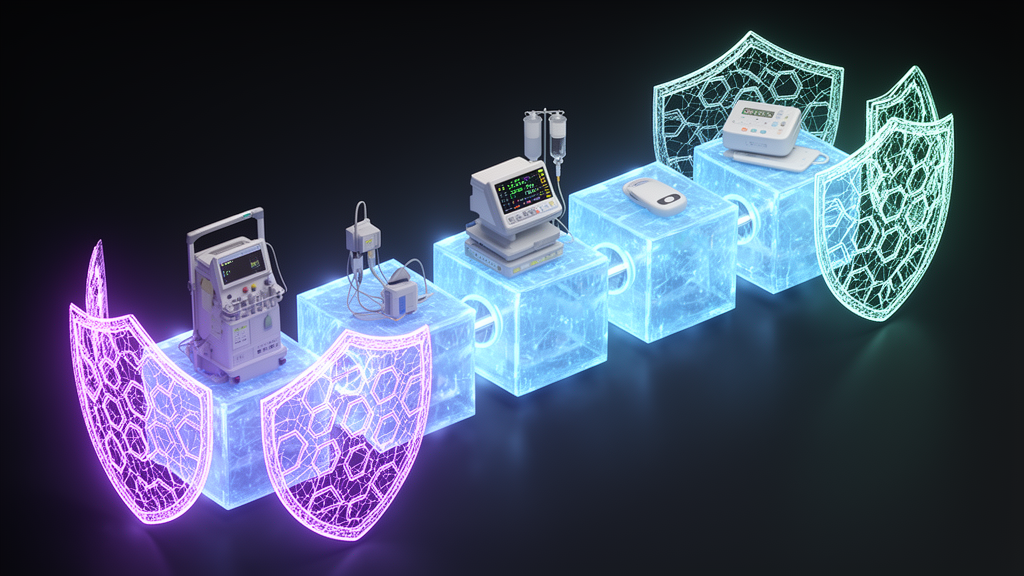
A new hybrid framework merges blockchain, software-defined networking, and post-quantum cryptography to secure medical device networks against current and future cyber threats, as studies published in late 2026 propose solutions for the growing Internet of Medical Things (IoMT).
The studies address critical security gaps in healthcare IoT systems, which are increasingly targeted by cyberattacks and vulnerable to future decryption by quantum computers. One study published in Discover Internet of Things on 17 October 2026 introduces an extended software-defined networking architecture with two new security planes: a Blockchain Plane for decentralized identity verification and a Quantum Security Plane for quantum-safe key establishment.
A Self-Mutable Blockchain Approach
The framework’s central innovation is a self-mutable blockchain designed to solve the problem of indefinite ledger growth, which burdens resource-constrained medical devices. When a sender transmits a message, the recipient verifies a signature, decrypts the payload, and checks a timestamped hash of a universally unique identifier (UUID) against the distributed blockchain. The message is authenticated only if a majority of blockchain nodes confirm the entry; otherwise, it is ignored.
This design uses Kyber, a lattice-based post-quantum key encapsulation mechanism selected by the US National Institute of Standards and Technology, to protect against “harvest now decrypt later” attacks. In simulations, the framework achieved an average authentication latency of 28.4 milliseconds and an average communication overhead of 23.6 kilobytes per transaction. Blockchain storage overhead was kept at approximately 13.2 megabytes by removing expired authentication records.
Patient Acceptance in Taiwan
In related research, a survey of 283 patients across eleven hospitals in Taiwan explored acceptance of a conceptual blockchain-IoT patient registration system. The study, published in November 2026, used an extended Technology Acceptance Model (TAM) framework to assess fifteen technological elements grouped into four clusters. Most respondents (88.7%) had used a digital registration service in the previous 12 months, and factor analysis identified three key components influencing acceptance.
The research highlighted the role of security features, such as the stateless hash-based digital signature algorithm SLH-DSA, in building trust. “Harvest now decrypt later (HNDL)” was noted as a significant risk, emphasizing the need for post-quantum protection in healthcare systems. The study did not validate the TAM construct assignments and said that while the sample size was adequate for exploratory analysis, no confirmatory power was claimed.
Hybrid Deep Learning Detects Healthcare IoT Intrusions
Another study, published in Frontiers in late November 2026, proposed a hybrid deep learning-based intrusion detection system for healthcare IoT. The framework uses a postquantum authenticated trust–score module to gate device observations via record–level authentication, with failed records conservatively assigned a trust score of zero for auditability. Each observation is represented as a compact record commitment and authenticated using CRYSTALS–Dilithium (ML–DSA) signatures.
Using the WUSTL EHMS 2020 dataset, the system achieved a detection accuracy of 0.937 with low cryptographic overhead—average signing time of 1.7 ms and verification time of 0.9 ms. The research noted the importance of rejecting stale or repeated records to prevent replay attacks and ensuring that rejected records do not influence trust scoring or intrusion detection outputs. The optional inclusion of a zero-knowledge proof allows for credential verification under classical assumptions.
Quantum Security Integration
The Quantum Security Plane handles all post-quantum cryptographic tasks, including Kyber key encapsulation, as reported by bioengineer.org.
While the Schnorr–style non–interactive zero–knowledge proof (NIZK) component is retained for proof–of–knowledge and privacy–related protocol functionality, it relies on classical cryptographic assumptions and is not itself claimed to be postquantum secure, according to Frontiers.
AVISPA Verification Finds No Attack Traces in Simulation
The quantum-resilient SDN framework was formally verified using the AVISPA tool, which reported no attack traces under bounded session assumptions for goals including sender authentication, message confidentiality, and resistance to impersonation. The analysis assumed an adversarial model where attackers can eavesdrop or replay traffic but cannot compromise a large number of blockchain nodes or break the security assumptions of Kyber.
The National Institute of Standards and Technology, an agency of the United States Department of Commerce, manages the selection process for these cryptographic safeguards. Through its physical science laboratory programs, the organization oversees information technology research to promote industrial competitiveness and innovation. This involvement ensures that algorithms like Kyber meet the rigorous standards required to protect sensitive data from emerging quantum threats.
Despite promising results, the authors caution that the framework has only been tested in simulated environments and not on large-scale physical IoMT testbeds. Real-world deployment would need to address computational costs of quantum-safe algorithms, interface standardization, compliance with healthcare privacy regulations, and device interoperability. Future work will focus on practical hospital network implementation and optimizing the blockchain for low-power medical devices.
Keep reading

SNU Researchers Capture Mag 2 Earthquake Rupture Using Telecom Fiber
South Korean researchers captured the rupture of a magnitude 2 earthquake in millisecond detail by turning a buried...

Study Finds Denisovans, Unknown Lineage in South China
Scientists identified four ancient human teeth from two cave sites in southern China as belonging to Denisovans and...

Stanford Researchers Show NbP Nanoribbons Beat Copper Conductivity at Nanoscale
Stanford researchers have shown niobium phosphide nanoribbons just a few nanometers wide conduct electricity better than copper at...

Euclid Telescope Finds Most Distant Quasar Dún Aonghasa
This time the leap in cosmic time is huge! said Julien Wolf, a postdoctoral researcher at the Max...