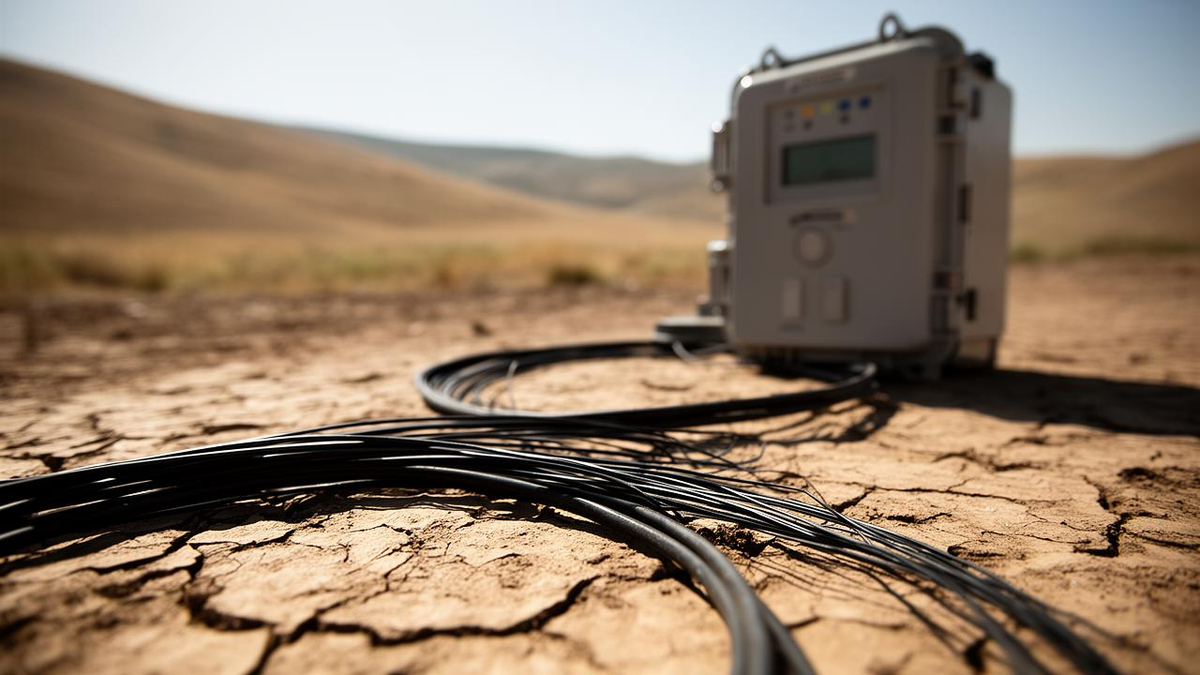
South Korean researchers captured the rupture of a magnitude 2 earthquake in millisecond detail by turning a buried telecom fiber into thousands of virtual seismometers, revealing a two-stage break that defied the long-held assumption of a simple circular crack.
- A 28-km fiber in California’s Brawley Seismic Zone acted as ~7,000 sensors spaced 4 meters apart.
- The magnitude 2.03 quake on May 14, 2021 ruptured in two adjacent patches 42 milliseconds apart.
- The first rupture likely triggered the second, and 16 nearby quakes broke non-overlapping patches within 500 meters.
- Similar “patchy rupture” patterns appeared in magnitude 5.3 and 5.4 quakes in the same zone in 2012.
Telecom cable becomes seismic array
The team, led by Seoul National University professor Kim Young-hee, fired laser light through an existing telecommunications fiber crossing the Brawley Seismic Zone at the southern end of the San Andreas Fault system.
Distributed acoustic sensing (DAS) measured tiny changes in the returning light, creating observation points every 4 meters along the roughly 28-kilometer cable — effectively turning a single strand into about 7,000 seismometers. Combined with records from five nearby seismic stations, the array reconstructed the fault rupture of a magnitude 2.03 earthquake that struck on May 14, 2021, down to the millisecond.
Rupture stops, then restarts
The analysis showed the quake did not spread uniformly from a single point. Instead, a second rupture broke out in a neighboring fault segment about 0.042 seconds after the first began.
The two segments each extended up to 150 meters, touched but did not overlap, and the second segment slipped up to about 9 millimeters. Seismic waves from the first rupture sharply raised stress in the adjacent area within roughly 0.04 seconds, triggering the second break. Researchers concluded the first rupture most likely triggered the second.

Even a common magnitude 2 earthquake harbors a complex process in which rupture stops and restarts.
Kim Young-hee, professor, Seoul National University
Pattern scales from tiny to moderate quakes
When the team examined 16 small earthquakes that occurred on the same fault over about three hours, they found these quakes also ruptured separate, mostly non-overlapping patches within a roughly 500-meter area — like puzzle pieces moving independently rather than a single large slip.
The same “fragmented rupture” pattern had been reported in successive magnitude 5.3 and 5.4 earthquakes in the same seismic zone in 2012, suggesting that earthquakes differing in energy by tens of thousands of times may share a common rupture mechanism.
Using telecom fiber-optic cables, we can turn small earthquakes into a new window for examining how faults work.
Kim Young-hee, professor, Seoul National University
Buried fiber cuts monitoring cost
The core advance is repurposing already-buried telecom infrastructure. No new dedicated observation cables are needed, drastically reducing cost. In areas where optical fiber is densely deployed — urban centers, fault zones — high-density monitoring networks can be established quickly.
The research team noted South Korea’s seismic network has grown denser since the Gyeongju earthquake, but capturing ruptures that end in 0.1 seconds demands even finer sensor spacing. Applying DAS to domestic fiber could supplement existing infrastructure and enable precise surveillance of microearthquakes near major cities and key fault lines.
Multiple institutions join study
Research institutions including Rice University and Lawrence Berkeley National Laboratory also participated in the study, BigGo Finance reported. Jonathan Ajo-Franklin, a professor at Rice University, characterized the 42-millisecond gap between rupture stages as an extremely brief interval in geological terms, according to Rice University.
Han, the study’s first author and now a postdoctoral researcher at the University of Washington, came to Rice as a visiting researcher to work with Ajo-Franklin while a graduate student in YoungHee’s lab, Han told Rice University. The collaboration brought together expertise from South Korean and U.S. institutions to analyze the fiber-optic data.
Funding sources and journal publication
The research was conducted with support from the Ministry of Science and ICT’s Basic Research Program for Leading Research Centers and Mid-Career Researchers, 파이낸셜뉴스 reported. The findings were published in Science, one of the world’s most prestigious international academic journals, at 4 a.m., the same outlet noted.
Additional support came from the National Research Foundation of Korea and the Imperial Valley Dark Fiber project, backed by the U.S. Department of Energy’s Geothermal Technologies Office with Lawrence Berkeley National Laboratory and Lawrence Livermore National Laboratory. These combined resources enabled the high-resolution fault rupture imaging.
Implications for unmapped faults in Korea
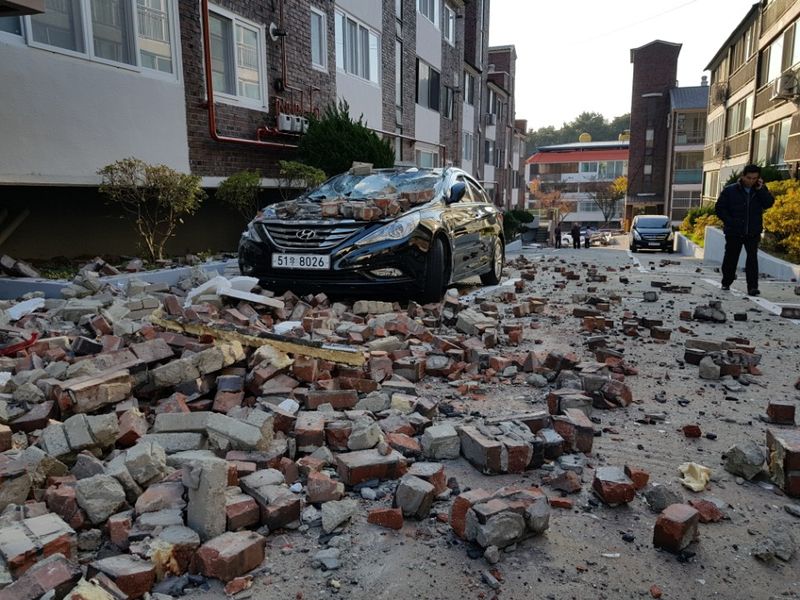
Researchers forecast that precise observation of micro-earthquakes in seismically active areas such as the southeastern Korean Peninsula could help identify fault zones that have not yet been mapped, BigGo Finance reported. The 2017 magnitude 5.4 earthquake in Pohang, North Gyeongsang Province, which collapsed an apartment building’s exterior wall and damaged a parked vehicle, illustrates the hazard from such faults, 파이낸셜뉴스 showed.
Applying distributed acoustic sensing to domestic telecom fiber already buried underground could supplement South Korea’s seismic network and enable systematic surveillance of microearthquakes near major cities and key fault lines, the source material indicated. Kim Young-hee said this approach could expand to systematically compare how rupture patterns differ from one region to another, the same source reported.
The Brawley Seismic Zone, connecting the San Andreas Fault’s southern end with the Imperial Fault, is an extensional tectonic zone and onshore spreading center, with subsidence occurring at the Salton Sea. In 1979, the zone ruptured for 13 km (8.1 mi) during the Imperial Valley earthquake, which had a surface rupture of over 30 km (19 mi) along the Imperial Fault.
Not prediction, but a better foundation for risk assessment
The study does not offer earthquake prediction. Its significance lies in strengthening the scientific basis for long-term seismic risk assessment by precisely analyzing the physical processes behind earthquake generation.
Laboratory rock experiments cannot fully replicate natural fault conditions, and large quakes are too rare to provide adequate data. Common small earthquakes, observed at millisecond resolution, become a repeatable natural laboratory for watching how faults slip and stop. The findings were published in Science with DOI: 10.1126/science.aei0507.
Keep reading

Study Finds Denisovans, Unknown Lineage in South China
Scientists identified four ancient human teeth from two cave sites in southern China as belonging to Denisovans and...

Stanford Researchers Show NbP Nanoribbons Beat Copper Conductivity at Nanoscale
Stanford researchers have shown niobium phosphide nanoribbons just a few nanometers wide conduct electricity better than copper at...
Euclid Telescope Finds Most Distant Quasar Dún Aonghasa
This time the leap in cosmic time is huge! said Julien Wolf, a postdoctoral researcher at the Max...

Simulations Suggest Earth-Mass Planet Beyond Neptune, Study Finds
New simulations point to an Earth-mass planet orbiting hundreds of times farther from the Sun than our world,...