
Scientists identified four ancient human teeth from two cave sites in southern China as belonging to Denisovans and an unknown archaic human lineage, according to a study published in Nature.
The discovery pushes the known range of Denisovans into the subtropical Lingnan region and challenges the assumption that a single Denisovan lineage dominated East Asia during the Middle Pleistocene.
Guangxi Cave Discoveries
Researchers recovered the teeth from Chuanshan Cave in Long’an County and Longchuan Cave in Luzhai County, located in the Guangxi Zhuang Autonomous Region. Excavations and surveys in the region’s caves began in 2015, uncovering Pleistocene mammal fossils alongside ancient human remains.
Uranium-series dating indicates that the two teeth from Longchuan Cave date between roughly 43,000 and 105,000 years ago. The specimens from Chuanshan Cave date back at least 101,000 years.
Protein Analysis Methods
To classify the specimens, researchers combined paleoproteomic extraction from tooth enamel with morphological comparisons using the Arizona State University Dental Anthropology System and other grading standards.
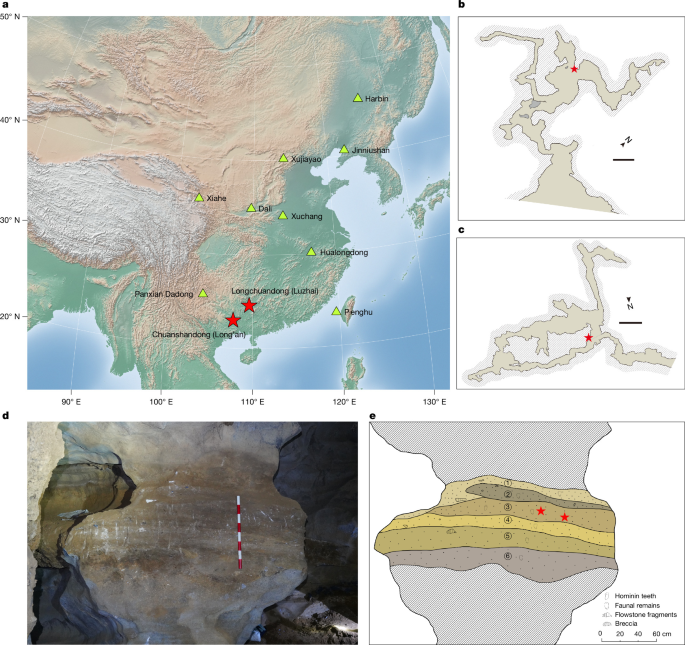
The two teeth from Longchuan Cave—a molar and a bicuspid—aligned with Denisovan dental traits previously identified in Siberia and elsewhere in Asia. This confirms that a Denisovan-related group inhabited southern China during the Late Pleistocene.
However, the two bicuspids from Chuanshan Cave presented distinct characteristics. Their complex root system resembled Homo erectus, while their crown symmetry aligned more closely with Homo sapiens. Further protein analysis determined that the fossils from both cave sites belonged to chromosomally male people.
Scientific Debate
While the Longchuan Cave specimens establish a permanent Denisovan presence in subtropical south China, the Chuanshandong teeth point toward an unresolved group. Researchers said that the morphology did not match established East Asian Homo members, suggesting that at least two non-sapiens Homo populations existed concurrently in the region’s subtropics.
We could call it the Chuanshandong group temporarily, but we need more fossil and molecular evidence to determine its affinity with other archaic Homo. It’s not clear whether they are our cousins.
Qiaomei Fu, director of the Ancient DNA Laboratory at the Institute of Vertebrate Paleontology and Paleoanthropology
John Hawks, an anthropologist at the University of Wisconsin-Madison, said that paleoproteomics is an emerging technique and questioned whether the specific genetic variant identified might also have existed within Homo erectus or Denisovan populations.
“The new Chuanshandong proteome is extremely interesting,” John Hawks, an anthropologist at the University of Wisconsin-Madison said
the paper characterizes this as an ‘unknown Homo’. I wouldn’t put it that way. The question is which group has variation of the proteome.
John Hawks, anthropologist at the University of Wisconsin-Madison
The research team suggests that the Chuanshandong lineage may have evolved locally as a specialized adaptation to the subtropical environment of Lingnan, or migrated to the region as a refuge.
Analysis Details
Investigating the morphology involved measuring the buccolingual and mesiodistal dimensions of the hominin teeth using a sliding calliper with recordings taken to the nearest 0.1 mm, followed by principal component analysis on the resulting shape variables. High-resolution in situ uranium-series dating using a laser ablation system connected with multi-collector inductively coupled plasma mass spectrometry directly dated the hominin teeth from both cave locations. Grain size for the fossil-bearing sediment was measured with a Malvern Mastersizer 3000 particle analyser possessing an analytical precision of under 1%. Tubes holding samples were immediately sealed with aluminium foil, taped, and wrapped in black plastic bags to prevent moisture loss and light exposure. Analyses using LA-MC-ICP-MS methods alongside solution techniques took place at the Institute of Vertebrate Paleontology and Paleoanthropology, Chinese Academy of Sciences, and Nanjing Normal University. Protein extractions involved processing a Neolithic human tooth from Henan Province’s Xiawanggang Site dating to approximately 5 ka alongside a blank extraction as positive and negative controls within the same batch. Eluted solutions underwent vacuum evaporation before LC-MS-MS analysis.
Peptides experienced separation through a 125-minute linear gradient program at a 350 nl min−1 flow rate, while full mass spectrometry scans measured m-over-z ranges from 350 to 1,500 with a resolution of 60,000, an automatic gain control target of 300%, and a maximum injection time of 50 milliseconds. Precursors were selected for higher-energy collisional dissociation fragmentation with an isolation window of 1.6 m-over-z and a dynamic exclusion duration of 60 seconds. Target database searches supplemented by a contaminant database used UniProt human reference proteome downloads with PEAKS Online for peptide de novo, PEAKS database, post-translational modifications, and SPIDER evaluations.
Enamel proteins investigated included amelogenin X isoform, AMELY, AMBN, enamelin, amelotin, odontogenic ameloblast-associated protein, matrix metalloproteinase 20, kallikrein 4, tuftelin, collagen alpha-1 chain, albumin, and alpha-2-HS-glycoprotein. Non-missing sites reached 16.67% in Longchuandong M2, 14.51% in Longchuandong P4, and 14.68% in Chuanshandong P3.
Phylogenetic trees used a 50% majority-rule consensus approach with clade frequencies representing posterior probabilities. Formal institutional approvals for the protein analyses came from the Guangxi Institute of Cultural Relics Protection and Archaeology and the Institute of Vertebrate Paleontology and Paleoanthropology, Chinese Academy of Sciences.
Related reading

Stanford Researchers Show NbP Nanoribbons Beat Copper Conductivity at Nanoscale
Stanford researchers have shown niobium phosphide nanoribbons just a few nanometers wide conduct electricity better than copper at...
Euclid Telescope Finds Most Distant Quasar Dún Aonghasa
This time the leap in cosmic time is huge! said Julien Wolf, a postdoctoral researcher at the Max...

Simulations Suggest Earth-Mass Planet Beyond Neptune, Study Finds
New simulations point to an Earth-mass planet orbiting hundreds of times farther from the Sun than our world,...
NSF NOIRLab Releases 570-Megapixel View of Supernova Remnant SNR G295.5+09.7
NSF NOIRLab released the most detailed view yet of supernova remnant SNR G295.5+09.7 on Monday captured by the...