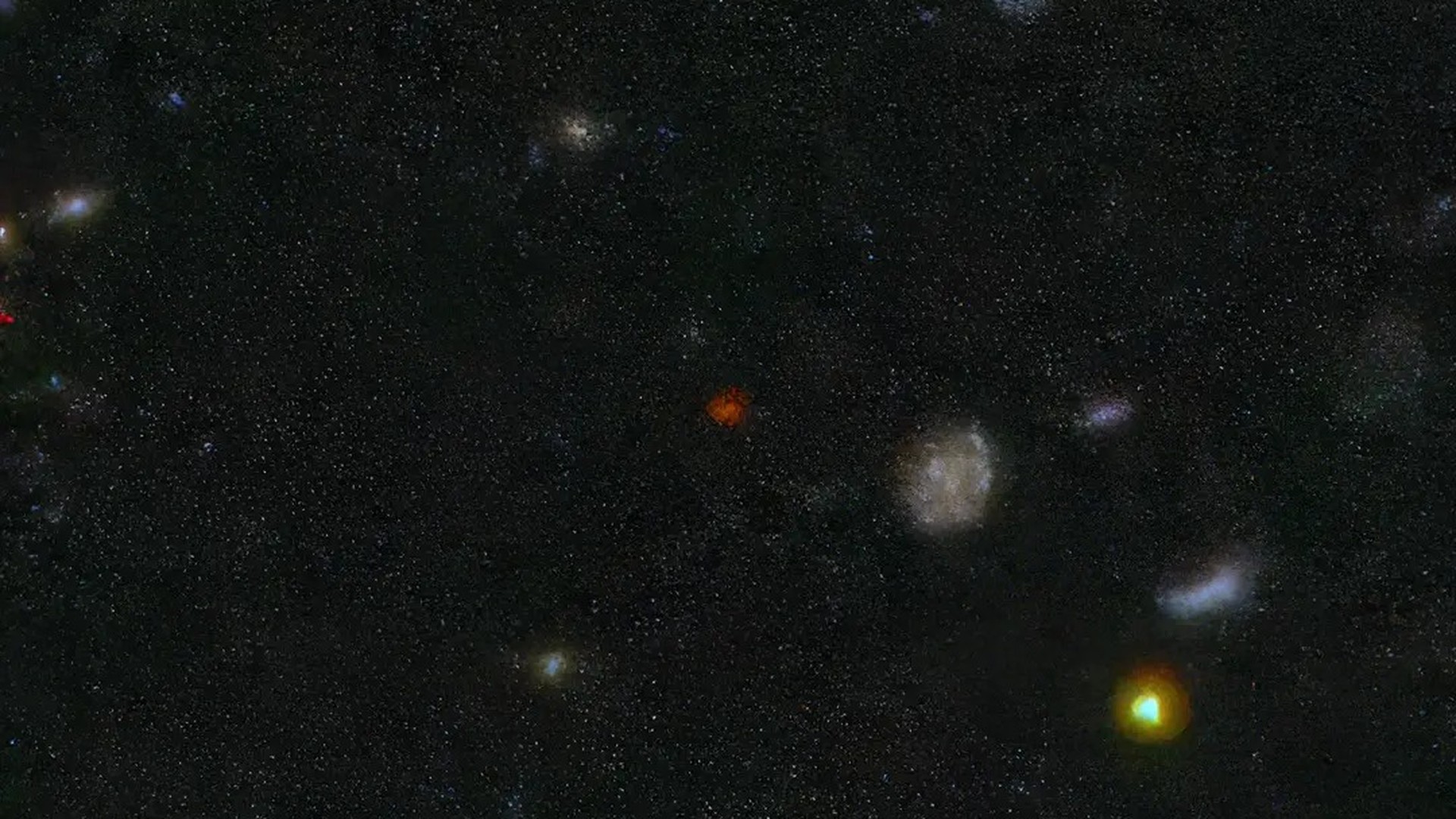
“This time the leap in cosmic time is huge!” said Julien Wolf, a postdoctoral researcher at the Max Planck Institute for Astronomy who led the discovery.
The European Space Agency announced on November 24 that its Euclid space telescope has identified the most distant quasar ever confirmed, an object whose light left it just 630 million years after the Big Bang. Nicknamed Dún Aonghasa after a prehistoric stone fort on Ireland’s Aran Islands, the quasar J1504+6252 sits at a redshift of z = 8.13, pushing the observational frontier back by roughly 40 million years.
Multiple observatories confirmed the record quasar
Euclid’s wide-field infrared survey spotted the candidate among millions of objects during its first 18 months of operations. Follow-up observations from the W.M. Keck Observatory and the Hubble Space Telescope narrowed its distance before the Large Binocular Telescope and the James Webb Space Telescope delivered the definitive spectroscopic confirmation.
Webb’s NIRSpec instrument measured hydrogen and magnesium emission lines at widths of 3,160 and 3,740 kilometres per second, yielding a black hole mass of about 360 million solar masses.
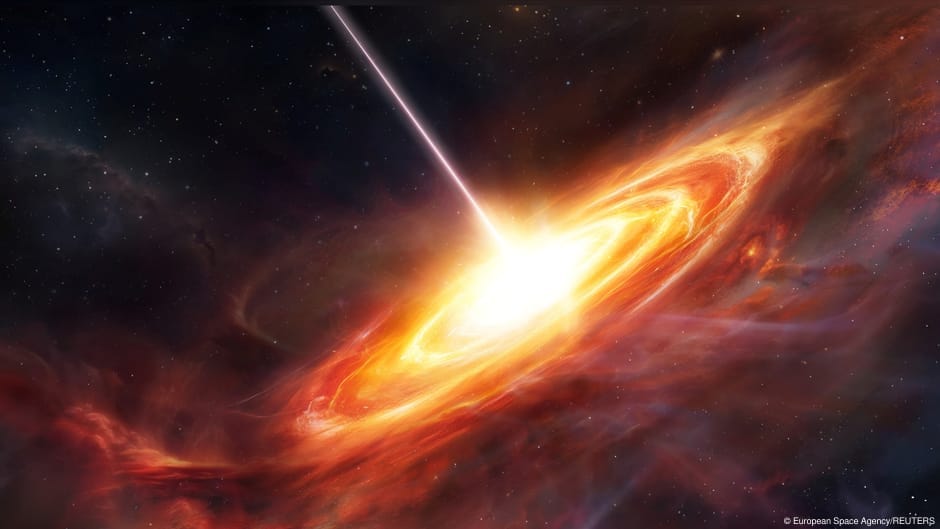
The discovery appears in Astronomy & Astrophysics, published November 24, 2026, with Wolf and Silvia Belladitta of the Max Planck Institute for Astronomy as lead authors.
Black hole mass challenges formation theories
A black hole of several hundred million solar masses existing when the universe was only 5% of its current age tightens the screws on formation models. Standard growth is limited by the Eddington limit, where radiation pressure from infalling gas halts further accretion. Yet Dún Aonghasa is feeding well below that limit today.
“The closer to the Big Bang we find them, the faster their black holes must have grown or the more massive they must have been at birth — or both.” Wolf said. That leaves two main paths: an early phase of super-Eddington accretion, or a massive seed from the direct collapse of a primordial gas cloud.
Direct collapse versus primordial seeds
The team’s modelling shows the direct collapse scenario — where a massive gas cloud skips star formation and collapses straight into a black hole — remains consistent with Dún Aonghasa’s properties, provided the seed formed early and grew rapidly at first. But if future discoveries push the quasar frontier even closer to the Big Bang, within a few hundred million years, even direct collapse may fall short.
In that case, astronomers would have to weigh a more exotic alternative: primordial black holes formed in the first instants after the Big Bang, acting as massive gravitational seeds. “Finding quasars at ever-increasing distances, at the edge of the observable universe, teaches us something about how the black holes in their centres grew.” Wolf said.

ESA and AP detail Wolf reaction and nickname origin
Astronomers needed more than ten years to locate the first ten or so quasars at redshift 7 or above, yet Euclid has uncovered more than that number in just one year, ESA noted.
With his wife and daughter being Irish, Wolf was deeply moved during their visit to the fort, according to the Irish Star. He described it as a boundary representing the promise of a vast horizon still to explore, much like this quasar, and said Dun Aonghasa gives us a new deadline for the early universe.
IFLScience and openaccessgovernment report on coordinated observatory campaign and Belladitta remarks
A coordinated campaign across premier space- and ground-based observatories was required to identify Dún Aonghasa, the first confirmed quasar beyond redshift 8.
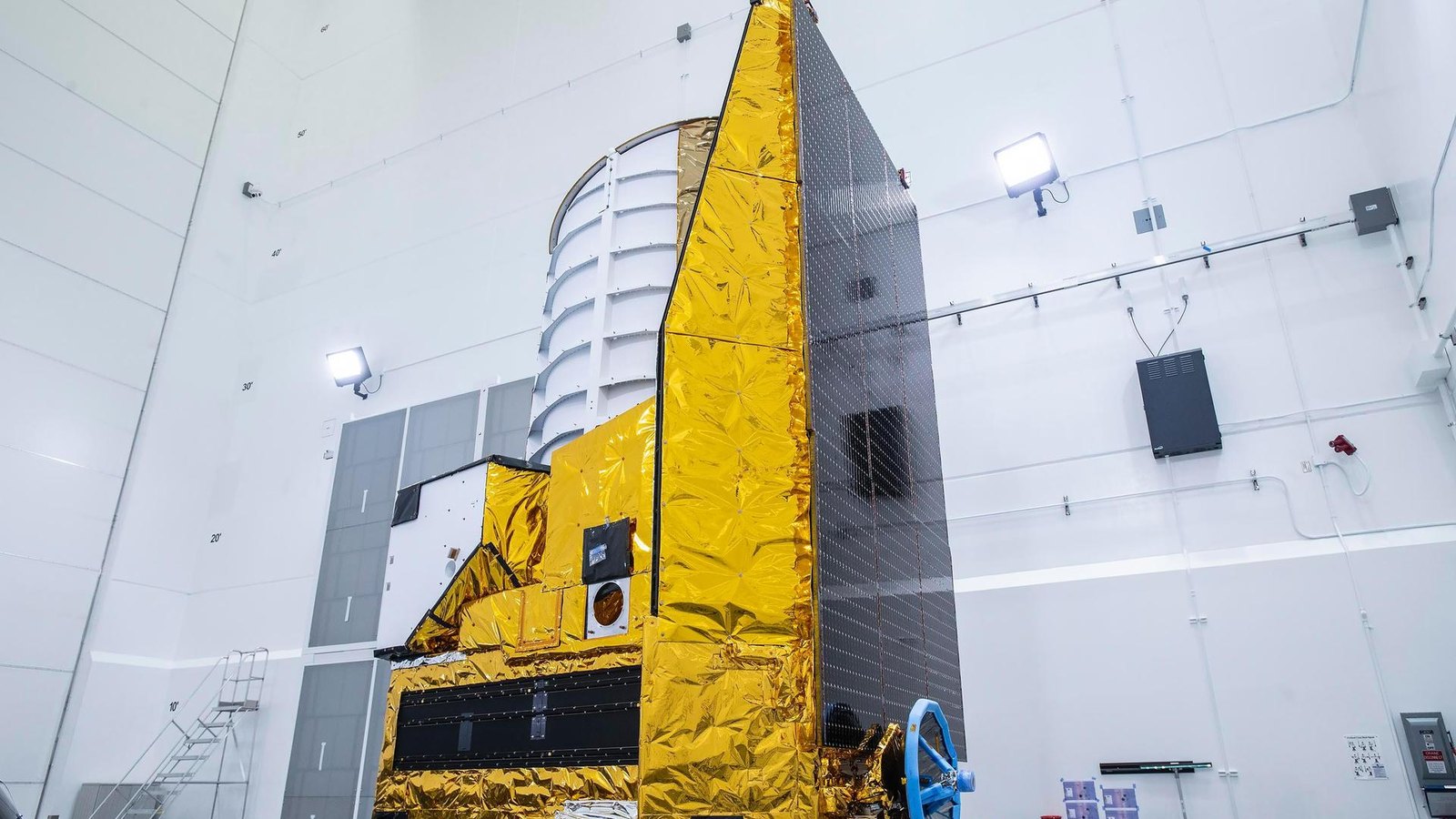
Belladitta told IFLScience that quasars are really the only tools we have to study the universe from now to the past. She said the discovery shows how quickly Euclid is expanding the census of the most distant quasars, and that future observations and discoveries of perhaps even more distant quasars will fully resolve the puzzle of how they formed.
Euclid’s early harvest and what comes next
Euclid has already flagged 31 quasars in its first 1.5 years, 12 of them beyond redshift 7. The previous record holder, at z = 7.77, was also a Euclid find announced only months earlier. ESA expects at most a few tens of quasars beyond redshift 8 in the full survey.
Webb follow-up of each new candidate will reveal whether Dún Aonghasa is a lone outlier or the first of a hidden population of heavy, slow-feeding black holes at the dawn of cosmic history. Wolf cautioned the record “could fall again in a few months or it could stand for years.”
Keep reading

Simulations Suggest Earth-Mass Planet Beyond Neptune, Study Finds
New simulations point to an Earth-mass planet orbiting hundreds of times farther from the Sun than our world,...
NSF NOIRLab Releases 570-Megapixel View of Supernova Remnant SNR G295.5+09.7
NSF NOIRLab released the most detailed view yet of supernova remnant SNR G295.5+09.7 on Monday captured by the...
Chalmers Team Finds Magnetic Loop Drives Star’s Stellar Wind
That changes a fundamental part of the origin story of the atoms we ourselves are made of, said...
NASA Webb Maps Cas A Dust, Finds Shells Merged Hours Before Blast
NASA's James Webb Space Telescope has mapped the dust inside Cassiopeia A and found evidence that the star's...