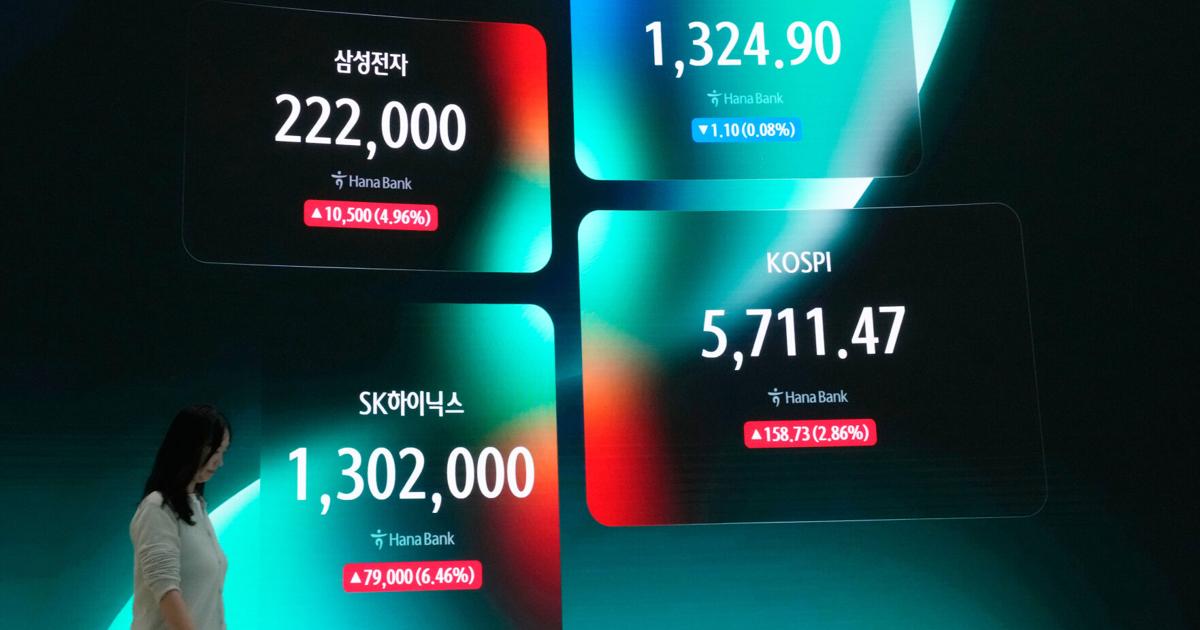
Global stock markets climbed on Wednesday as strong corporate earnings countered French 10-year bond yields hitting 5% for the first time since 2002 and Middle East supply worries pushing crude oil higher.
The S&P 500 rose 0.58% to 7,757.17, moving within 0.8% of its all-time high set earlier in the month, according to market data compiled by Reuters. Major stock indexes advanced as early profit reports relieved investors who had grown jittery over the past week’s tech sell-off. The Dow Jones Industrial Average added 360.21 points, or 0.69%, to close at 52,856.09, while the Nasdaq Composite gained 1.05% to finish at 26,702.86.
SpaceX Boosts Technology Sector Profits
SpaceX reported its first quarterly profit as a public company following a net profit of $4.4 billion for July through September, exceeding expectations as deals to rent computing power to artificial intelligence firms sent revenue soaring, according to Bloomberg reporting. Enthusiasm across the technology sector was sparked by these stronger-than-expected financial results.
Elon Musk stated on Tuesday that a merger of Tesla and SpaceX would be a good idea
and that they had formed special committees to explore the possibility. Tesla shares rose 3.4% during regular trading and gained further ground in after-hours trading after reporting a surprise positive cash flow for the third quarter. Other hardware and server makers also rallied on AI demand. Investor morale was additionally boosted by Super Micro Computer reporting preliminary quarterly financial results that exceeded expectations, alongside Unity Software announcing that its fourth-quarter revenue climbed 35% from the previous year to $609 million—surpassing the anticipated $562.71 million—while also posting a quarterly loss of 66 cents per share.
Clear earnings beats and constructive corporate updates are helping to ease some of the AI anxiety that has surfaced in recent sessions.
Tim Waterer, KCM Trade
French Bond Yields Hit 24-Year High
France’s 10-year government bond yield hit 5% for the first time since 2002, driven by growing concern over the country’s fiscal outlook and violent protests surrounding government plans. European debt markets faced severe pressure while equity markets found relief in corporate balance sheets. The premium on French yields over benchmark 10-year German Bunds widened toward early October’s 15-year high of nearly 160 basis points, while French 10-year government bond yields rose 2.7 basis points to 4.94% in related trading sessions.
Prime Minister Sébastien Lecornu announced that authorities would deploy a significant contingent of extra security forces to keep Saturday’s scheduled rallies under control, whereas President Emmanuel Macron pledged to stop any recurrence of violence during upcoming protests and brushed off foreign leaders’ remarks concerning the internal turmoil as stupid
and unacceptable
. Despite the fiscal strain, Mark Haefele, chief investment officer at UBS Global Wealth Management, maintained an attractive rating on euro zone equities, arguing that the unrest should not detract from a resilient regional economy and strengthening European earnings cycle.

Asian Markets Trade Mixed on Supply Pressures
South Korea’s Kospi jumped 3.3% to 4.15% in one of the region’s largest moves, powered by a recovery in artificial infrastructure firms like Elice Group, which surged almost 30% to rebound from a slump in its market debut. Asian equities traded mixed on Wednesday following the Wall Street momentum. Japan’s Nikkei 225 gained 1.17% to 1.3%, with government data showing Japan’s exports in September rose 16.7% from a year earlier, missing estimates. Hong Kong’s Hang Seng added 0.17%, the Shenzhen Composite increased by 0.42%, and the Shanghai Composite decreased by 0.08%, while Australia’s S&P/ASX 200 dropped by 0.16%. In contrast, Chinese battery giant CATL dropped 10% in Hong Kong after reporting third-quarter profit growth that fell short of analyst estimates, and data center developer NEXTDC sank more than 40% in Sydney after slashing its outlook.
The UKMTO maritime agency reported that a tanker sailing off the north coast of Qatar had been struck by multiple projectiles
, causing an unspecified number of casualties around 500 kilometres away. Crude oil prices climbed more than 1% in commodity markets. Brent crude rose to settle at $108.82 a barrel, while West Texas Intermediate settled at $97.15 a barrel.
How security forces will control Saturday’s scheduled rallies and what casualties resulted from the tanker strike off the north coast of Qatar remain unknown.
Abbott Cuts 2026 Sales View, Plans Spin-Off by 2027
Abbott Laboratories lowered its full-year 2026 sales growth forecast on Wednesday and announced plans to spin off its...

CNBC Daily Open: Tech investors buy the dip – but debt remains a concern
Following a bruising weekly rout, the tech-heavy Nasdaq Composite rose 1.11% on Monday as investors returned to artificial...

Banque du Caire to Raise Up to $454 Million in Egyptian IPO
Banque du Caire is preparing to raise up to 24.25 billion Egyptian pounds, equivalent to $454 million, through...