
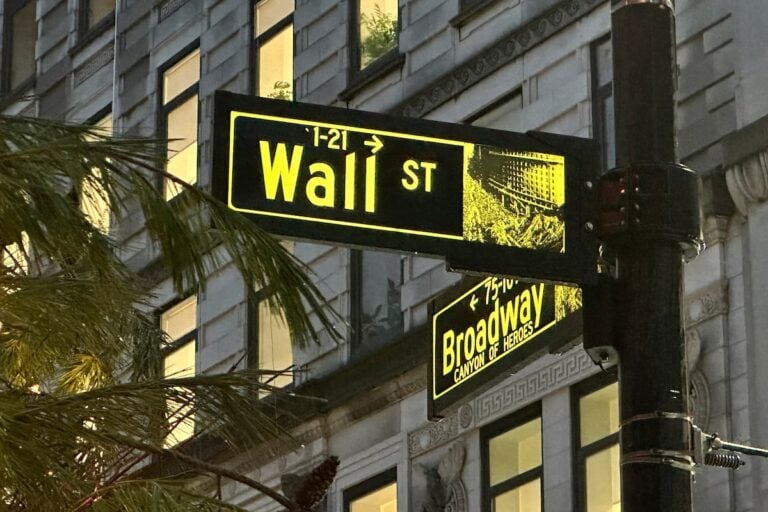
Following a bruising weekly rout, the tech-heavy Nasdaq Composite rose 1.11% on Monday as investors returned to artificial intelligence and semiconductor stocks. Wall Street navigated fluctuating energy markets and ongoing debt concerns ahead of a heavy wave of corporate earnings reports.
Semiconductor Stocks Snap Eight-Day Losing Streak
Technology shares found a footing on Monday after enduring their steepest weekly pullback since late June. The Philadelphia Semiconductor Index closed up 1.6%, breaking a punishing eight-day slide that erased about 15.7% of its value and marked its longest descent since October 2008.
Market participants stepped back into the sector as sentiment shifted following the weekend. Rosenblatt Securities managing director Michael James pointed to extreme pessimism as the primary catalyst for the rebound.
Rubber bands can only stretch so far in one direction before they snap and start reversing, and you finally saw that enough-is-enough moment in the semiconductors after Friday’s close.
Debt Pressures and Neocloud Credit Stress
Despite the broader market recovery, funding anxieties continued to shadow capital-intensive operators. Neocloud provider CoreWeave sat at the center of last week’s turbulence after its shares plunged more than 25% amid mounting unease over a $50 billion debt load. CoreWeave shares dipped 0.4% on Monday, giving up initial gains that followed a rating upgrade to buy from Goldman Sachs.
Credit stress extended beyond neocloud firms to enterprise technology giants. Oracle faced mounting pressure as it risked a credit rating downgrade that could push its debt into junk territory. Its rating at S&P Credit Ratings stands at BBB-, representing the lowest rung of the investment-grade spectrum. The shifting sentiment showed clearly in the cost of insuring against default: Oracle’s five-year credit default swap spread reached 295 basis points after briefly touching 300 basis points last Thursday, surging 287% over the course of a year. Gavan Nolan, executive director of fixed income pricing at S&P Global Market Intelligence, noted that the trading range aligns more closely with high-yield BB and B credit.
Corporate Earnings and Market Movers on Wall Street
Monday’s session brought uneven gains across major indexes. The Dow Jones Industrial Average slipped 36.38 points, or 0.07%, to close at 51,966.03. The S&P 500 added 31.29 points, or 0.41%, to finish at 7,690.73, while the Nasdaq Composite climbed 290.85 points, or 1.11%, to settle at 26,430.89. Energy markets trimmed earlier gains after US crude oil futures reversed losses to settle up 2.2% at $103.66 a barrel, driven by attacks in Yemen and Saudi Arabia.

- Amazon climbed 5% after Morgan Stanley designated the e-commerce and cloud computing firm its top pick.
- Tesla advanced 3.8%, providing the consumer discretionary sector with its second-biggest index point boost.
- Intel shares rallied 2.4% following an upgrade by J.P. Morgan analysts from underweight to neutral.
- Cleveland-Cliffs shares surged 16% after the steelmaker beat analysts’ projections for its third-quarter profit.
Looking ahead, Wall Street is bracing for a packed slate of corporate results. Meta Platforms, Tesla, and SpaceX are all scheduled to report financial figures in the coming days, alongside upcoming reports from Netflix.
>
Keep reading

Banque du Caire to Raise Up to $454 Million in Egyptian IPO
Banque du Caire is preparing to raise up to 24.25 billion Egyptian pounds, equivalent to $454 million, through...

Tanzania’s finance minister thanked the World Bank on October 12, 2026, for supporting 33 strategic
Tanzania’s finance minister thanked the World Bank on October 12, 2026, for supporting 33 strategic projects valued at...

Tesla Unveils New Roadster with SpaceX Thrusters, Set for 2028
Tesla unveiled a radically redesigned Roadster at its McGregor, Texas facility, featuring SpaceX cold-gas thrusters and an underbody...