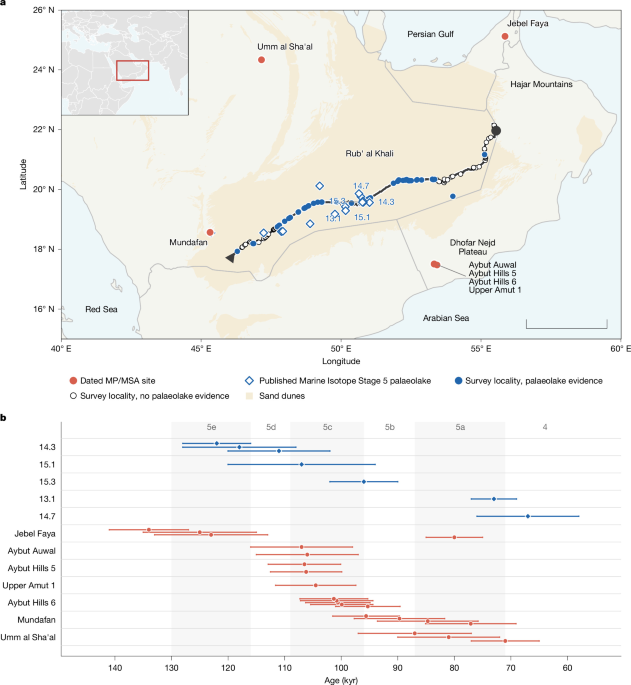
Early human settlement of the desert was governed by stone and water. Research indicates that Homo sapiens moved through “climatic windows”—humid periods that affected the Nefud and Rub’al Khali deserts—while their movements were linked to the availability of water and lithic resources.
Humid Periods Created Habitable Corridors for Human Dispersal
The dispersal of early humans into Arabia was facilitated by pluvial periods that transformed arid regions into habitable corridors. These humid intervals created “windows of opportunity” for modern human dispersal, particularly in southern Arabia and the Nafud desert. Evidence from palaeolake deposits confirms that these wet phases allowed populations to penetrate deep into regions that are currently desert.
Stone Tool Production Shaped Early Settlement Patterns
Human occupation was closely tied to the presence of stone for tool production. Archaeological findings include the Nubian Complex in Dhofar, Oman, which represents an African Middle Stone Age industry. Other Middle Palaeolithic occupations have been identified in central Saudi Arabia during MIS 5 and MIS 7, as well as at Jebel Faya in the United Arab Emirates. These sites demonstrate that early humans utilized specific lithic reduction strategies to survive and migrate across the peninsula.
Water Sources in the Desert
Water availability was a primary driver of settlement, with early humans clustering around palaeolakes. The Mundafan Al-Buhayrah in Saudi Arabia provides evidence of human occupation during MIS 5, showing how these ancient lake systems supported populations in the Arabian empty quarter. Remote sensing and GIS techniques have been used to reconstruct this palaeohydrology and identify the archaeological sites associated with these water sources.

While these patterns establish how climate and stone governed migration, it remains to be determined the full extent of failed expansions, such as a potential human expansion out of Africa 100,000 years ago.

UN Report Accuses Israel of Continued Genocide in Gaza and Crimes Against Humanity
A United Nations commission of inquiry has accused Israel of continuing to commit genocide in Gaza and crimes...

PNG man Luka Rahan rescued in Kiribati after 41 days adrift at sea
Luka Rahan, an 18-year-old Papua New Guinean man, was rescued by Kiribati fishermen on Tuesday afternoon after spending...

Nintendo Reveals 23 Indie Games for Switch and Switch 2
Nintendo revealed 23 independent titles for the Switch and Switch 2 during its Indie World Showcase on October...

Sudan Food Crisis: Soaring Prices and Inflation Push Khartoum Families to the Brink
Sudanese families in Khartoum are facing a catastrophic collapse of purchasing power as the Sudanese pound plummets and...