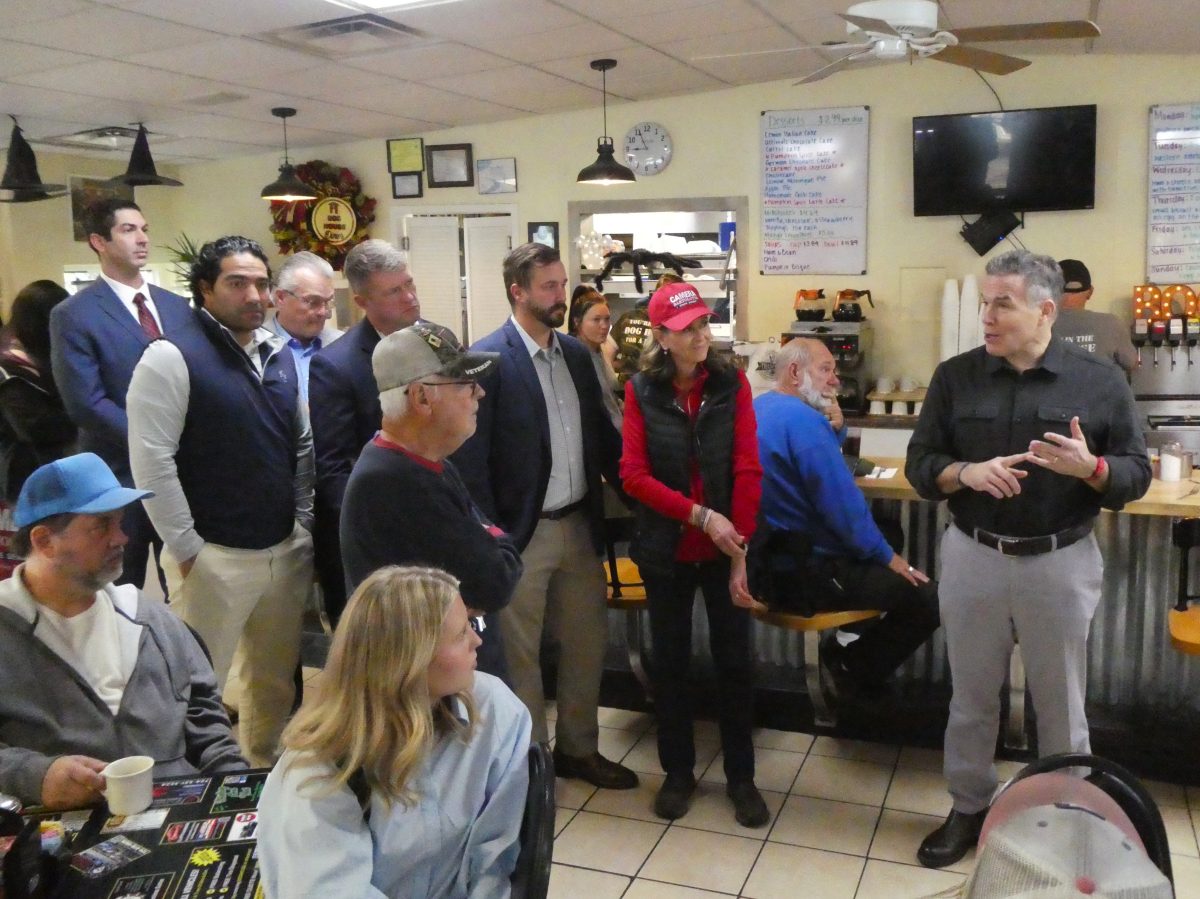
Local Republican lawmakers in Southwestern Pennsylvania are preparing for a new political environment in Harrisburg as Democrats claim their first state Senate majority since 1993.
Pennsylvania Democrats rode the nationwide blue wave in November, securing a governing trifecta that gives Democratic Gov. Josh Shapiro room to pursue an ambitious legislative agenda including housing reform and a minimum wage hike. While the southwest region largely preserved its deep-red legislative delegation, incoming and returning lawmakers now face the daily legislative realities of operating in the minority.
State Sen. Camera Bartolotta secured reelection to her 46th District seat after defeating independent environmental activist Jodi Borello. Her campaign team worked extensively to maintain ground in a shifting electoral map.
“My team worked their tails off to make that happen.”
Bartolotta said that she has relied on bipartisan cooperation to pass several bills over nearly 12 years in the state Senate. That collaborative approach will face steeper procedural hurdles starting in January.

“It’s going to be a little more challenging to get bills put up in committee now.”
Bartolotta warned that an immediate push by Shapiro to raise the minimum wage to $15 or more per hour could threaten small businesses across Southwestern Pennsylvania. She argued that implementing such a mandate without a gradual phase-in would harm local business and restaurant owners, pointing to her 2016 vote for a phased wage increase as proof of her willingness to negotiate.
Beyond wage policy, Bartolotta plans to defend regional energy infrastructure and reintroduce legislation aimed at licensing more nurse practitioners to ease critical shortages of essential healthcare workers. She emphasized that constituents want lawmakers to concentrate on practical economic relief rather than partisan social battles.
State Rep. Jason Ortitay acknowledged that minority status makes passing legislation more difficult, but noted it remains achievable through established relationships across the aisle. His legislative record includes Act No. 55 of 2022 and Act No. 47 of 2025, which reformed state-level literacy education oversight and provided targeted grant funds to improve student reading scores.
“My name may not always be on the front of a bill, and that’s fine with me. I care about getting results for the district, not about who gets the credit.”
Ortitay maintained that local concerns such as school quality, road safety, and household costs transcend party lines. Incoming state Rep. Ben Humble similarly emphasized pragmatic local governance after defeating Democratic candidate Lois Bower-Bjornson to hold the 50th House District seat for Republicans.
Humble prioritized supporting local first responders, noting that many local fire departments face declining funding and diminishing attention from the state capital in recent years. He suggested adopting tax incentives similar to West Virginia’s programs to increase emergency volunteer retention.
“My goal is to work with both sides for the betterment of the people. It’s not Washington, D.C.; it’s a small town municipal government here, and we have to work together.”
Related reading
Trial Examines Wyoming Boys’ School Culture of Total Control
A culture of total control—that is how a Massachusetts psychiatrist described the environment at the Wyoming Boys’ School...

Justin Herbert and Madison Beer’s Relationship and Engagement
Justin Herbert and his fiancée, Madison Beer, have moved from the sidelines of NFL games to the center...

Bengals vs. Commanders Predictions and Odds for NFL Week 11
The Cincinnati Bengals head to Northwest Stadium on Monday, Nov. 23, with a clear objective: proving their current...

West Virginia State Auditor, Office Employees Indicted in Theft, Fraud Investigation – WCHS
West Virginia State Auditor Mark Hunt and four of his office employees are facing federal charges following a...