Trump Foreign Policy Shifts Spark Sharp Backlash From McFaul
In a biting assessment published on michaelmcfaul.substack.com, Michael McFaul argues that recent foreign policy maneuvers regarding Russia and Ukraine constitute a tragic and strategically destructive capitulation to Vladimir Putin. Writing about October, McFaul points to a series of troubling developments, including negotiations over sanctioned Russian oil assets and diesel, as proof of a dangerous alignment away from democratic allies.
The core of McFaul’s critique centers on economic and diplomatic concessions made to Moscow while the war in Ukraine grinds forward. According to reporting highlighted in his essay, Trump’s team has engaged in talks concerning a multibillion-dollar deal involving sanctioned assets of the Russian oil giant Lukoil. Potential buyers in these discussions reportedly include investors close to Trump’s family and advisers, with separate talks touching on American stakes in the Nord Stream pipelines. McFaul notes the striking contradiction of pursuing business opportunities with Russian entities while Russian forces continue their attacks in Ukraine.
Further straining transatlantic ties, the Trump administration chose to ease sanctions on Russian diesel, a move that could route billions in additional revenue toward funding the Kremlin’s war effort. When Ukrainian President Volodymyr Zelenskyy criticized the policy, Trump publicly suggested it was time for Ukraine to secure a new president—language that closely mirrors official Kremlin talking points. These shifts coincided with the administration waiving additional sanctions against Russia that had been signed into law just weeks prior, alongside ongoing restrictions on satellite communications vital to Ukraine’s battlefield defense.
Democratic Breakthroughs Abroad Provide a Counterbalance
While U.S. policy toward Eastern Europe faces severe friction, McFaul highlights encouraging democratic counterweights emerging internationally. Last weekend brought major electoral and political shifts across Serbia, Brazil, and Venezuela.
In Serbia, a student-led opposition movement secured a historic electoral victory against the increasingly autocratic Aleksandar Vučić and his governing party. Meanwhile, voters in Brazil firmly rejected a return to the Bolsonaro family’s brand of politics. In Venezuela, opposition leader María Corina Machado returned home following nearly a year in exile, reinvigorating domestic hopes for a transition back to democratic governance. McFaul acknowledges that significant governing challenges remain in all three nations and that he does not endorse every policy position held by figures like Lula, Machado, or the Serbian student leaders. Instead, he emphasizes that democracy functions by granting citizens the fundamental power to choose and replace their leadership through the ballot box.
Book Tour Milestones and Media Outreach
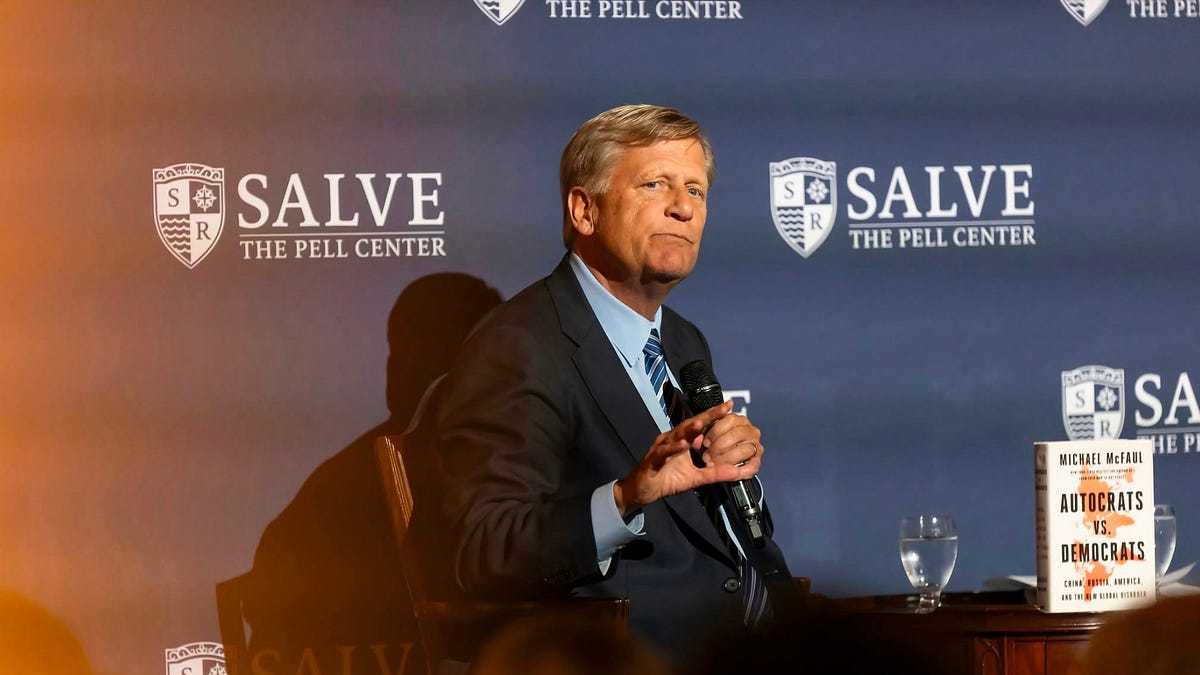
The publication of McFaul’s book, Autocrats vs. Democrats, reached its one-year anniversary this October. The milestone coincided with an intensive speaking schedule that took him to Salve Regina University in Rhode Island, Cornell University in New York City, two talks in New York City, and one talk in Portola Valley, California. Across fifty talks spanning seventeen states, audience inquiries have routinely focused on why Trump likes Putin so much and the geopolitical future of the Korean Peninsula.
The East Coast leg of the tour also allowed McFaul to make in-person appearances at the MS NOW studios. Following the split between MS NOW and NBC News—where McFaul spent twelve years contributing since 2014—he appeared on programs hosted by Alicia Menendez, Katy Tur, and Nicolle Wallace, alongside a guest spot on Morning Joe, to analyze shifting U.S. foreign policy and international election outcomes.
With midterm elections approaching in the United States, McFaul concludes his commentary by tying international democracy promotion directly to domestic civic participation, urging every eligible American to vote.
Worth a look

Utah Beats Cincinnati 49-25 to Reach 8-0 Record
Utah opens fast and cruises past Cincinnati to reach 8-0 Morgan Scalley had Utah ready to play from...

Vermont Consolidated Federal Programs Grant Reporting and Data
Vermont education officials are navigating a complex landscape of federal funding disclosures and compliance requirements under the Consolidated...

Austin Reaves calls his play terrible in Lakers loss to Warriors
Austin Reaves drained two free throws to open the second quarter on Friday night at Chase Center, pushing...

ABC Greater Tennessee reports 2.2% construction input price hike
Tennessee Contractors Face Margin Squeeze After Sharp September Input Price Surge When construction input prices jump by more...