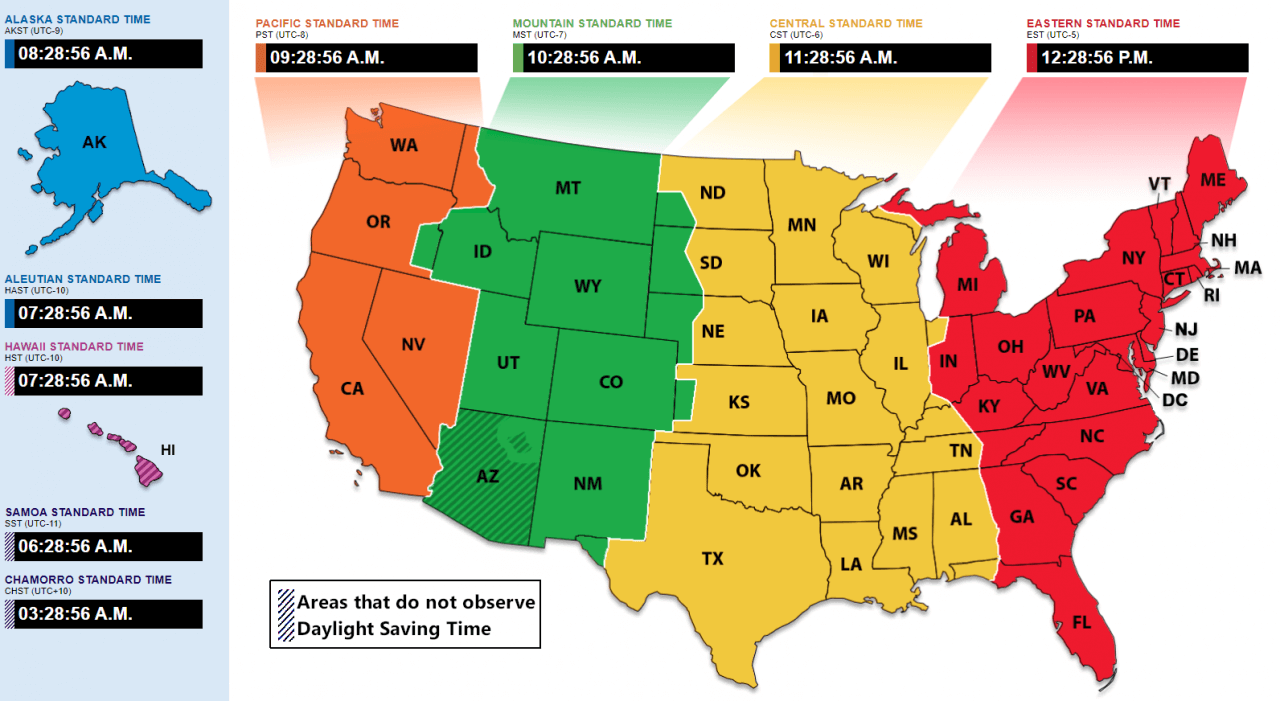
The time difference between New York and California is a fixed three-hour gap, with New York operating in the Eastern Time Zone (ET) and California in the Pacific Time Zone (PT). This separation dictates the rhythm of daily life, business coordination, and media broadcasting across the United States.
The Mechanics of the Clock
The three-hour divide is a direct result of the longitudinal distance between the two coasts. New York is located within the Eastern Time Zone, observing Coordinated Universal Time minus five hours (UTC-5) during Standard Time and UTC-4 during Daylight Saving Time.
California occupies the Pacific Time Zone, defined as UTC-8 during Standard Time and UTC-7 during Daylight Saving Time.
Because both regions observe Daylight Saving Time, this creates a fixed three-hour difference, with New York always ahead.
Synchronizing the Business Day
For companies spanning both coasts, this geography of time is an operational reality. Managing the gap requires intentionality, particularly when coordinating real-time collaboration or project deadlines.
“In our global economy, the coasts are the engines, and the time difference is simply the geography of opportunity. We have to be intentional about when we connect.”
This insight, shared by a senior executive at a Fortune 500 tech company, highlights the logistical friction often felt in the boardroom. To optimize meetings, professionals in California should aim to schedule calls between 9:00 AM and 2:00 PM local time. This window aligns with 12:00 PM to 5:00 PM in New York, capturing the most productive overlap of the standard workday.
This geographic expanse, known as California, covers 163,696 square miles and serves as the most populous state in the nation. Its vast territory, which was ceded to the United States in 1848 and admitted as the 31st state in 1850, is home to a diverse landscape ranging from metropolitan centers to the Sierra Nevada mountains.
Beyond its size, the state functions as the largest sub-national economy in the world. It plays a critical role in global commerce, hosting the busiest port in the country, which manages approximately 40% of all goods imported into the United States.
| California Time | New York Time |
|---|---|
| 9:00 AM | 12:00 PM |
| 10:00 AM | 1:00 PM |
| 11:00 AM | 2:00 PM |
| 12:00 PM | 3:00 PM |
| 1:00 PM | 4:00 PM |
| 2:00 PM | 5:00 PM |
Media Schedules and Personal Lives Rely on Clock Coordination
The impact of this gap extends well beyond corporate conference rooms. The media industry relies on the clock to dictate the flow of information. National news programs recorded in New York during the afternoon are timed for West Coast broadcast, ensuring the latest news is available to all viewers at a reasonable hour. A baseball game starting at 7:05 PM Eastern often requires West Coast viewers to adjust their late-afternoon plans to catch the first pitch at 4:05 PM.
Personal communication faces similar constraints. Families separated by the country often struggle with the “social jet lag” that occurs when one person is wrapping up their evening while the other is just beginning their day.
On-demand streaming has introduced new layers of complexity by obscuring traditional boundaries, yet live broadcasts and scheduled content remain strictly tied to the clock. Whether it is a parent connecting with a child across the country or a global firm managing manufacturing plants, the clock serves as the primary arbiter of coordination.
The time gap between New York and California is a persistent, mathematical element in the structure of contemporary life, affecting everything from international commerce and broadcast studios to private living rooms.
Tennessee Fans Throw Golf Balls, Trash Onto Field Late in 4th Quarter
Tennessee fans threw golf balls, mustard bottles, and trash onto the field at Neyland Stadium on Nov. 21,...

Mamdani Announces Disbanding NYPD Strategic Response Group on Nov 16
New York City Mayor Zohran Mamdani announced on November 16 that he is disbanding the NYPD’s Strategic Response...

University of Kentucky Opens New $27M Environmental Quality Management Center
The University of Kentucky opened its new $27 million Environmental Quality Management Center (EQMC) on Nov. 17, 2026,...

Bill Sniffin Reflects on Gratitude of Residents in Small Wyoming Towns
In a recent column for Cowboy State Daily, Bill Sniffin reflects on the evolution of his perspective regarding...