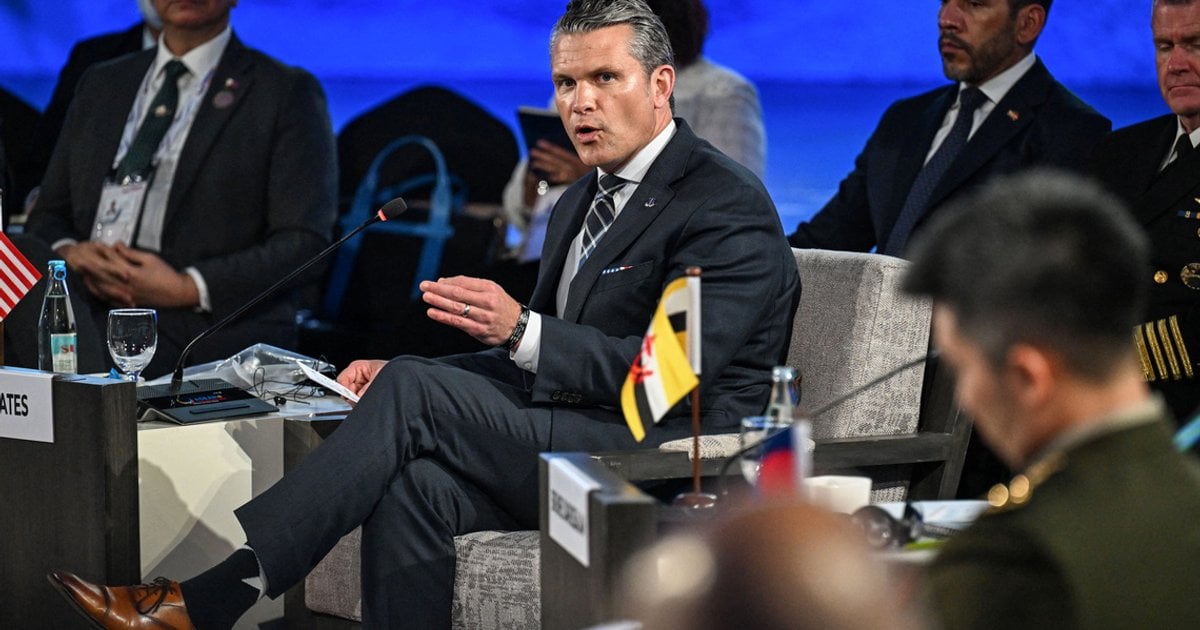
US Defense Secretary Pete Hegseth sought to reassure Southeast Asian counterparts in Cebu on October 28 of Washington’s commitment to the Indo-Pacific, pledging practical defense cooperation and stronger maritime ties amid regional tensions and military strains from the Iran war.
US Defense Secretary Pete Hegseth arrived in Cebu, Philippines, for the two-day ASEAN defence ministers and related meetings to solidify regional alliances. Governments across Southeast Asia have weighed Washington’s capacity to maintain its focus on the Asia-Pacific as the Iran war strains military resources and creates domestic political pressure.
Speaking to regional counterparts, Hegseth outlined a security posture defined by three distinct qualities, characterizing the American strategy as strong, quiet and clear
.
We will defend our interests and the interests of our allies and partners. That is, by definition, peace through strength.
Pete Hegseth, US Defense Secretary
Practical Defense Cooperation and the US-ASEAN Framework
To back up Washington’s commitments, Hegseth pledged tangible collaboration centered on stronger maritime domain awareness, greater interoperability, and enhanced naval cooperation. He proposed the development of a US-ASEAN framework for defence cooperation designed to guide bilateral ties through the coming years as both sides prepare to mark half a century of formal relations.
US Defense Secretary Pete Hegseth says Pentagon is ready to work with Southeast Asian partners based on their individual needs and shared security goals. pic.twitter.com/q0NoW2s1aM
These are not symbolic things. They are concrete demonstrations of what serious partners do. Serious partners train together, learn together, plan together and build confidence and competence necessary to prevent conflict.
Pete Hegseth, US Defense Secretary
Security scholars note that these diplomatic overtures unfold against a backdrop of complex regional friction. The Iran conflict, initiated by US and Israeli strikes on February 28, has disrupted global shipping lanes and oil markets. This instability leaves Southeast Asian economies particularly vulnerable to imported-fuel shocks, thrusting energy security to the forefront of the ASEAN agenda.
Territorial Friction in the South China Sea and Manila’s Balancing Act
Regional tensions are further compounded by territorial disputes in the South China Sea. China claims nearly the entire waterway, running counter to overlapping claims maintained by Brunei, Malaysia, the Philippines, Taiwan, and Vietnam. Relations between Manila and Beijing have soured following repeated confrontations near disputed features like the Scarborough Shoal and the Spratly Islands, alongside Chinese sanctions and the summoning of the Chinese ambassador.

Tensions escalated sharply ahead of the summit. The US Naval Institute reported at least eight close encounters in the region and the Luzon Strait. Prior to the gathering, the Philippine armed forces kept watch on and trailed the Chinese Liaoning aircraft carrier group as it navigated past waters near the southern Philippines towards the Celebes Sea.
Drawing attention to the delicate diplomatic situation confronting the host nation, Greg Poling, director of the Asia Maritime Transparency Initiative, pointed out that the Philippines has faced a tricky balancing act throughout its entire tenure as ASEAN chair, adding that he anticipates tactical collaboration on ADMM workstreams rather than any strategic consensus regarding the South China Sea or other contentious topics.
Expanded Multilateral Talks and the ADMM-Plus Agenda
While bilateral sideline discussions target specific regional anxieties, broader multilateral engagements continue. Defense chiefs from the Squad — an informal security grouping comprising the United States, Japan, Australia, and the Philippines — scheduled meetings on October 28.

Hegseth’s itinerary also includes the expanded ADMM-Plus gathering on October 29. That session brings together all 11 members of ASEAN alongside eight dialogue partners: Australia, China, India, Japan, New Zealand, Russia, and South Korea. China’s defense ministry confirmed that its defense attaché in the Philippines would attend, while leaving open the possibility of a last-minute appearance by Chinese Defense Minister Dong Jun.
Despite robust closed-door debates over regional security, analysts expect the eventual formal output to reflect traditional diplomatic caution. Koh noted that the chairman’s statement will likely remain restrained, relying on familiar ASEAN language rather than breaking new strategic ground on the contested waterway.
Keep reading
Uganda Embassy Confirms 14 Nationals Killed in Russian Military Service
Uganda’s Embassy in Moscow has confirmed that 11 Ugandan nationals recruited into the Russian military have been killed...

Human Rights Watch Criticizes South Korea’s Restrictive Abortion Limits
South Korea plans to introduce medication abortion in 2027 following years of unregulated access since its abortion ban...

Mnangagwa Urges Zimbabwean Students to Return Home
President Mnangagwa urged Zimbabwean students studying in the Russian Federation to return home upon completing their degrees to...

Kenya: UN Board Rejects Plan to Phase Out UNAIDS, Opts for Reforms
The UNAIDS Programme Coordinating Board unanimously rejected a proposal to phase out the Joint United Nations Programme on...