
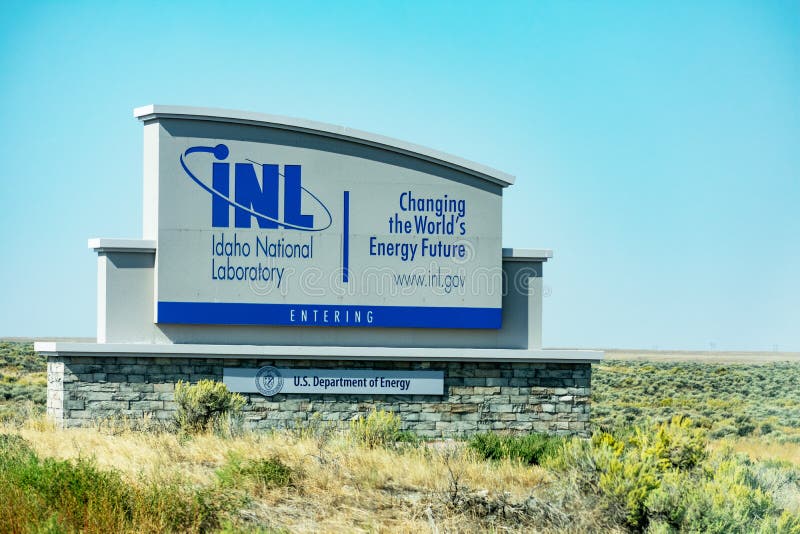
The federal government has sued the state of Idaho in U.S. District Court, seeking to block state officials from curtailing water use at the Idaho National Laboratory and from administering federal water rights, court records indicate.
Filed on Sept. 11 against the state, the Idaho Department of Water Resources, and Idaho Department of Water Resources Director Mathew Weaver, the lawsuit asks the court to throw out a water curtailment order that applies to the Idaho National Laboratory. At the core of the legal dispute is whether federal installations are shielded by the supremacy clause of the U.S. Constitution from direct state regulation.
“Through the order, and (Idaho Department of Water Resources’) program of administering water rights, defendants are attempting to directly regulate federal agencies,” the lawsuit states. “However, federal installations are shielded by the supremacy clause from direct state regulation, unless Congress has provided clear and unambiguous authorization for such regulation.”
State Countersues as Water Rights Clash
Attorneys for the state of Idaho filed a response on Oct. 16 denying the federal allegations and countersued the federal government. Idaho Attorney General Raúl Labrador maintained that the Idaho National Laboratory and the U.S. Department of Energy ought to be bound by the identical water regulations governing every other user in Idaho.
“Water is the lifeblood of Idaho, and my office will protect the water rights of Idahoans who depend on it,” Labrador said in a written statement. “Our sovereign authority to administer those rights has been established for more than 100 years, and it applies to every water user in this state, including the federal government. The federal government gets no special treatment under Idaho law.”
Legal representatives for the state argued in court submissions that the lawsuit brought by the feds puts other decreed water rights at risk of harm and endangers the fundamental state sovereignty required to distribute and manage Idaho’s water supply in accordance with Idaho water statutes. Idaho Gov. Brad Little’s office echoed that stance, stating that the administration will continue working toward a mitigation plan while protecting Idaho water resources.
Seniority and the 1900 Threshold
Water administration in Idaho operates on a seniority-based framework. When there is not enough water to go around, the director of the Idaho Department of Water Resources can issue curtailment orders cutting off water for junior water rights holders to protect senior users.

The situation reached a critical point in May when Weaver released a directive restricting water rights that had been granted following Oct. 11, 1900. Even though the U.S. Department of Energy possesses an annual Idaho water allocation of 35,000 acre-feet and entered the Big Lost River Ground Water District for the 2026 water year to take part in mitigation efforts, the federal administration is presently disputing Idaho’s authority to uphold those water rights.
This measurement of volume, known as an acre-foot, calculates the quantity of water needed to submerge a one-acre area at a depth of one foot. For comparison, one acre is a little bit smaller than a football field.
Nuclear Momentum and Operational Risks
According to the federal government, potential consequences for safety, the economy, and energy supplies could arise if the state cuts off water access for the U.S. Department of Energy facility at the Idaho National Laboratory. The laboratory is ramping up nuclear projects at its 890-square mile complex in eastern Idaho and discussing adding data centers, and is one of the finalist states to host a new U.S. Department of Energy Nuclear Lifecycle Innovation Campus.
“Curtailment of INL’s water right would disrupt this national nuclear energy momentum,” the lawsuit states. “Forcing these facilities to curtail operations poses nuclear safety risks and would halt research support for the Navy’s nuclear-powered warships and commercial advanced reactor licensing,” the lawsuit continued.
A central unresolved question remains whether the case should be heard in federal court or in state court, setting up a high-stakes legal battle over federal supremacy and state water sovereignty.
Related reading
$325,000: Beth Sumner Named New Boise Airport Director
Boise’s New Airport Director to Earn $325,000, Stepping In Just Below Her Predecessor's Pay Boise’s new airport director...

Diamond Head Abduction Attempt Suspect Arrested After Residents Intervene
A broad-daylight abduction attempt on Honolulu's Diamond Head Gold Coast was thwarted after neighborhood residents intervened and forced...
Georgia Officials: Anthropic AI Agent Accessed Public Election Data, Not Voter Records
An artificial intelligence agent developed by Anthropic accessed publicly available election information through Georgia’s digital platform on October...
Florida-Georgia game relocates to Atlanta due to stadium renovations
Atlanta Claims the Gridiron Classic While Jacksonville Pivots for Halloween There will be no RV City, no World's...