
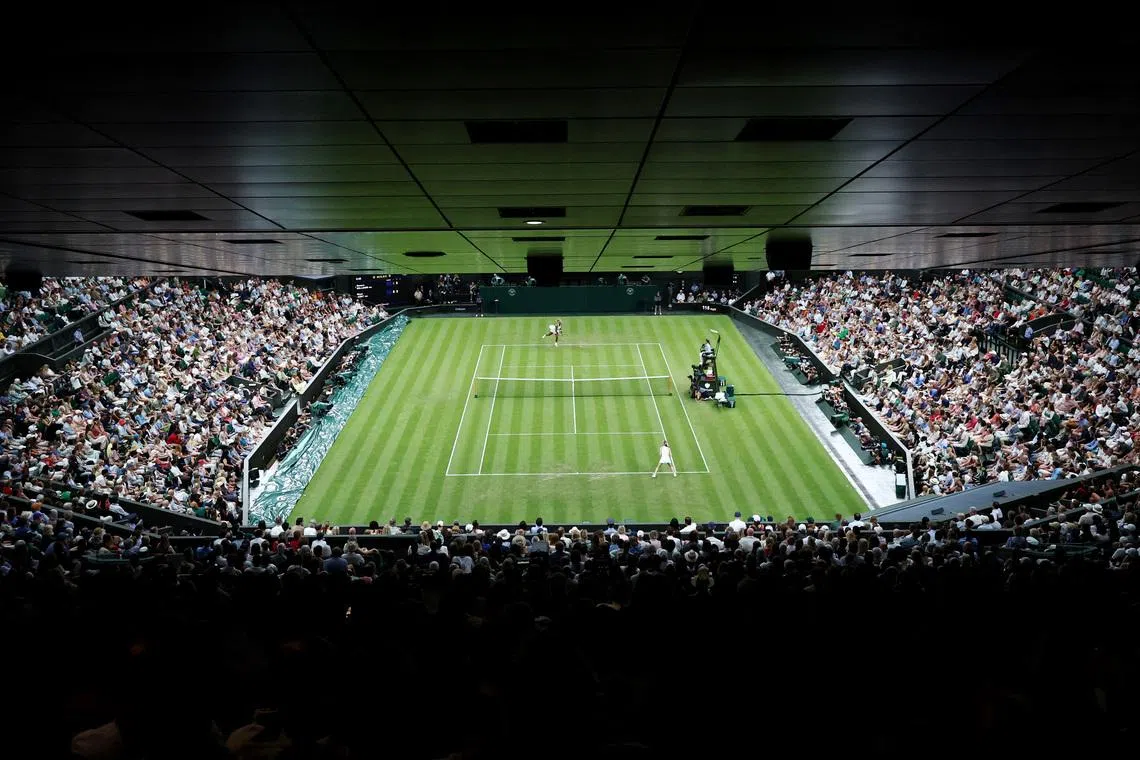
Wimbledon shattered its overall attendance record by drawing 550,151 fans over its fortnight, defying potential viewer losses from the football World Cup during the first rain-free tournament since 2019, according to announcements made by the All England Club on July 29, 2026.
Record Crowds and the Power of the Wimbledon Queue
The 139th edition of the grass-court Grand Slam proved that tennis fans remain deeply committed to traditional match-watching despite overlapping sporting spectacles. Driven by clear skies and the first completely dry fortnight in seven years, the All England Club confirmed that a cumulative 550,151 fans passed through the gates, edging slightly above the figures recorded in 2025. Daily attendance records fell on three separate days across the tournament, specifically on Days 7, 12, and 14, with the final day coinciding with the men’s championship match.
A significant driver of this steady turnout was the resilience of the famous Wimbledon Queue, which saw tens of thousands of visitors purchasing tickets on the day of play. International fans traveled in high numbers as well, with the highest concentrations arriving from the United States, Ireland, Italy, and Germany.
Arthur Fery’s Historic Run and Broadcast Adjustments
On-court drama played an equally vital role in keeping local audiences glued to screens rather than drifting entirely toward the football World Cup. British wildcard and local SW19 resident Arthur Fery galvanized home support by becoming the first British wild card to reach the men’s semifinals in the Open Era. His inspiring journey ended with a straight-sets loss to French Open champion Alexander Zverev, but the match commanded immense attention from fans packing Henman Hill and watching from home.
Scheduling adjustments helped mitigate direct television conflicts. Fery and Zverev’s semifinal clash was moved to an earlier 1:30 pm BST slot ahead of the five-hour marathon between Novak Djokovic and Jannik Sinner. This clever rescheduling allowed the BBC to broadcast Fery’s match on BBC One, successfully avoiding a direct overlap with the World Cup quarter-final between Spain and Belgium later that same evening.
Fery added that the immense backing served as a powerful motivator. Yeah, it’s awesome. It’s awesome. It pushes me to do better and give my best on the court,
he noted after his exit.
Global Television Ratings and Digital Impressions
Beyond the grounds at SW19, media consumption reached staggering heights across multiple continents and broadcasting platforms. The All England Club reported that the tournament generated nearly 5 billion social media impressions, while the official Wimbledon social media following grew by 11 per cent across all platforms. Broadcasters reaped the rewards of this global appetite, which spans media rights agreements covering over 200 territories.
In the United Kingdom, BBC coverage was streamed more than 54.8 million times, accumulating a total of 206 million audience hours. The gentlemen’s singles final drew a peak audience of 6.24 million viewers, with the vast majority tuning into BBC One. Meanwhile, 3.92 million viewers watched the all-Czech ladies’ singles final, where Linda Noskova defeated Karolina Muchova on her sixth championship point.
International viewership mirrored this enthusiasm. ESPN reported its second-most-viewed Wimbledon championships of all time, trailing only the historic 2019 tournament. ESPN’s coverage saw an 18% year-over-year increase across its networks, averaging 853,000 viewers. The women’s final shattered records to become ESPN’s most-watched ladies’ final in history, averaging 1.9 million viewers with a peak of 2.46 million.
How Wimbledon Compares to Other Grand Slams
Despite setting new internal milestones, Wimbledon still trails the other three tennis majors in total raw attendance volume due to structural limitations. The tournament grounds remain restricted to a 14-day window, whereas rival majors host main-draw competitions over 15 days.
| Grand Slam Tournament | Recent Main Draw Attendance | Duration |
|---|---|---|
| Australian Open | More than 1.1 million | 15 days |
| U.S. Open | More than 900,000 | 15 days |
| French Open (2026) | 589,500 | 15 days |
| Wimbledon (2026) | 550,151 | 14 days |
Wimbledon’s qualifying event takes place entirely off-site, leaving the All England Club with less physical footprint for pre-tournament fan engagement. Yet, retail numbers underscored the event’s unmatched commercial drawing power during the fortnight, highlighted by a record 117,995 hats sold.
Strategic Broadcaster Decisions Across Europe
Strategic moves by European rights holders also unlocked massive audience numbers for the finals. In the Czech Republic, Eurosport sub-licensed coverage of the Noskova-Muchova final to free-to-air broadcaster Prima, capturing a remarkable 38.5 per cent audience share and peaking at 900,000 viewers. In Germany, Amazon Prime lifted its paywall for the men’s final featuring Alexander Zverev, dramatically expanding reach and pulling in over three million viewers.
Italy witnessed similar engagement when Sky Italia broadcast the gentlemen’s final across its main sports channels and the free-to-air platform TV8, yielding a combined average of 4.39 million viewers and a peak audience of 5.88 million. These figures cement the reality that when weather permits uninterrupted play and local contenders make deep tournament runs, marquee tennis retains an extraordinary capacity to dominate global sports attention.
Keep reading

Hawthorn Captain Emily Bates to Miss Season After ACL Injury
Hawthorn captain Emily Bates will miss the remainder of the AFLW season after scans confirmed she ruptured the...

Ferrari Reveals 720-HP 296 GT Modificata Track Car
Ferrari has pulled the wraps off the 296 GT Modificata, an extreme, track-only machine derived from the 296...

Pirates Defeat Cubs 4-3 to Maintain Longshot Wild Card Hopes
The Pittsburgh Pirates defeated the Chicago Cubs 4-3 on Sunday to finish a road trip 4-2 and hold...
Indian Women’s Cricket Team Refuses Asia Cup Trophy From Mohsin Naqvi
The Indian Women's Cricket Team captured a record-extending eighth Asia Cup title by defeating Sri Lanka by 72...