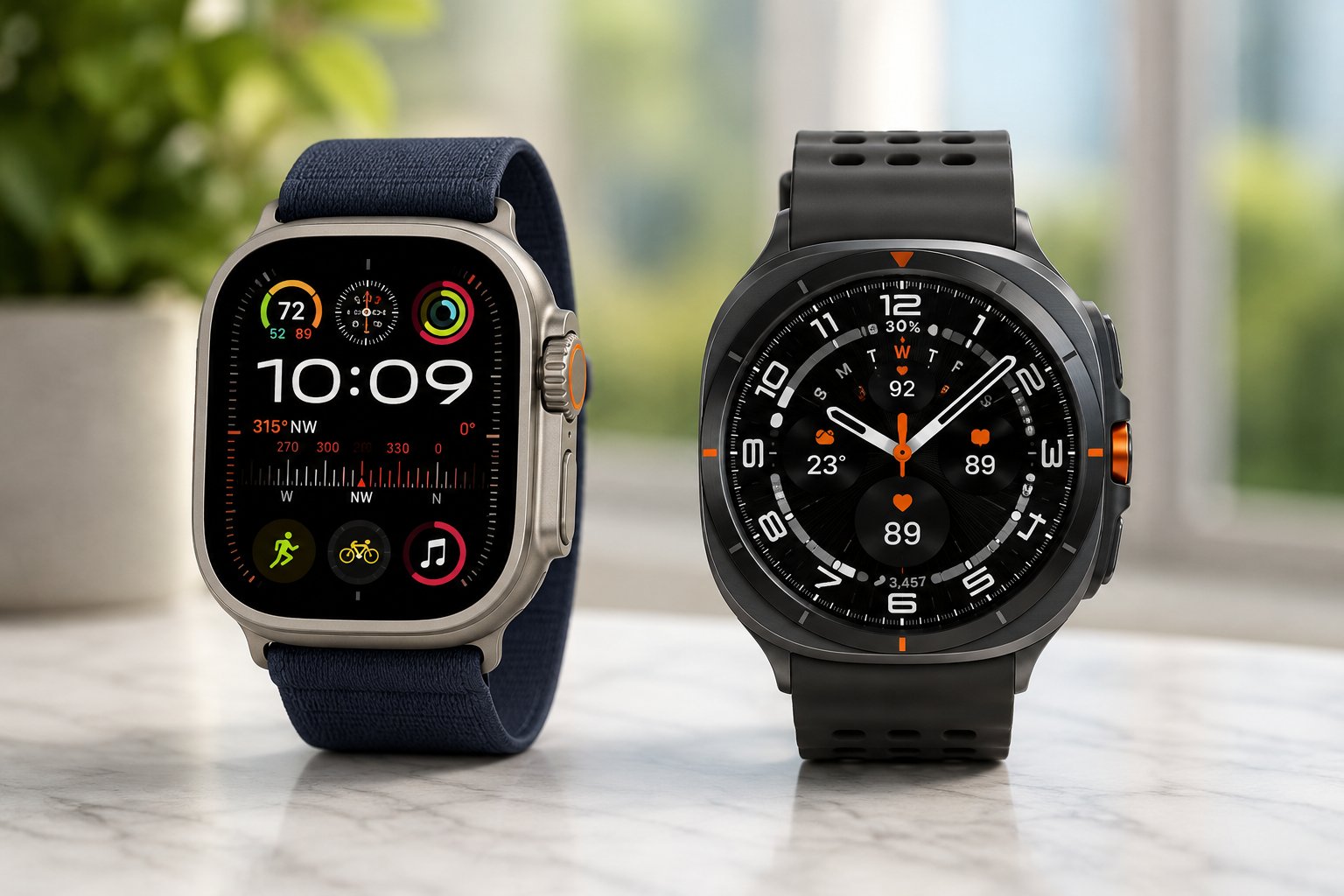
Samsung’s Galaxy Watch Ultra 2 arrives with a slimmer titanium chassis, an 800mAh battery, and a 5,000-nit display, retailing for $699.99 alongside the mainline Galaxy Watch 9. Positioned as an outdoor-focused companion, it squares off against the Apple Watch Ultra 3 in a battle of differing ecosystems, battery claims, and rugged engineering.
Pricing, Dimensions, and Ecosystem Divides
Choosing between Samsung’s rugged flagship and Apple’s top-tier wearable still starts with the smartphone in your pocket. Apple Watch Ultra 3 requires an iPhone 11 or later running iOS 26, according to Apple specifications. Meanwhile, Samsung put the Galaxy Watch Ultra 2 on sale in the US on August 7 for $699.99, with the device requiring a compatible phone running Android 13 or later. That price tag makes Samsung’s smartwatch about $99 cheaper than the Apple Watch Ultra 3, which lists at $799.

For buyers examining mainline alternatives, the Galaxy Watch 9 starts at $379.99 for the Bluetooth-only 40mm model—representing a $30 price increase compared with the previous Galaxy Watch 8. The larger 44mm Galaxy Watch 9 model starts at $409.99, with an extra $50 required for LTE-equipped variants across both sizes. This positions the $699.99 Galaxy Watch Ultra 2 as a $320 premium over the base Watch 9.
Samsung managed to trim the Ultra 2 chassis by approximately 12 per cent while simultaneously increasing battery capacity. Although the watch weighs slightly more at 61.5 grams, engineers paired it with a redesigned Marine Band that is 26 per cent lighter and more flexible, easing sweat buildup during sleep and exercise tracking.
Qualcomm Snapdragon Wear Elite Power and Software Integration
Under the hood, Qualcomm’s Snapdragon Wear Elite powers both the Galaxy Watch 9 and the Galaxy Watch Ultra 2. According to the manufacturer, the new processor delivers 32 percent more processing power, while the integrated graphics processing unit is 19 percent more powerful than previous Exynos hardware.
While the base Watch 9 packs 2GB of RAM and 32GB of storage, the Ultra 2 doubles the onboard storage to 64GB. Both running Google’s Wear OS 7 paired with Samsung’s One UI 9 interface, the watches bring Google Gemini closer to the wrist. A marquee software addition is the Raise to Talk
feature, which lets users raise their wrist and speak instantly to trigger Gemini without pressing buttons or uttering a wake-word.
Display Brilliance and Endurance Benchmarks
The Galaxy Watch Ultra 2 features a 1.52-inch Super AMOLED screen with a peak brightness specification of 5,000 nits. While test lab instruments recorded maximum figures slightly lower than the manufacturer ceiling, the panel easily overcomes harsh, direct sunlight during outdoor commutes and workouts. By comparison, the Apple Watch Ultra 3 tops out at 3,000 nits of brightness, and the standard Galaxy Watch 9 offers a 3,000-nit peak across its 1.34-inch and 1.47-inch display variants.

Battery capacity is where the Ultra series justifies its footprint. The Ultra 2 upgrades to an 800mAh battery cell, stepping up from the 590mAh cell found in the original model. Samsung estimates up to 60 hours of use with the always-on display enabled, or up to 80 hours with it disabled. In practical testing, the Ultra 2 outlasted the manufacturer estimate, running for 69.5 hours under normal use with the always-on display active. Conversely, the Galaxy Watch 9 models house smaller cells—390mAh for the 40mm and 445mAh for the 44mm—delivering roughly a single day of power between charges.
Durability Ratings and Outdoor Safety Tools
Both flagship adventure watches are built for extreme environments, though their safety ecosystems diverge sharply. The Apple Watch Ultra 3 includes Emergency SOS via satellite, satellite messaging, and Find My location sharing without requiring a cellular plan. The Galaxy Watch Ultra 2 lacks direct satellite messaging, relying instead on an 86-decibel siren triggered via its orange Quick Button, along with fall detection and emergency calling.
For aquatic durability, Samsung equips the Ultra 2 with 10 ATM water resistance, IP69K dust and water protection, MIL-STD-810H standards, and EN13319 certification, officially allowing the smartwatch to act as a diving instrument for recreational dives down to 40 meters. Apple lists equivalent 40-meter recreational dive limits alongside WR100 water resistance and EN13319 certification.
Keep reading
iPhone Ultra Testers Praise Design but Note Missing Face ID and Telephoto Lens
Apple’s first foldable iPhone, rumored as the iPhone Ultra, has impressed early internal testers with its pocket-friendly design,...

Australian Recording Industry Association Bans AI Music From Official Charts
Music created primarily by artificial intelligence has been barred from Australia's official music charts under a new code...
Apple iPhone 18 Pro To Feature Uniform Aluminum Design And Four Colors
When Apple unveils the iPhone 18 Pro and iPhone 18 Pro Max, the design will remain a central...

Amazon Raises Prices for Echo, Fire TV, and Kindle Devices by Up to 60%
Amazon has quietly raised prices across its hardware lineup by up to 60 percent, hitting Echo smart speakers,...