
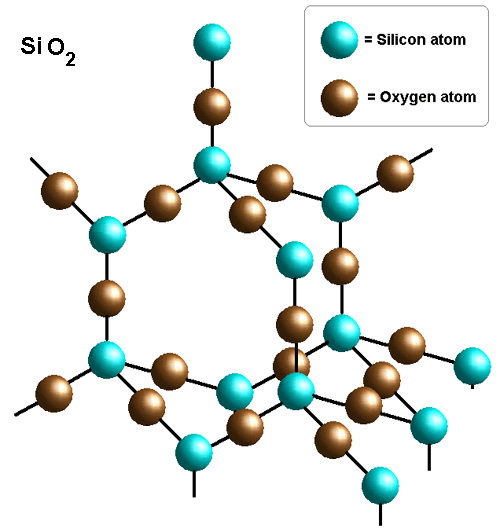
A recent scientific study has determined that the surface of Mercury contains significantly less silicon dioxide than previously assumed. According to Max-Planck-Gesellschaft, researchers from the Max Planck Institute for Solar System Research in Germany, along with the Universities of Münster and Göttingen, utilized an indirect approach to measure the proportion of silicon dioxide, also known as silica or SiO2, on the planet’s surface.
New Study Reveals Lower Silicon Dioxide Abundance on Mercury
The research findings were published in the journal Planetary Research under the title The SiO2 abundance on the surfaces of the Moon and Mercury.
The study reveals that silicon dioxide has a mass fraction of approximately 37 percent on Mercury, making it up to 25 percent less abundant than earlier estimates indicated.
Methodology Involving Infrared Radiation and Lunar Data
To determine the precise composition of Mercury, the researchers executed a three-step procedure. First, they established a relationship between infrared radiation and SiO2 content using laboratory measurements. Second, they verified this relationship using measurement data from the Moon and lunar samples. Finally, they applied infrared data from Mercury to determine the silicon dioxide content of its surface.

The investigation utilized the Christiansen Feature, which functions similarly to a wavelength transparency point in a mid-infrared spectrum specific to a mineral’s composition and structure. By observing how this feature shifts as SiO2 abundance changes, scientists are able to apply remote sensing techniques to evaluate the volcanic history and silica content of other celestial bodies.
Implications for Mercury’s Volcanic Past and Interior
The unexpected shortage of silicon dioxide on the surface points to a different geological and volcanic history for the planet than previously understood. Lead author Christian Renggli, who serves as a research scientist and head of the Experimental Laboratory Magma Ocean research group at the Max Planck Institute for Solar System Research, explained the geological mechanism behind the findings.
Our findings suggest that the volcanic rocks on Mercury formed from more deeply melted mantle material than previously assumed,
said Christian Renggli, according to Universe Today. Under the solid crust of a young rocky planet, silica typically accumulates in the molten mantle over time because early-formed cooling rocks do not extract substantial amounts of SiO2 from the melt. Alternatively, researchers note that it is also possible Mercury once contained more silicon dioxide in its crust but gradually lost oxygen.
Context of Mercury’s Volcanism and Upcoming Exploration
Mercury’s northern region features expansive smooth plains created by massive amounts of volcanic material that flooded the surface between about 4.1 and 3.5 billion years ago, burying craters and leaving behind rim traces known as ghost craters. Unlike Earth, where plate tectonics and ongoing volcanism continuously disrupt the crust, Mercury began cooling early, bringing volcanic activity to a halt approximately one billion years after its formation.
More precise findings regarding the planet’s composition are anticipated from the ESA/JAXA BepiColombo spacecraft, which is scheduled to reach Mercury and enter orbit.
Worth a look
Astronomers Discover 10-Sided Atmospheric Wave at Saturn’s South Pole
Astronomers using the Hubble Space Telescope have discovered a massive, evolving 10-sided atmospheric wave circling Saturn’s south pole.
Monash Researchers Propose Expanding Genus Homo to Rewrite Family Tree
Monash University researchers argue that early human relatives and close fossil relatives living up to 5 million years...
Researchers Measure Gravity Effect on Quantum Atoms in New Study
Researchers have directly measured gravity’s predicted effect on the quantum phase of freely falling rubidium atoms, observing Einstein’s...

Corrected Headline: Harvest Moon Rises Near Saturn on September 26
The Harvest Moon of September 2026 will rise on September 26, appearing near Saturn and Neptune in the...