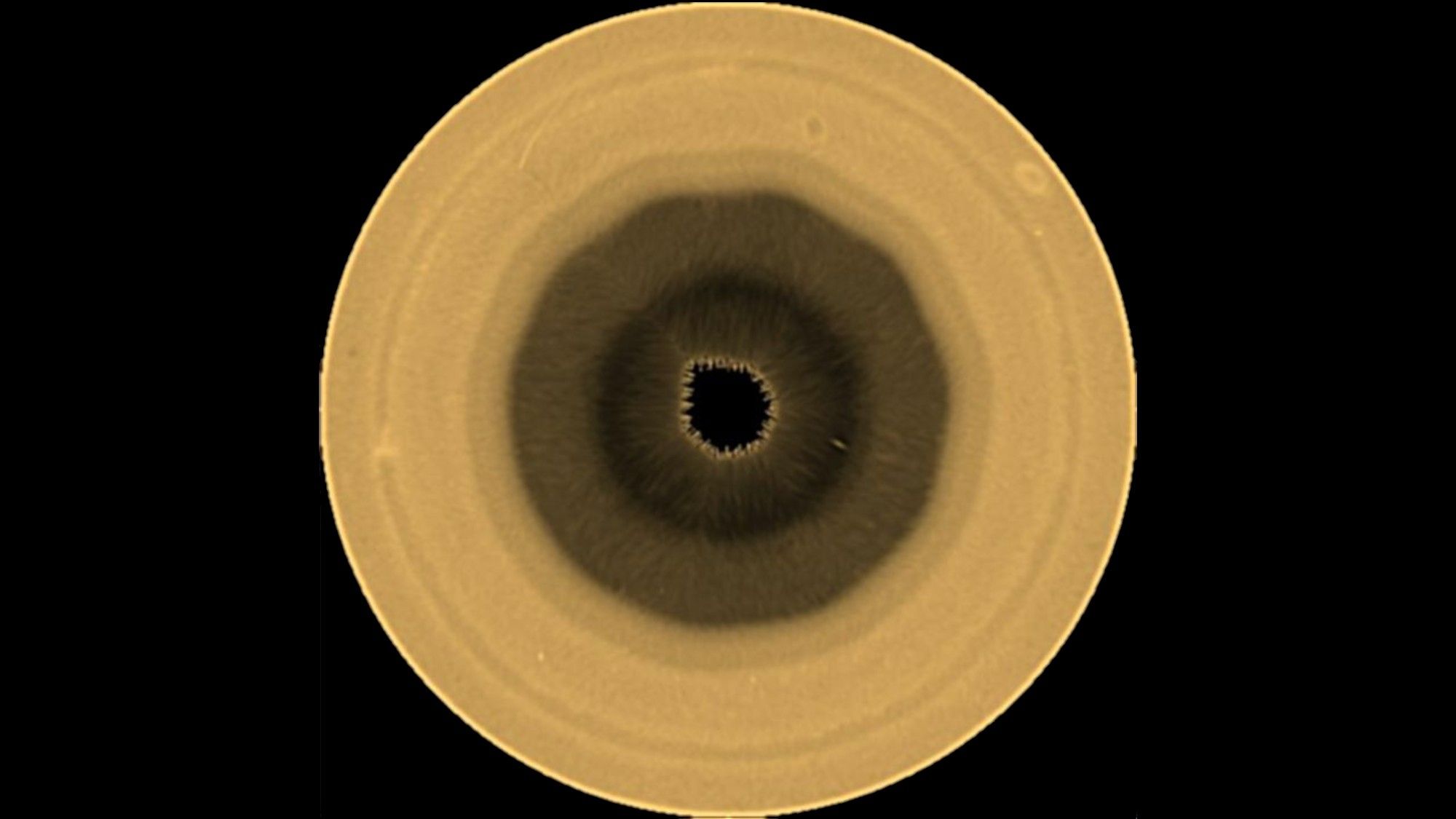
Astronomers using the Hubble Space Telescope have discovered a massive, evolving 10-sided atmospheric wave circling Saturn’s south pole. Revealed in findings published on September 2, 2026, the newfound decagon breaks decades of assumptions that Saturn’s polar geometry was uniquely limited to its famous northern hexagon.
Hubble Spotlights a Rare Southern Decagon
Saturn is reshaping our understanding of planetary meteorology. After decades of scrutiny focused almost exclusively on the planet’s northern hemisphere, astronomers have discovered a mysterious 10-sided cloud structure at Saturn’s south pole. The finding was detailed in a study published on September 2, 2026, in the journal Science Advances.
The newly identified decagon is an atmospheric wave embedded deep within one of Saturn’s powerful jet streams, centered around 63 degrees south latitude. Unlike ordinary circular weather bands, this geometric formation spans roughly 104,250 miles in total width, with each of its ten distinct sides measuring about 10,425 miles long.
Observations across multiple wavelengths show that the pattern extends through multiple layers of the gas giant’s atmosphere, indicating it is far more than a shallow cloud-layer anomaly. Yet, while the northern hexagon remains practically stationary, the southern decagon migrates eastward at a tame pace of about 6 mph, completing a full rotation around the planet in roughly 800 days.
How Seasons and Citizen Science Cracked the Case
For years, Saturn’s south pole remained a blind spot. NASA’s Cassini spacecraft orbited the ringed planet from 2004 to 2017, generating exhaustive maps of the southern hemisphere that revealed a monstrous, hurricane-like vortex at the pole but no polygon whatsoever.
Because Saturn takes 29.5 Earth years to complete a single orbit around the sun, its seasons crawl. The planet’s axial tilt turned its southern hemisphere away from Earth between 2012 and 2023, hiding the region from ground-based telescopes and Earth-orbiting instruments alike. When the slow shift of Saturnian seasons eventually tilted the south pole back into view, the planet had effectively redecorated.
The breakthrough began with citizen science. In 2024, lead study author Agustín Sánchez-Lavega and amateur astronomers spotted an undulating band while reviewing ground-based images stored in the Planetary Virtual Observatory Laboratory. Subsequent checks of Hubble Space Telescope data confirmed that the pattern was present as early as 2023, having likely formed during the unobserved window between 2017 and 2023.
Challenging Assumptions About Planetary Geometry
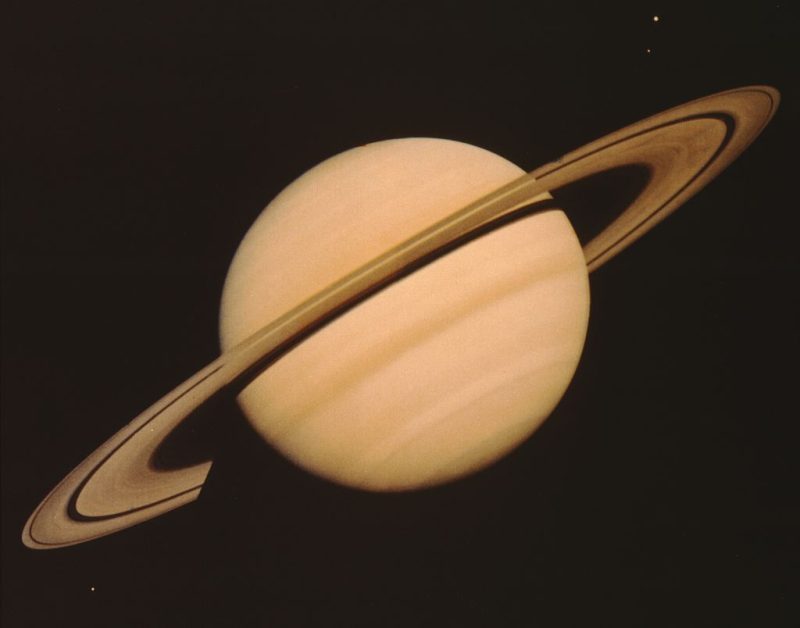
Before this discovery, Saturn was viewed as a solitary geometry showpiece. In the early 1980s, NASA’s twin Voyager flybys revealed a six-sided jet stream, or hexagon, ringing Saturn’s north pole. That northern feature has persisted for more than 40 years without significant change.
Astronomers had searched for a southern counterpart since 1990, assuming the planet’s north-south jet stream system should exhibit symmetry. Finding nothing during the Cassini era led many to believe the northern hexagon was a singular fluke. The discovery of the decagon completely alters that perspective.
“The findings are significant because it shows the ‘unique’ hexagon is not as extraordinary as we thought.”
Agustin Sanchez-Lavega, University of the Basque Country
Although all gas giants with atmospheres host wave-spawning disturbances, only Saturn churns them out looking like polygons bounded by straight lines.
What Comes Next for Saturn’s Mysterious Decagon
Unlike its stable northern sibling, the southern decagon is actively evolving. Its individual sides vary in darkness across features, suggesting the atmospheric wave is still strengthening and shifting.
“We need to understand how the decagon evolves — in other words, whether in the coming years it will become unstable and break up, or conversely, become more stable and robust as solar radiation increases, which will peak at its latitude of around 60 degrees south in 2032.”
Agustin Sanchez-Lavega, University of the Basque Country

Researchers in southwestern China discovered a nearly 5-pound fungus so unique it required a new family
Researchers in southwestern China have discovered a towering new fungus species, Dianjunus rex, that grows up to 50...

Microraptor was a very small, feathered dinosaur with wings on its legs as well as its arms
Discovered in northeastern China, Microraptor is a diminutive, feathered dinosaur renowned for its four wings and shimmering plumage,...

SpaceX Launches Starfall Return Capsule for Second Time
SpaceX launched the uncrewed Starfall reentry capsule for the second time on October 20, 2026, from Cape Canaveral...
Orionid Meteor Shower Peaks October 21-22, 2026
The annual Orionid meteor shower reaches its peak during the pre-dawn hours of October 21-22, 2026.