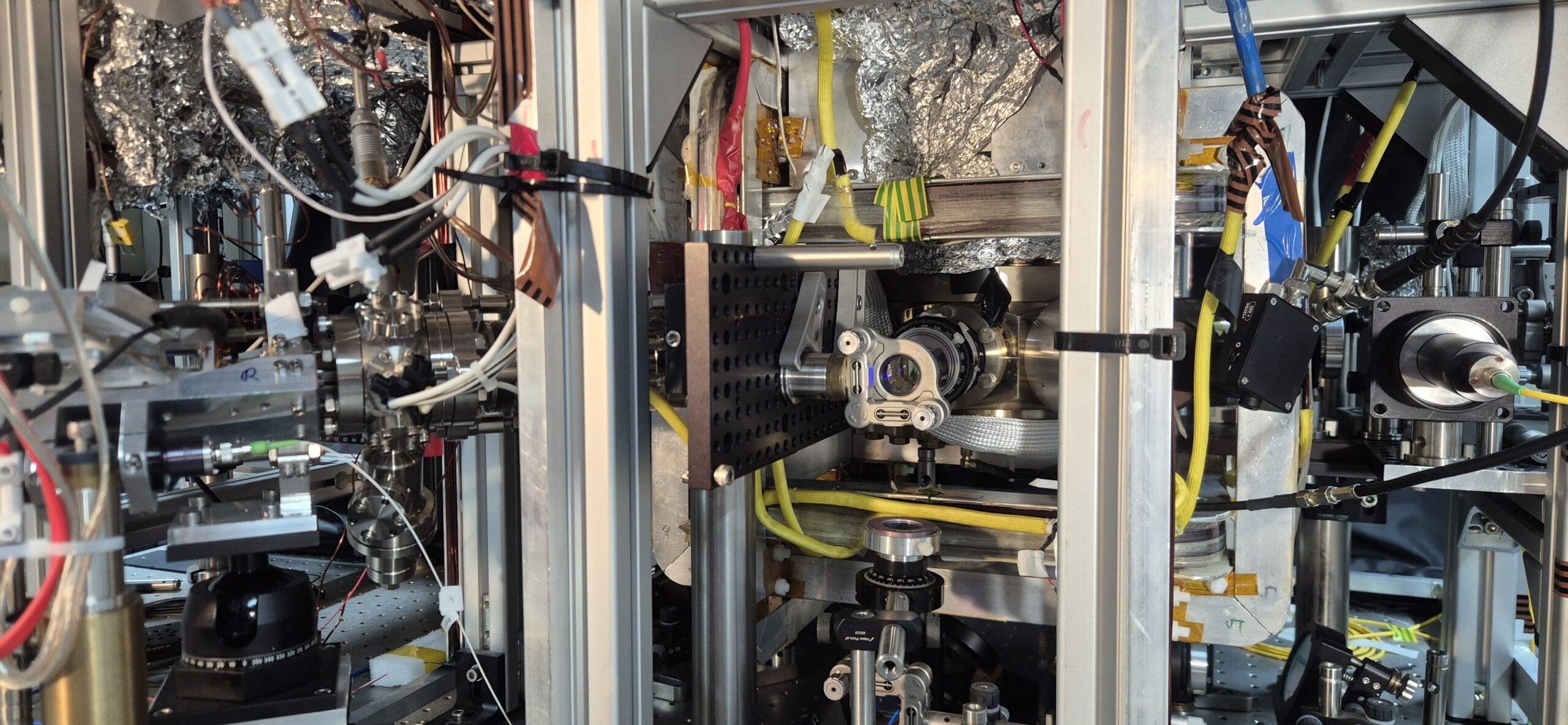
Researchers have directly measured gravity’s predicted effect on the quantum phase of freely falling rubidium atoms, observing Einstein’s equivalence principle in the quantum realm. Published in Science Advances and carried out at Ben-Gurion University, the experiment used a new Quantum Galileo Interferometer to split atomic waves.
For more than a century, modern physics has operated with a profound divide. Quantum mechanics governs the strange behavior of the very small, while Einstein’s general theory of relativity explains gravity and the cosmic architecture of the very large. Exactly how these two foundational frameworks fit together remains one of the most stubborn mysteries in modern science.
Now, an international team including Nobel Prize-winning physicist Professor Sir Roger Penrose has caught a glimpse of where they meet. According to researchers at Ben-Gurion University, The University of Ulm, and the University of Oxford, an experiment has successfully observed a long-predicted effect of gravity on a falling quantum object for the first time. The findings demonstrate that a fundamental principle at the heart of Einstein’s theory of gravity remains consistent with the behavior of matter in the quantum world.
Inside the Quantum Galileo Interferometer Setup
Testing Einstein’s equivalence principle on an atomic scale requires overcoming immense experimental hurdles. The equivalence principle dictates that for an observer in free fall, gravity locally disappears—much like a person experiencing weightlessness inside a freely falling elevator. While this theory has passed rigorous tests involving classical matter, applying it to quantum objects presented a unique roadblock because quantum particles can behave as waves and travel along multiple paths simultaneously.

To solve this, the experimental team engineered a novel apparatus known as the Quantum Galileo Interferometer. The physical setup requires extreme isolation, relying on a vacuum chamber equipped with a two-dimensional magneto-optical trap (MOT) that feeds atoms into a science chamber housing an atom chip.
Inside this specialized chamber at Ben-Gurion University, clouds of rubidium atoms were cooled to temperatures just above absolute zero. PhD student Or Dobkowski and colleagues utilized microwave pulses to place the ultracold atoms into a quantum superposition, effectively forcing each atom to travel along two distinct paths at once.
Separating Paths and Measuring Phase Differences
With the atomic waves split, the team deployed tiny electrical wires on the atom chip to generate precisely controlled magnetic fields. One segment of the atomic wave responded to the magnetic field, allowing the scientists to apply an upward force that completely counteracted the downward pull of gravity. This portion remained stationary relative to the laboratory and the Earth.
/quantum_physics_bose_einstein_condensate.jpg/jcr:content/renditions/cq5dam.web.1280.1280.jpeg "Photo: NASA")
Meanwhile, the second part of the wave received a controlled magnetic push upward before being switched into a state largely immune to the magnetic field, enabling it to fall freely under gravity along a ballistic trajectory. At the conclusion of the drop, a final magnetic pulse steered the two split waves back together.
When the waves reunited, they interfered with one another. That interference pattern allowed the research team to calculate the tiny difference in quantum phase accumulated while one path remained stationary and the other fell. The measured phase matched precisely what Einstein’s equivalence principle predicts when applied to such a quantum wave.
Broader Efforts to Unify Quantum Mechanics and Gravity
Across the scientific community, researchers are developing new methodologies—from quantum networks utilizing entangled W-states to investigate curved space-time, to levitating magnets detecting weak gravitational pulls at the University of Southampton. In parallel, space agencies are leveraging the unique conditions of low Earth orbit to strip away the masking interference of terrestrial gravity.
NASA’s Biological and Physical Sciences Division operates facilities like the Cold Atom Lab aboard the International Space Station, which chills atoms to near absolute zero to study Bose-Einstein condensates in microgravity. According to University of Rochester physics professor Nicholas Bigelow, removing terrestrial gravity permits significantly longer observation times to uncover delicate quantum effects that would otherwise remain hidden.
Despite these strides, investigators emphasize that current measurements do not unify gravity with quantum mechanics or prove that gravity itself possesses quantum properties. Instead, the new interferometry technique provides a vital experimental bridge, establishing a reliable baseline for testing how fundamental physical laws behave where the atomic scale meets the curvature of space-time.
Related reading

Orionid Meteor Shower Peaks October 21-22, 2026
The annual Orionid meteor shower reaches its peak during the pre-dawn hours of October 21-22, 2026.
Researchers Validate Space-Based Methane Detection
Researchers have completed the largest controlled test of space-based methane monitoring, publishing results in October 2026 showing that...

Voyager Probes Approach One Light-Day Distance After Decades
Nearly half a century after launching to explore the outer solar system, the Voyager probes are still operating...
Natural History Museum Uncovers New Dinosaur Species in Century-Old Fossil
Researchers have identified Europe’s first megaraptoran dinosaur, named Invictibellatrix amberina, from a fossil skull fragment acquired by London’s...