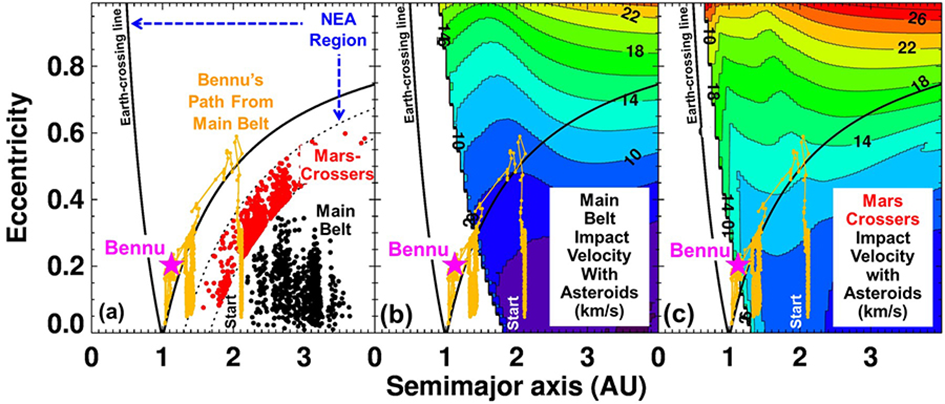
Researchers analyzing titanium, chromium, and iron isotopes in samples returned by NASA’s OSIRIS-REx mission have discovered that asteroid Bennu shares a distinctive isotopic fingerprint with asteroid Ryugu and rare CI carbonaceous chondrites, indicating its parent material likely assembled just outside the inner Solar System’s water-ice line.
A handful of dark grains returned from asteroid Bennu is reshaping scientific understanding of where the Solar System’s most primitive material formed. Researchers at ETH Zurich examined titanium, chromium, and iron isotopes in samples brought back to Earth by NASA’s OSIRIS-REx mission, revealing that Bennu shares a unique isotopic signature with asteroid Ryugu and rare CI carbonaceous chondrites.
Isotope Measurements Link Bennu, Ryugu, and CI Chondrites
The OSIRIS-REx spacecraft returned roughly 120 grams of Bennu material to Earth in September 2023. ETH Zurich received a portion of this collection for laboratory analysis, measuring several isotopes of titanium, chromium, and iron across five sample portions representing different particle types and sample masses. Isotopes are versions of the same element containing different numbers of neutrons, and their relative abundances act as fingerprints because different regions of the early Solar System inherited distinct mixtures of ancient stellar material.
While titanium and iron isotope compositions remained remarkably consistent among the Bennu samples, chromium showed more variability—a trait researchers link to later alteration by liquid water inside Bennu’s parent body. Even with those differences, Bennu overlaps strongly with Ryugu and CI meteorites. That isotopic similarity indicates that all three bodies incorporated a similar reservoir of early Solar System dust, placing Bennu within a chemically distinctive family that differs from most known meteorites and asteroids.
Challenging Outer Solar System Formation Models
Primitive meteorites traditionally fall into two main isotopic families: noncarbonaceous materials linked to the inner Solar System and carbonaceous materials associated with more distant regions. Bennu is rich in carbon and water-altered minerals, placing it among carbonaceous bodies, but its detailed isotope pattern complicates that simple division. Specifically, Bennu, Ryugu, and CI chondrites feature iron isotope compositions that overlap more closely with inner Solar System material than many other carbonaceous meteorites do.
Bennu is a hybrid: the material does not clearly match either the inner or the outer Solar System.
Maria Schönbächler, ETH Zurich isotope geochemist
This hybrid nature led researchers to question earlier models placing Bennu’s parent body far beyond Jupiter in the distant comet-forming environment. Instead, the new data favor formation just outside the young Solar System’s water-ice line, positioning Bennu’s parent material in a transition zone where fine dust from both inner and outer regions could mix.
Jupiter’s Role as a Size-Selective Filter
The study, published in Science Advances, assigns a central mechanism to early Jupiter in shaping this mixed reservoir. The giant planet may have functioned as a size-selective filter, blocking larger particles while permitting smaller dust grains and fragments to drift across its orbit. These drifting particles were then incorporated into the material that eventually formed Bennu-like bodies in a cold, volatile-rich zone closer to the young Sun than previously thought.
Related reading
Researchers Discover Kayrasaurus changliensis Dinosaur Species in China
Researchers in China have discovered a new therizinosaurian dinosaur species named Kayrasaurus changliensis, which measured approximately 11.8 feet...
NASA Names Four Astronauts for SpaceX Crew-14 Mission to ISS
NASA has assigned four astronauts from three space agencies to the SpaceX Crew-14 mission, targeting a Falcon 9...
Black Hole Shock Waves Spark Star Formation in Nearby Galaxies
Astronomers studying nine local galaxies have discovered that shock waves from active supermassive black holes consistently travel perpendicular...
UBC Researchers Discover Two New Sea Spider Species in the Salish Sea
Researchers at the University of British Columbia have discovered two new species of sea spiders, Callipallene pilosuspedes and...