At IFA 2026 in Berlin, AMD and major hardware manufacturers unveiled a sweeping hardware shift toward local, agentic artificial intelligence, introducing high-performance client chips, massive unified memory architectures, and on-device systems capable of running models with numerous parameters without relying on the cloud.
Shifting Paradigms from Command Execution to Agentic AI
The computing industry is undergoing a structural pivot. Technology firms are moving away from traditional machines that merely execute user commands and toward agentic AI that understands your goals. This evolution demands a massive upgrade in local compute capability to handle exploding token processing growth, prioritize user privacy, and deliver contextual assistance entirely on-device.
By shifting computational weight away from remote data centers, hardware developers aim to eliminate cloud token limits and network latency. The approach redefines personal artificial intelligence as local, private, and contextual, allowing complex digital workflows to execute locally on consumer and creator hardware.
Strix Halo, Gorgon Halo, and the End of Memory Bottlenecks
At the center of this hardware transformation are Strix Halo and Gorgon Halo chips, designed specifically to break traditional memory bottlenecks that constrain large-scale machine learning on local machines. These advanced architectures make it feasible to run massive artificial intelligence models locally on consumer operating systems, including executing 125-billion parameter models locally on Windows.
Hardware makers are rapidly integrating these platforms into new form factors. Lenovo introduced the ThinkCenter X powered by the Gorgon Halo chip, while HP developed a new class of creator laptops under the code name Sunday. Alongside these client systems, the hardware ecosystem extends to specialized desktop configurations, highlighted by the introduction of the Threadripper Halo Station, which functions as a 96-core local supercomputer.
ASUS ProArt RTX Spark PCs and NVIDIA Blackwell Integration
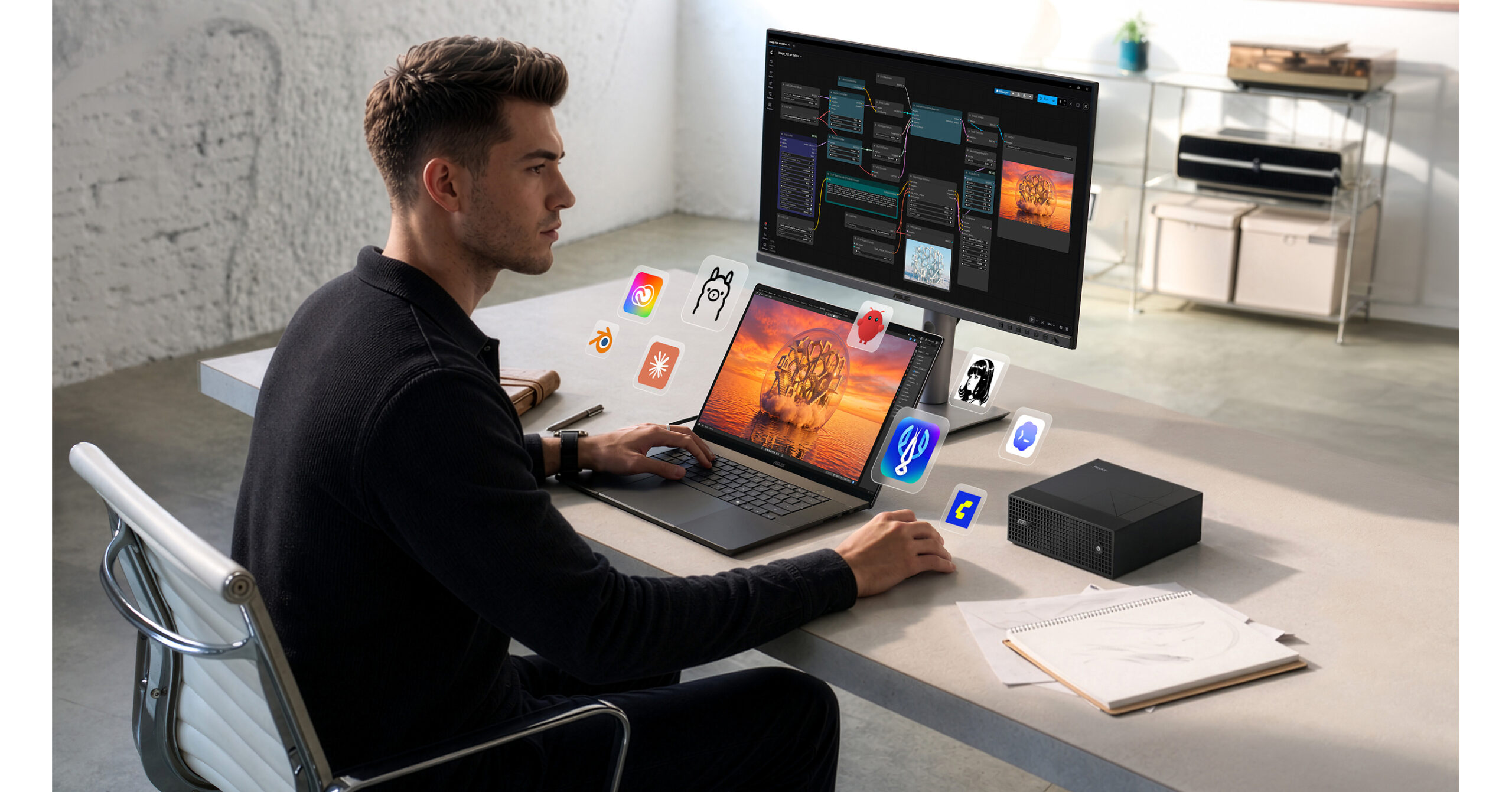
Building on these foundational architectures, ASUS unleashed its new ProArt lineup at the Berlin media showroom, showcasing creator machines built to handle heavy artificial intelligence workloads entirely on-device. Powered by NVIDIA RTX Spark, the hardware pairs a Blackwell RTX graphics processor featuring 6,144 CUDA cores with a 20-core NVIDIA Grace central processing unit.
This integrated chip design enables the new hardware to deliver exceptional performance while maintaining slim physical dimensions. The ProArt P16 measures 12.9mm thick and weighs 1.77kg, while the P14 measures 13.9mm and weighs 1.48kg. Both laptops pack high-capacity batteries up to 99Wh alongside ASUS Lumina Pro OLED displays offering Delta E < 1 color accuracy, up to 1,600 nits of peak brightness, and 120Hz refresh rates.
The ProArt ecosystem also expands into desktop hardware with the compact GR1X mini PC, measuring 150 x 150 x 51mm and designed for continuous 24/7 workloads in Nano Black or a new Neo White finish. Together, these systems deliver up to 1 petaflop of artificial intelligence performance while equipping creators with up to 128GB of unified memory.
Local Execution Limits for On-Device Creators
The technical specifications of the new RTX Spark systems translate directly into heavy local workload capabilities for developers and artists. According to the company’s hardware disclosures, the machines are built for AI-powered creators and developers: RTX Spark runs 120B-parameter LLMs, renders 90GB+ 3D scenes, and generates 4K AI video entirely on-device.

This capability frees creators from dependence on external servers. By orchestrating agentic workflows locally, users maintain full data privacy and customization freedom. Software integration plays an active role in this environment, with applications like MuseTree and StoryCube bringing generative AI models such as FLUX and WAN directly into the ProArt ecosystem, alongside bundled Adobe Creative Cloud subscriptions and Google AI Pro integration.
Project Zenith and Open Windows Development Platforms
Software ecosystems are adapting in parallel with these hardware strides. Microsoft’s Pavan Davuluri made a special appearance during the showcase to detail Project Zenith for developers, positioning Windows as an open platform designed to support secure, agentic user experiences.
By establishing open standards for local intelligence, technology leaders hope to make advanced capabilities accessible to a broader audience of developers. As hardware manufacturers roll out deskside workstations and ultra-thin mobile systems equipped with massive unified memory pools, the boundary between local client computing and data center performance continues to blur.
Related reading

Berkshire Shares Hit New All-Time Highs Under Greg Abel
Berkshire Hathaway Class B shares reached $543.06 in New York, touching a fresh all-time high amid a broader...

iPhone Duo Suffers Screen Failures After Launch
Apple’s first foldable phone, the iPhone Duo, launched on October 23, 2026, priced at $1,999 and up, as...

Samsung Brings Certified Re-Newed Galaxy Phones to Amazon
Samsung has expanded its Certified Re-Newed Galaxy program to Amazon for the first time, making 14 refurbished configurations...

Canva Launches AI Image Generator
Australian design platform Canva released its first in-house image generation model, Canva Craft, developed to compete with major...