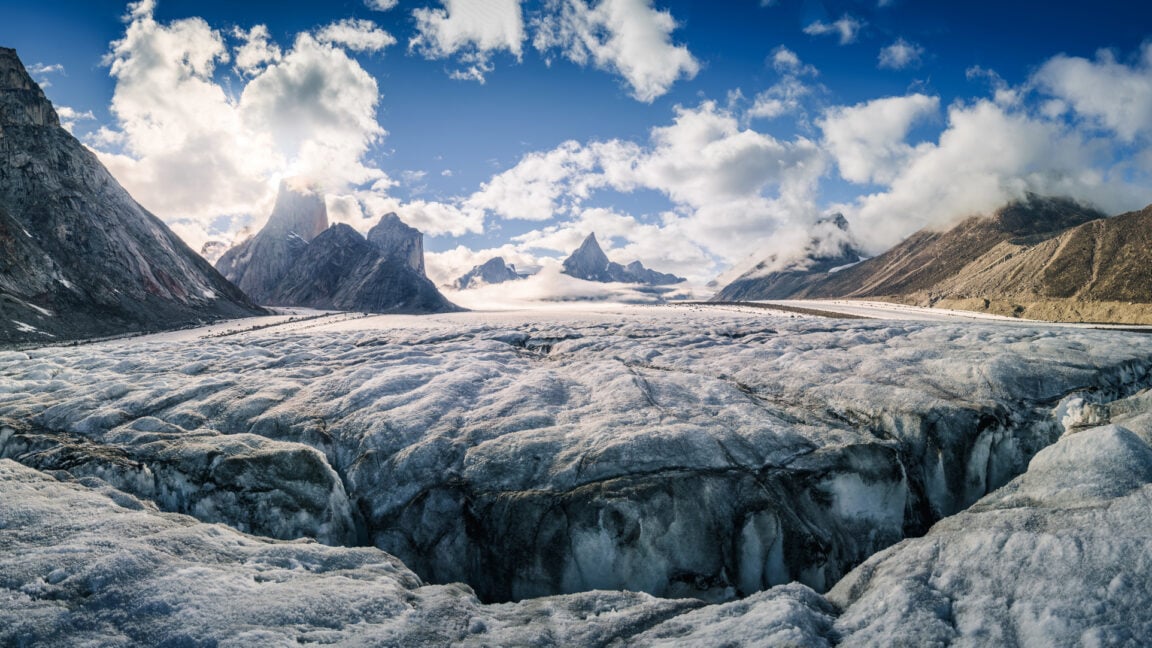
Radiocarbon dating of dead moss preserved beneath the Barnes Ice Cap reveals that glacier expansion began around 2,000 years ago, reversing course only when modern carbon emissions drove widespread retreat starting in the 1960s.
Dating the Barnes Ice Cap With Beryllium-10 and Radiocarbon
Scientists studying the Barnes Ice Cap on Baffin Island have pieced together how ice sheets move across the terrain by analyzing physical traces left behind on newly exposed land. Researchers use beryllium-10, an isotope that accumulates in the top few centimeters of rock exposed to the sky, to measure how long a boulder has remained uncovered. That technique indicated the Laurentide Ice Sheet had withdrawn to within today’s ice margin by 3,600 years ago, before shrinking further around 3,000 years ago.
Beyond rock sampling, the research team examined plants trapped beneath advancing ice. When an ice cap retreats, mosses colonize the newly exposed terrain. As the ice re-expanded, it covered and killed the vegetation.
There were all these plants growing, just like today,
said Nicolás Young, a paleoclimatologist at the Lamont-Doherty Earth Observatory at Columbia University and lead author of the new paper published in Science. He added, And included in that are mosses, these little mosses that are rooted in the ground. So they’re there, they’re living their life, and eventually the Laurentide Ice Sheet starts to re-expand. And when that ice margin covers the moss, it literally kills it.

By radiocarbon dating these moss remnants, researchers pinpointed kill dates representing the exact moments ice arrived at specific spots. About 70 percent of the radiocarbon dates cluster around 1800 CE during the culmination of the Little Ice Age, which marked the period when Northern Hemisphere glaciers were at their most extensive in recent millennia. At Barnes, researchers concluded that this pulse was part of an advance that had been running for two thousand years.
Comparing Barnes Ice Cap Expansion With Neighboring Plateau Ice Caps
Because older moss specimens remain buried beneath the active edges of the Barnes Ice Cap, researchers looked to neighboring ice caps scattered across the same plateau to determine when the expansion initially began. Earlier studies collected nearly 200 kill dates from beneath those smaller ice caps. None of those samples are older than 2,000 years, indicating that the regional ice expansion started uniformly across the plateau.
What that means is that all of those ice caps up there didn’t start advancing or re-expanding until about 2,000 years ago. Since the Barnes Ice Cap is right next door, it’s probably a good bet that it also started expanding 2,000 years ago.
Nicolás Young, lead author and paleoclimatologist at the Lamont-Doherty Earth Observatory at Columbia University
Meredith Kelly, a professor of earth sciences at Dartmouth, called the data gathered in the study awesome
and noted that the findings display a clear pattern of historical ice cap behavior. However, Kelly noted she would like to see comparisons with other global sites to better understand how Earth moved into its glaciation period prior to human-caused warming.
Reversing Two Millennia of Growth Through Fossil Fuel Emissions
While the ice cap grew steadily for two thousand years, that trajectory halted in the 1960s. Historic aerial photographs show that the Barnes Ice Cap reversed course, retreating significantly back from its margins. Its edges have retreated an average of 4 meters per year since the 1980s, driven by rapidly increasing carbon emissions that have caused ice to shrink worldwide.
The modern retreat has covered between 200 and 800 meters since 1960, exposing mosses killed from about 1000 CE onward while leaving older layers buried. Modern retreat of this glacier has reversed 2,000 years of net expansion—that’s a pretty decent chunk of time,
Young said.
Addressing 1970s Climate Hypotheses at Brown University
The findings also address a decades-old scientific debate that has frequently been cited by climate skeptics. In the early 1970s, scientists gathered at Brown University to discuss hypotheses regarding the onset of the next ice age. Scientists discussed hypotheses regarding the onset of the next ice age during that gathering, eventually sending a warning letter to President Richard Nixon regarding an imminent glaciation period. Two coauthors of the new paper attended that historic meeting.
I think this study actually helps show that scientists were right about a pending glaciation. Media coverage of the meeting, as well as a colder period of weather in the 1970s, have long been pitched by climate deniers as ‘proof’ that global warming isn’t actually happening. It very much is, though, and the new research actually adds to the evidence.
Nicolás Young, lead author and paleoclimatologist at the Lamont-Doherty Earth Observatory at Columbia University
- Egypt Uncovers Fossils of Five Extinct Shark Species in Western Desert
- Korean Artists Hyewon Kwon, Boo Jihyun, Eunhae Jung, Eco Orot Explore Water’s Ecological Role
- A 42% Cut in Melanoma Relapse Means 12 More Per 100 at Two Years (daybreakwire.com)
- Baldock approves 3,200 new homes in 70% expansion plan (newsarchyuk.com)
Egypt Uncovers Fossils of Five Extinct Shark Species in Western Desert
Fourteen shark teeth from at least five extinct species have been discovered in Egypt’s Western Desert.
Korean Artists Hyewon Kwon, Boo Jihyun, Eunhae Jung, Eco Orot Explore Water’s Ecological Role
Aqua Paradiso continues as a 2026 touring exhibition at Korean Cultural Centres in India and Australia.

Scientists crack Silicon Carbide Divacancy Discrepancy
Researchers have built a computational framework that captures the complete optical cycle of spin defects in crystals, resolving...

Researchers Study Link Between Early Brain Development and Conditions Like Autism
Researchers using non-invasive tools like EEG and fMRI are probing infant brain development to pinpoint when consciousness emerges.