
After eight years and six billion miles, the BepiColombo spacecraft is about to become only the second mission ever to orbit Mercury.
The joint European-Japanese mission launched in October 2018. It has completed nine planetary flybys — one of Earth, two of Venus and six of Mercury — to shed enough speed for the innermost planet’s gravity to capture it.
Controllers plan to fire thrusters on Saturday, November 21, beginning a months-long sequence of 16 maneuvers that will lower the orbit before the two science orbiters separate in December. Science operations are scheduled to start in April 2027.
“I think it's a little bit of an under-loved planet in the inner Solar System, but I think that's one of the reasons why it is so compelling,” said Prof Emma Bunce from Leicester University, principal investigator for the Mercury Imaging X-ray Spectrometer (MIXS).
“There are lots of reasons, scientifically, why we really want to understand Mercury, how it formed, how it evolved, what it looks like today, but also how it interacts with the Sun and the extreme space weather that it experiences.”
Getting to Mercury is unusually difficult. Because the planet sits deep in the Sun’s gravity well, a spacecraft accelerates as it falls inward and must spend most of its journey braking. NASA’s MESSENGER, the only previous orbiter, entered orbit in 2011.
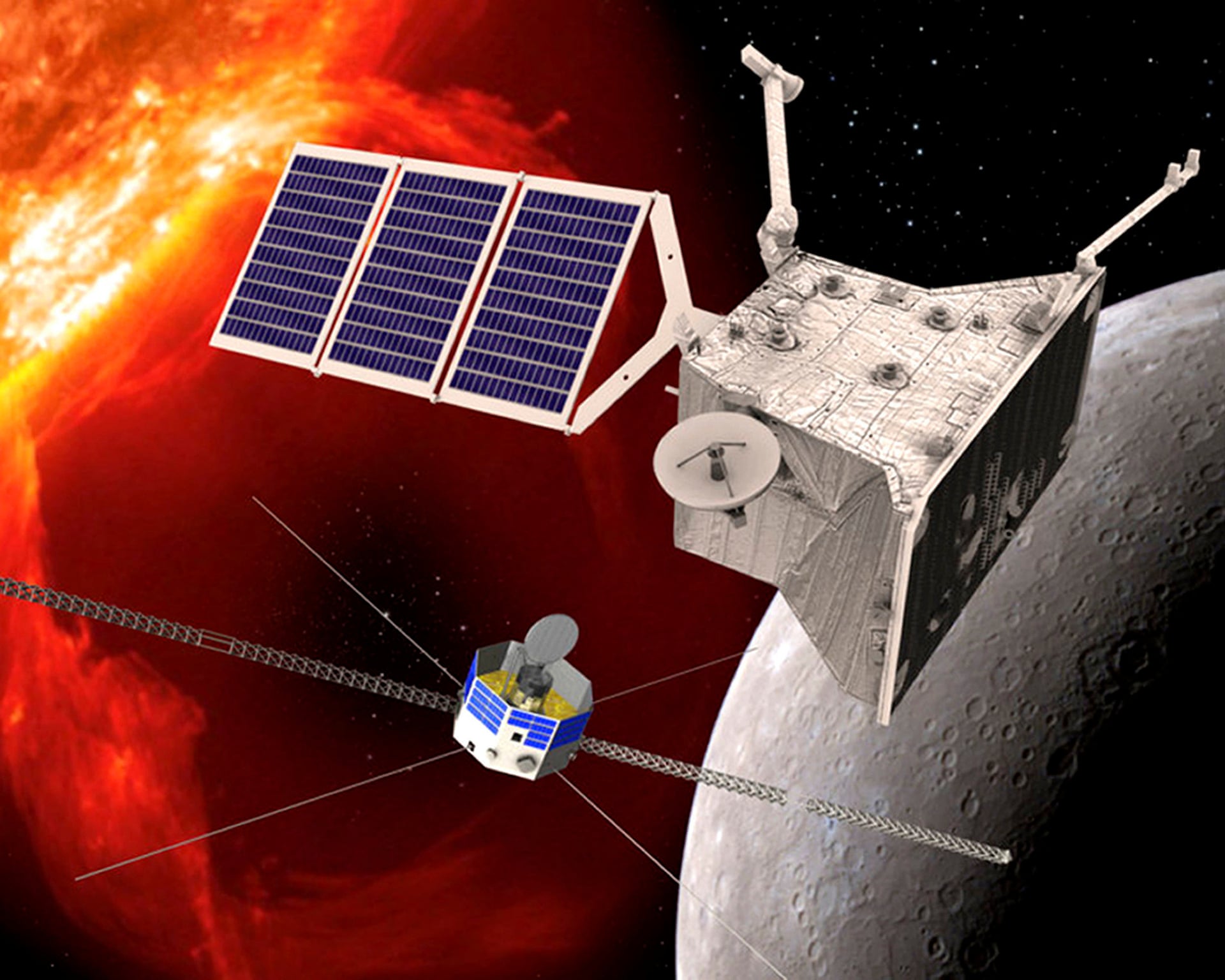
BepiColombo takes a different approach: a weak stability boundary capture that relies on a small maneuver at closest approach, followed by months of orbit-lowering burns. The mission’s electric thrusters lost power in April 2024 when unexpected currents appeared between the solar array and the power distribution unit, forcing a redesigned trajectory that added a year to the cruise.
Two orbiters, two science goals
Once captured, the composite spacecraft will split into the Mercury Planetary Orbiter (MPO) and JAXA’s Mercury Magnetospheric Orbiter, nicknamed Mio. MPO will map the surface and interior from a low polar orbit.
It targets the planet’s oversized iron core — which extends about 85 percent of the way from center to surface, compared with 55 percent for Earth — and the strange shallow depressions called hollows. Mio will swing into an elongated orbit to measure the magnetic field and the tenuous sodium exosphere.
“We're expecting to learn a huge amount, bringing more powerful instruments on two spacecraft to study all aspects of the planet – its interior, surface, and the space around it,” said Prof Geraint Jones, lead project scientist at the European Space Agency. The orbiters are expected to operate for about three years before running out of fuel and impacting the surface.
UK-built X-ray telescope passes first-light test
In September, the MIXS instrument observed the Crab Nebula during 55 spacecraft slews over 39 hours. The angular resolution came in slightly better than the last laboratory measurement in 2015, with no stray-light artifacts. “During our calibration observations we have determined that MIXS is generally performing fantastically well in space,” Bunce said.
“We see some self-fluorescence which appears when the Sun is illuminating the optic, but this won't affect our dayside observations of Mercury's surface. And the detector has suffered no radiation damage after eight years in space.”
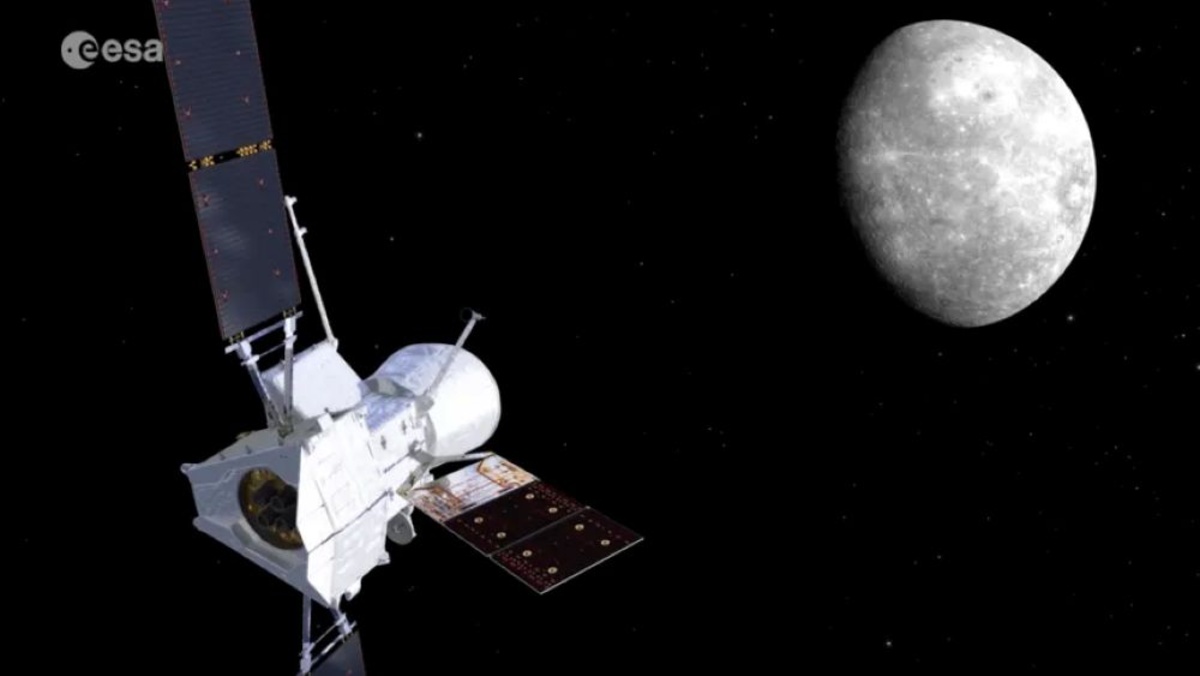
Mercury is the smallest planet in the Solar System and the closest to the Sun, orbiting at a distance that makes it the target with the highest delta-v requirement for spacecraft arriving from Earth.
Its iron core extends roughly 85 percent of the planetary radius, a proportion far larger than Earth’s 55 percent, giving Mercury the second-highest uncompressed density of any planet. The surface endures extremes from −170 °C at night to 420 °C in daylight, yet permanently shadowed polar craters may harbor water ice.
Key milestones ahead
- November 21, 2026 — Mercury capture (weak stability boundary)
- December 9–10, 2026 — MPO and Mio separate
- March 10, 2027 — MPO reaches final science orbit
- April 2027 — Science phase begins
“We have waited a long time to make measurements with MIXS and it is fantastic to see it operating brilliantly in space. 80% of the technology on MIXS is new,” Bunce said. The €1.6 billion mission now enters its most critical phase, decades in the making.
Keep reading

Ireland Orders Mandatory Poultry Housing From Monday After Bird Flu Found in Offaly Swans
A mandatory housing order for all poultry and captive birds takes effect across Ireland on Monday, November 23,...

Crufts Match Leads to Rare Pharaoh Hound Litter After 3,500-Mile Breeding Effort
Six newborn pharaoh hounds arrived in Hungary on November 18, a litter bred from a matchmaker’s nudge at...

Dr Steve Allder Says Gaming Engages Multiple Brain Networks
Millions of players are clearing schedules for Thursday's launch of Grand Theft Auto VI on PlayStation 5 and...

Central Florida Flood Crisis: 28 Inches of Rain, Record River Levels, Dozens Rescued
Central Florida’s Atlantic coast is waking up to a flood crisis that has already rewritten November rainfall records...