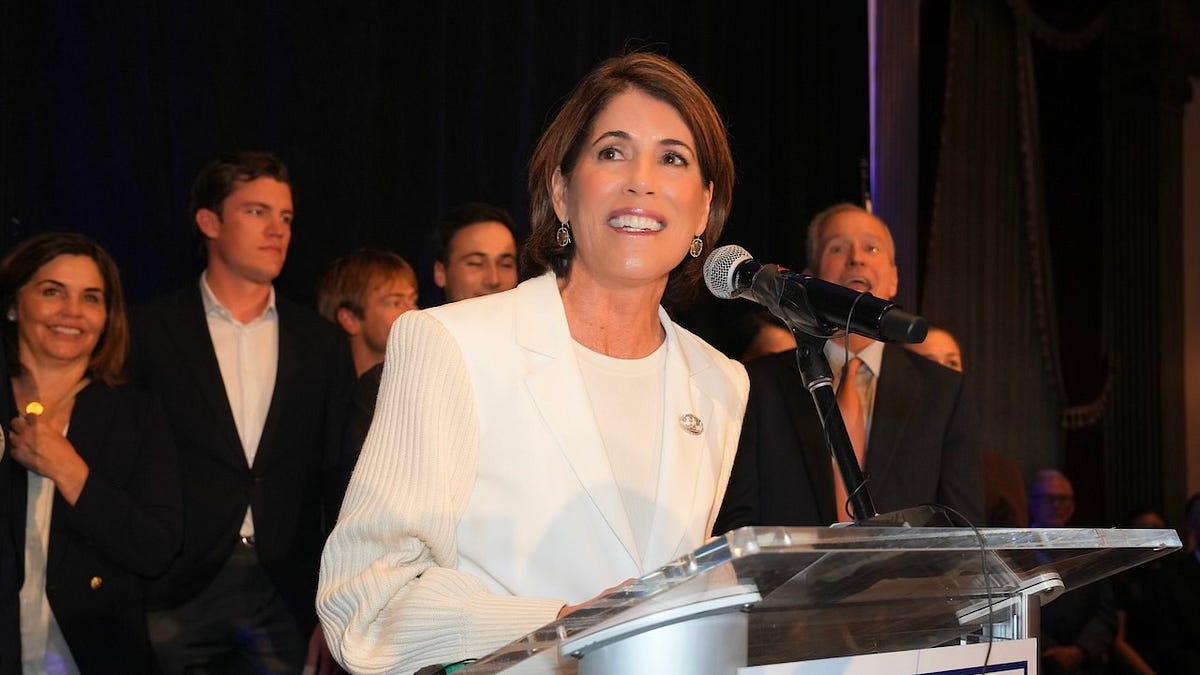
Helena Buonanno Foulkes won the Rhode Island governor’s race Tuesday night with more than 57 percent of the vote in a five-way contest, capping a night in which Democrats held every statewide office on the ballot and voters delivered a striking rebuke to a well-funded business coalition that spent anonymously across the state, Steve Ahlquist reported.
The margins were not close. Even if Republican Aaron Guckian had withdrawn and handed his entire vote share to independent Kenneth Block, Foulkes would still have carried a clear majority. In the lieutenant governor’s race, incumbent Democrat Sabina Matos won 60 percent of the vote — roughly 4,000 more individual votes than Foulkes received — easily beating Republican John Loughlin. Attorney General-elect Kimberly Ahern cruised to victory, noting in her acceptance speech at the Graduate Hotel in downtown Providence that she is the first openly gay person elected to one of the state’s five statewide seats, and that women now hold a majority of those seats for the first time.
Down the ballot, incumbent Democrat James Diossa easily defeated Republican Micholas Credle to win a second term as state treasurer, and Secretary of State Gregg Amore ran unopposed. Democratic Senators Jack Reed and Representatives Gabe Amo and Seth Magaziner all retained their congressional seats — though Magaziner’s race drew attention for an unusual opponent: Vic Mellor, a January 6 participant who spent millions of his own money, in the form of a loan, on the race.
A Senate caucus reduced to two — and a white-supremacist incumbent ousted
The real damage for Republicans came in the General Assembly. Democratic incumbents held every Senate seat they defended, but two Republican senators went down: Elaine Morgan of District 34 lost to Democrat Samantha Wilcox, and Thomas Paolino of District 17 lost to Democrat Nelly Burdette. That leaves the Senate Republican caucus with just two members — a position the source notes should not be fatal, since plenty of conservative Senate Democrats remain available as partners. Republican Richard Fascia also failed to defend his District 42 Johnston/Cranston seat against Democrat Edward Stravato.
One of the night’s most decisive results came in Woonsocket, where Democrat Veronicka Vega ousted Jon Brien, a white-supremacist independent, from his District 49 seat. In Cranston, former mayor and independent Allan Fung took the District 15 seat from Republican Christopher Palauskas with over 39 percent of the vote, with Democrat Collen Crudele finishing second.
The House saw a wave of turnover tied to higher-office runs. Amy Santiago won the District 7 Providence seat vacated by Providence Mayor-elect David Morales; Zakary Pereira took the District 22 Warwick seat vacated by Joseph Solomon Jr.; Nicole Jellinek won the District 67 Barrington/Warren seat left by her spouse, Jason Knight, who gave up his House seat for an unsuccessful attorney general bid; and William Muto took the District 23 Warwick seat vacated by former Speaker K. Joseph Shekarchi, who stepped down to pursue a judgeship. Angela Coburn won the District 27 seat vacated by retiring Patricia Serpa, Robert Craven Jr. inherited his father’s District 32 North Kingstown seat, Republican Michael Riley took the District 41 seat vacated by Robert Quattrocchi, and former senator James Shehan won the District 31 seat vacated by Julie Casimiro. Incumbent Megan Cotter also held District 39 against a Republican challenger backed by Moms for Liberty.
Bonds split: green economy passes, corporate welfare fails
The Green Economy Bond was the most popular measure on the ballot, a result that suggests voters do not want the state to temporarily weaken the Act on Climate to lower energy costs — they want the state to double down on it. Both Kenneth Block and outgoing Governor Daniel McKee campaigned on lowering energy costs at the expense of the environment, and both lost soundly to Foulkes.
But the clearest signal came on corporate welfare. The $100 million Economic Development Bond — written so broadly it could have funded anything from data centers to fossil fuel development — was rejected by voters despite expectations it would pass. Bond number 4, a $50 million proposal to build a new cultural center for the state’s treasures and documents, also failed — a result the source calls a shame but understandable in a state where energy, rent, food, health care, and education costs are rising faster than wages.
The League of Rhode Island Businesses, a group created by Brewed Awakenings owner Dave Levesque that exploited a campaign finance loophole to let wealthy conservative donors give anonymously across the state, endorsed candidates who went winless. Not one of their backed candidates won. The episode fed a broader argument the source presses directly: electing more business owners has not proven to produce better administrators, and the 2026 midterms offered little evidence otherwise — Elon Musk, after all, wasted nearly half a billion dollars on the cycle.
Finally, the Providence mayor’s race showed voters shrugging off a “red-scare” campaign. Incumbent Brett Smiley ran hard against David Morales’s brand of socialism, to no avail. Voters, the source argues, see Morales’s platform not as a threat but as the services their tax dollars are supposed to pay for — education, housing, and climate action — while rejecting the one form of socialism they do dislike: corporate welfare handed to billion-dollar industries.

UW-Platteville volleyball beats Cornell College in five sets
The University of Wisconsin-Platteville volleyball team dug out of a two-set hole and beat Cornell College 25-17, 22-25,...

Phil Scott Wins sixth term as Vermont governor defeating Amanda Janoo
Vermont Governor Phil Scott won an unprecedented sixth two-year term on Tuesday, defeating Democrat Amanda Janoo 52 to...

Seattle Public Utilities warns of road flooding, ponding from coming rain systems
Seattle Public Utilities is warning that a series of soaking storm systems rolling through this weekend and into...

Building Inclusive Communities: Jonathan Zur’s Cookson Lecture at Batten University
At a moment when American public life feels increasingly fractured, the question of what actually binds neighbors to...