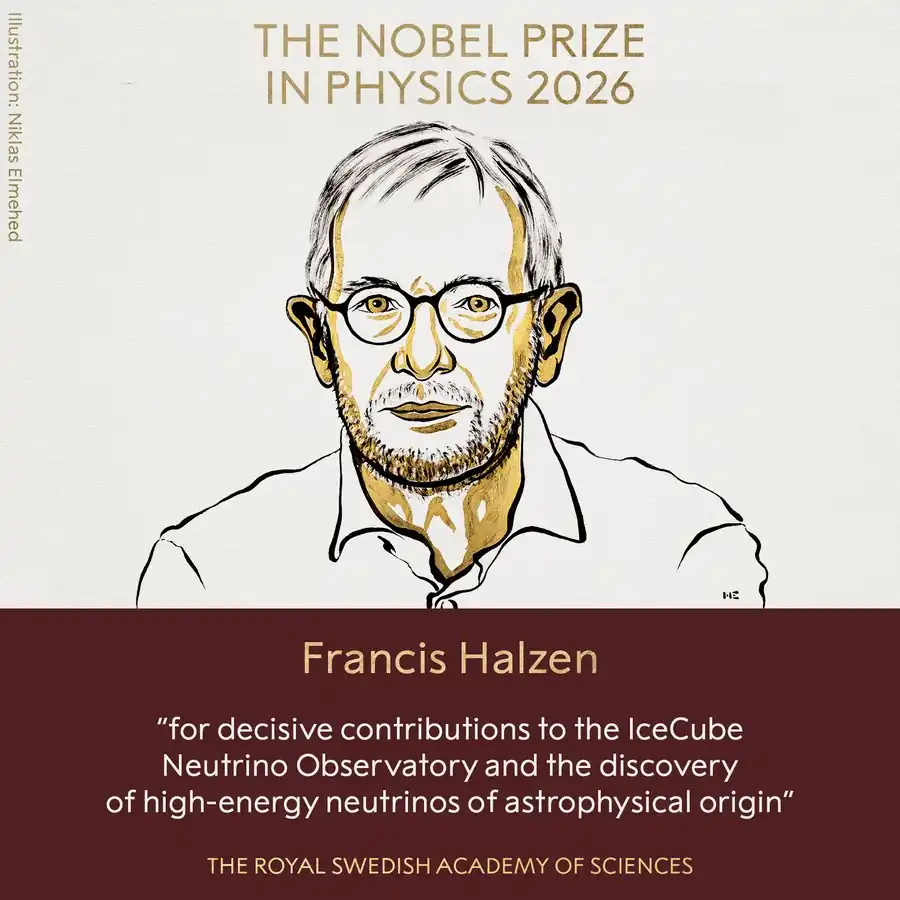
Francis Halzen, a professor at the University of Wisconsin–Madison, was awarded the 2026 Nobel Prize in Physics for his work with the IceCube Neutrino Observatory. His contributions led to the discovery of high-energy neutrinos from distant astrophysical sources, providing a new method for studying the universe.
For centuries, the study of the cosmos relied on light from galaxies and stars. However, certain high-energy events leave clues that light cannot fully reveal. Neutrinos, fundamental subatomic particles that rarely interact with matter, can travel vast distances without being absorbed, scattered, or blocked. This allows them to preserve information about their origins that light cannot.
The Scale of IceCube at the South Pole
Detecting neutrinos is difficult because they are so elusive; billions pass through the human body every second without a trace. To capture them, the IceCube Neutrino Observatory uses a cubic kilometer of Antarctic ice—roughly one-fourth of a cubic mile—as a giant detector. When a high-energy neutrino strikes an atom in the ice, it creates a flash of light detected by thousands of sensors embedded deep below the surface.
BREAKING NEWSThe Royal Swedish Academy of Sciences has decided to award the 2026 #NobelPrize in Physics to Francis Halzen “for decisive contributions to the IceCube Neutrino Observatory and the discovery of high-energy neutrinos of astrophysical origin.” pic.twitter.com/UcPBWk0RiK
For every billion, billion, billion [1,000,000,000,000,000,000,000,000,000, or one octillion] neutrinos that pass through your detector, a single one might strike an atom in your detector and reveal itself with a flash of light.
Bryce Littlejohn, Associate Professor of Physics at Illinois Tech
Halzen established the theoretical foundations for using ice as a detector decades before the observatory was built. During a post-Nobel Prize news conference, Halzen noted that while some previously believed the idea would never work
, the greatest surprise is that we did make it work
.
Testing Physics Beyond Particle Accelerators
The neutrinos captured by IceCube possess significantly higher energy than those produced by the sun. These particles are thousands of times more energetic than those humans can generate at particle accelerator labs like CERN or Fermilab. By observing these extreme energies, physicists can look for clues that existing theories cannot yet explain.
2026 physics laureate Francis Halzen realised that ice at the South Pole could be used to track particles known as neutrinos. His vision and scientific leadership have been fundamental for the IceCube Neutrino Observatory – a cubic kilometre of ice that is equipped with light… pic.twitter.com/sgpv040U87
Combined Observation Methods Provide Complete Picture of Stellar Explosions
It’s like opening up a whole new window into studying the universe that we hadn’t had before.
Goni Halevi, Assistant Teaching Professor of Physics at Illinois Tech
Halevi suggests that a more complete picture of stellar explosions will come from combining three different observation methods: light, gravitational waves, and high-energy neutrinos.
More on Nobel Prize
IceCube Principal Investigator and @UWMadison Prof. Francis Halzen has been awarded the 2026 Nobel Prize in Physics "for decisive contributions to the IceCube Neutrino Observatory and the discovery of high-energy neutrinos of astrophysical origin.” 🎉🏅#NobelPrizeInPhysics2026 pic.twitter.com/nyfVYJto5M
“Beyond all the other risks, this was what really made the project possible – and that was pure luck.” We got hold of the new physics laureate Francis Halzen right after he learned of his Nobel Prize. In this conversation, he speaks about the hurdles that he and his team had to… pic.twitter.com/YDdKuStCeL
Say hello to our 2026 physics laureate Francis Halzen! Halzen sent us a snapshot from his hotel room in Italy – join us in congratulating our new #NobelPrize laureate. pic.twitter.com/5nlwBADLk0
Keep reading

Mass General Brigham to close PANS/PANDAS program and lose doctor
"This is a joke list," said Kim Panton, a PANS/PANDAS advocate and mother of two adult sons who...

India to cut retail prices of 543 anti-cancer medicines by up to 90%
India is preparing to slash the retail prices of 543 brands of anti-cancer medicines by up to 90...

Levetiracetam in Dogs: Crushing vs. Splitting ER Tablets
Crushing extended-release levetiracetam tablets in dogs alters how the drug enters the bloodstream, causing it to produce a...

BTNGR: Mt Rinjani Gave Rp443 Billion Economic Impact (2021-2025)
Between 2021 and 2025, tourism and ecosystem services at Mount Rinjani National Park generated an economic turnover of...