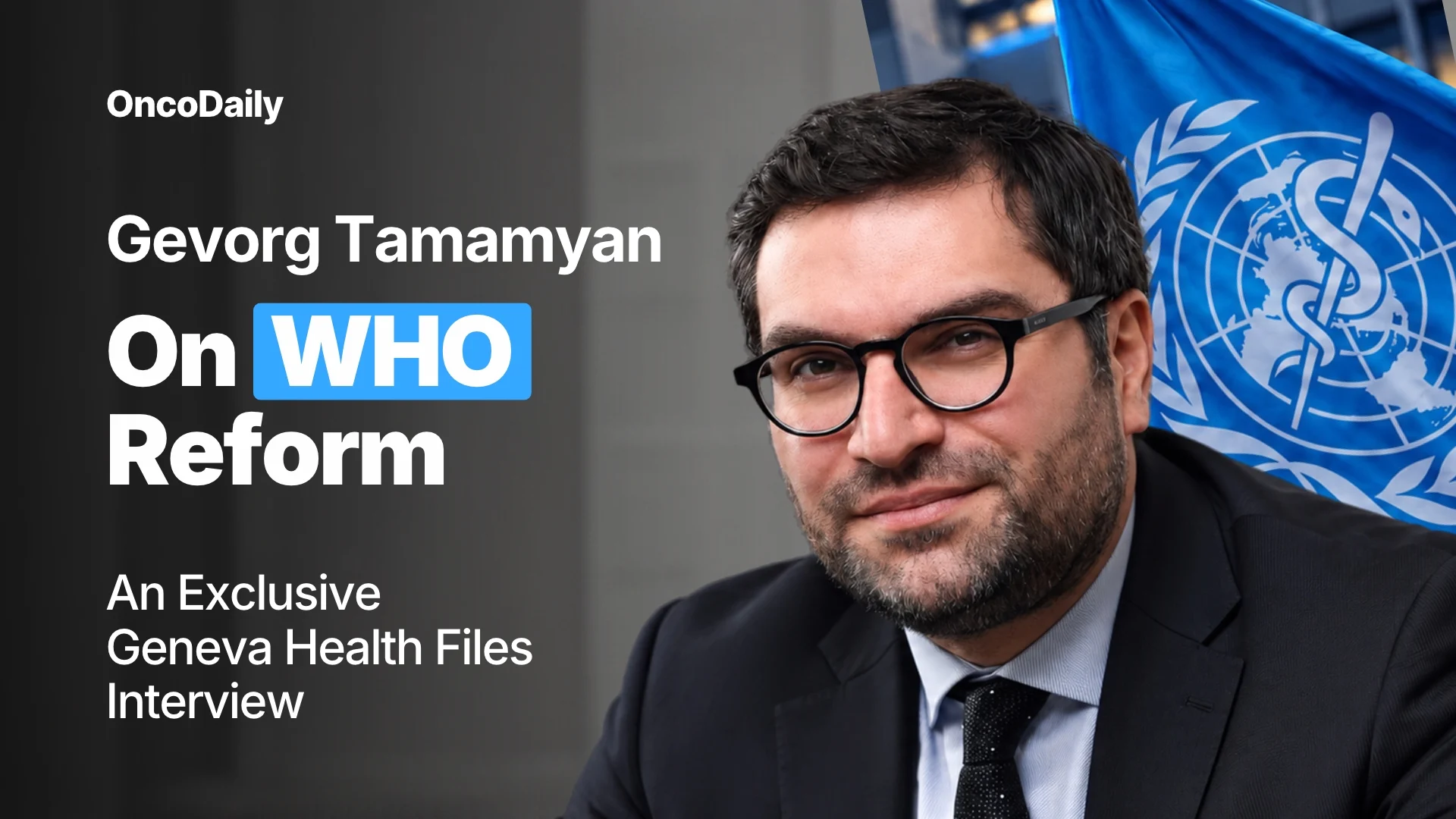
Gevorg Tamamyan Outlines Vision for WHO Reform Following Botswana Nomination
As the World Health Organization enters a critical period of transition, pediatric oncologist Gevorg Tamamyan has emerged as a candidate for Director-General with a platform centered on institutional downsizing, financial independence, and a radical shift toward measurable healthcare delivery. Nominated by Botswana, Tamamyan detailed his strategic outlook in an interview originally conducted by Priti Patnaik of Geneva Health Files and subsequently republished by OncoDaily on November 5, 2026.
“We are proud to see one of our alumni on this incredible trajectory” Global Health Delivery Project at Harvard University congratulates Dr. Gevorg Tamamyan (@GevTamamyan) on his candidacy for @WHO Director-General. Read more on OncoDaily.https://t.co/tKKQ57Eqpl@Harvard pic.twitter.com/OvzXqTP3Yo
Tamamyan, who has held leadership roles in the International Society of Pediatric Oncology Asia Continental Branch and served as a co-chair of the St. Jude Global Alliance regional committee, argues that the WHO must pivot away from its current role as a sprawling bureaucracy. Instead, he contends the organization should focus on a limited set of flagship priorities where it can exert genuine global influence. This proposed “doing fewer things, fully” approach is designed to restore the trust lost through unfunded mandates and fluctuating geopolitical support.
A New Financial Architecture for Global Health
Central to Tamamyan’s candidacy is a proposal to overhaul the organization’s funding model. He advocates for transforming the WHO Foundation into a mass-market vehicle for individual donations, aiming to emulate the success of institutions like St. Jude Children’s Research Hospital. His stated goal is to mobilize $250 million annually in unearmarked support by 2032, scaling to $1 billion by 2037.
For the American public, these reforms carry significant weight. As the United States remains a primary donor to global health initiatives, the prospect of a more transparent, metric-driven WHO could alter how federal aid is allocated and monitored. Tamamyan emphasizes that financial security is directly tied to visible results. He proposes that the Director-General and regional leads publish an annual “report card” for the Executive Board, detailing progress against specific health metrics and explaining any failures in implementation.
“Donors do not fund invisibility. Every year the Director-General, ADGs and Regional Directors will present a public report card to the Executive Board on progress against agreed metrics, including what was not delivered and why,” Tamamyan stated in the interview.
Bridging the Gap Between Science and Delivery
Tamamyan’s background as a physician-scientist in Armenia—where he consolidated fragmented pediatric oncology services and raised survival rates to approximately 80%—informs his skepticism of top-down global health governance. He argues that the primary failure of the current scientific establishment is not a lack of data, but a failure to translate evidence into equitable access at the community level. He proposes shortening the timeline for issuing scientific guidelines and integrating younger scientists into the organization’s leadership structure to ensure that WHO policies remain grounded in current clinical realities.
His approach to climate change reflects a similar focus on pragmatic, local application rather than broad, abstract policy. He suggests that the WHO should provide countries with a “practical toolkit” to build climate-resilient health facilities. This includes developing supply chains capable of maintaining the delivery of insulin, chemotherapy, and dialysis services during extreme weather events, rather than focusing solely on global emissions advocacy.
Accountability in a Changing Landscape
The candidate acknowledges that he is not a traditional “Geneva insider,” a label he views as an asset in the current political climate. With two Member States having recently withdrawn from the organization, Tamamyan argues that the WHO must prove its relevance by standing alongside nations rather than attempting to dictate policy from above. He supports the principles of the “Accra Reset,” which prioritize country ownership and the development of local manufacturing capacity for vaccines and diagnostics.
However, his proposal to strictly limit the organization’s scope faces potential opposition from member nations that rely on the WHO for a wide array of technical and social services. By promising to be “disciplined” and willing to decline projects that lack clear potential for impact, Tamamyan risks alienating partners accustomed to the current, more expansive, and often fragmented mandate. Whether these reforms can be implemented within the rigid framework of the WHO’s existing governance structure remains the central question for Member States as they evaluate the field of candidates.
Worth a look

Micheál Martin to attend first Taoiseach visit to PSNI ceremony
Taoiseach Micheál Martin Marks Quarter-Century of Northern Ireland Policing Micheál Martin will today become the first Taoiseach to...

Japanese Minister Blames X for Diplomatic Near-Miss
Tokyo. A Japanese minister held Elon Musk's X social media platform responsible on Friday for nearly creating a...

Inside Team Trump’s Midterm Collapse: Hubris and Wreckage
Gallows Humor on a Private Call Before a Historic Midterm Wipeout Six days before a midterm election that...
Malaysia Ranks Among Top 3 Global Destinations for International Student Growth
Malaysia Ranks Third Globally for International Student Growth in ICEF Insights 2027 Malaysia has secured a spot among...