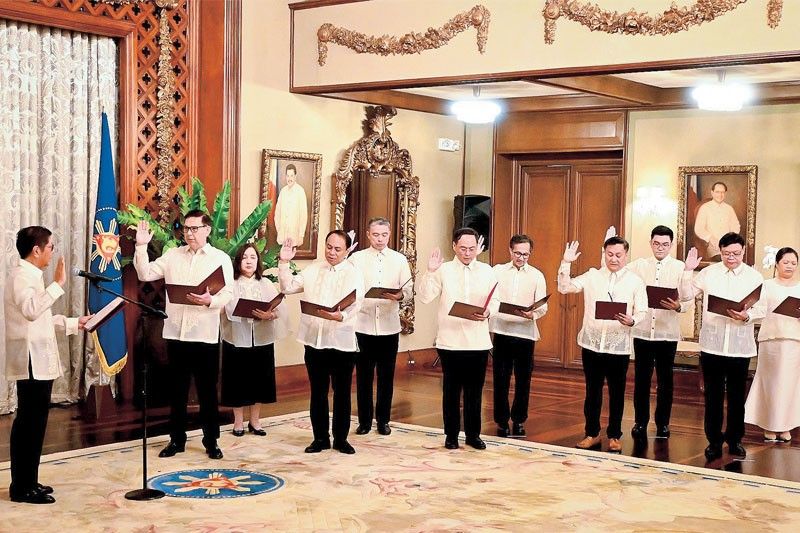
President Marcos Swears in 10 Cabinet Officials
President Ferdinand Marcos Jr. administered the oath of office to 10 senior government officials on Friday, November 6, 2026, marking a significant step in the administration’s leadership transition. The ceremony at Malacañang Palace formalized the roles of these individuals as ad interim appointees, a move that allows them to assume their duties immediately while awaiting the mandatory confirmation process by the Commission on Appointments.
During the event, President Marcos expressed strong confidence in his new team, describing them as the “best team ever assembled” since the administration of his father, the late former president Ferdinand Marcos Sr. This sentiment was reported across multiple outlets, including The Manila Times, Philstar.com, and The Filipino Times, highlighting the administration’s emphasis on continuity and experience.
The Path to Confirmation
The appointment process is not yet final. Because the appointments are classified as “ad interim,” they are subject to review by the Commission on Appointments, a constitutional body comprised of members from both the Senate and the House of Representatives. Executive Secretary Ralph Recto clarified the procedure following the oath-taking, noting that the administration has already submitted the necessary documentation to the commission.
President Marcos has transferred the administrative supervision of the Presidential Commission for the Urban Poor (PCUP) and the National Anti-Poverty Commission (NAPC) to the Office of the President, bringing the two agencies back under direct Palace oversight.…
“Itong oath-taking ngayon ay ibig sabihin lahat kami dito ngayon, ad interim appointments ng Pangulo. Dadaan kaming lahat sa Commission on Appointments. Nakapag-submit na tayo sa Commission on Appointments,” said Executive Secretary Ralph Recto.
This constitutional check serves as a balance between the executive and legislative branches, ensuring that high-level officials undergo public scrutiny before receiving permanent tenure. The timing of these appointments—made while Congress is in recess—is a standard mechanism that ensures government operations continue without interruption.
Key Appointments and Agency Leadership
The roster of officials sworn in reflects a broad range of responsibilities spanning infrastructure, economic management, and social services. The complete list of the 10 officials includes:

- Ralph Recto – Executive Secretary
- Fredderick Vida – Secretary of Justice
- Giovanni Lopez – Secretary of Public Works and Highways
- Francis Tolentino – Secretary of Labor and Employment
- Edwin Mercado – Secretary of Health
- Juan Miguel Cuna – Secretary of Environment and Natural Resources
- Maria Bernardita Mathay – Secretary of Tourism
- Vivencio Dizon – Secretary of Transportation
- Kim Robert De Leon – Secretary of Budget and Management
- Gay Jane Perez – Director General of the Philippine Space Agency
This group follows the oath-taking of Finance Secretary Frederick Go, who was sworn in on Thursday, November 5. The administration has signaled that these appointments are intended to address long-standing challenges and drive priority programs forward. According to Malacañang, the primary expectations for these leaders are stronger accountability, cleaner governance, and the delivery of tangible results for Filipino families.
Economic and Social Stakes
The urgency behind these appointments appears linked to broader administration goals, including the push to make the upcoming holiday season more affordable for citizens. Presidential communications have emphasized that public service must translate into concrete actions that protect the welfare of families and workers. For the average Filipino, the effectiveness of these secretaries—particularly in the departments of Public Works, Transportation, and Budget—directly influences the pace of infrastructure development and the availability of essential social services.
While the administration remains optimistic about this “best team,” the confirmation process will offer a platform for legislators to evaluate the policy directions of these specific departments. As these officials settle into their posts, the public will be watching to see how their leadership impacts the day-to-day economic realities of the country, from infrastructure project timelines to the management of national fiscal resources.
Related reading

Mary Ebert argues U.S. healthcare system has systemic inefficiencies
The Rising Disconnect Between Healthcare Spending and Access In a recent column for InForum, Mary Ebert, a resident...

Witnesses describe Scarlett Faulkner assault at murder trial
The Scene at Birdhill: A Trial Unfolds On the afternoon of March 21, 2026, motorists driving near the...

Can Changing Food Order Help Blunt Blood Sugar Spikes? New Study Suggests Benefits
Olive Oil Before Glucose: Does Meal Sequence Control Blood Sugar Spikes? A new study published in the journal...

Nepal PM Balen Shah meets Indian diplomat ahead of India trip
For months, the diplomatic temperature between Kathmandu and New Delhi hovered near a freezing point. As recently as...