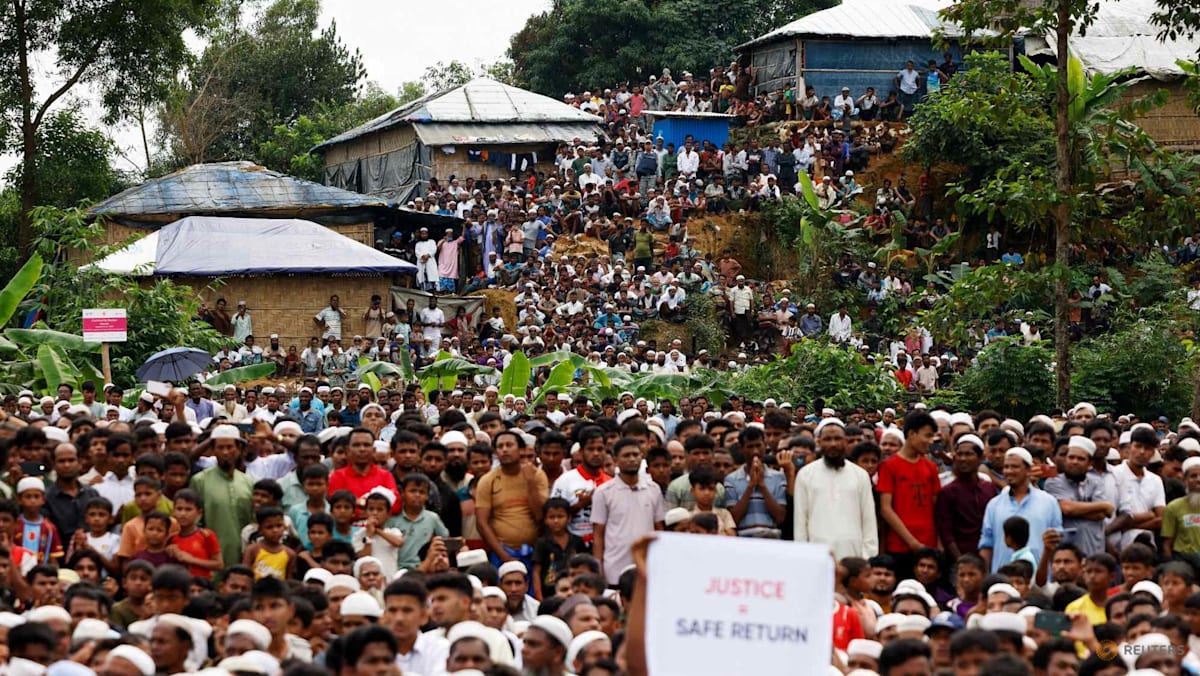
“A judgment on paper is not justice in life — now it must be given effect,” said Khalilur Rahman, calling for the Rohingya’s safe, voluntary and dignified return.
The International Court of Justice ruled Thursday that Myanmar committed genocide against the Rohingya, the first time in the court’s 80-year history it has held a state responsible for the crime.
The 9-6 decision, delivered after seven years of proceedings, found that Myanmar’s military “systemically destroyed” Rohingya villages and replaced inhabitants with non-Rohingya populations during 2016-2017 clearance operations.
Presiding Judge Iwasawa Yuji said the scale and nature of atrocities were “characteristic of an intent to destroy a substantial part of the group,” rejecting Myanmar’s defense that actions were legitimate counter-terrorism operations. The court ordered safe passage for refugees, unspecified reparations, and prosecution of suspected perpetrators.
Myanmar rejects verdict as ‘unfair’
Myanmar’s presidential spokesperson called the ruling “unfair” Friday, emphasizing the six dissenting votes among 15 judges. “So this was not a unanimous decision … I would say it is not fair,” the spokesperson said. The military-led government has consistently denied genocide, maintaining its forces targeted a violent insurgency by the Arakan Rohingya Salvation Army.
Min Aung Hlaing, who headed the military during the 2016-17 operations and now leads the ruling junta, already faces a separate arrest warrant from the International Criminal Court for crimes against humanity. He was installed as civilian president in April after elections widely discredited by the international community.
The @CIJ_ICJ judgment finding Myanmar responsible for genocide must be a turning point for justice for the Rohingya. Their suffering is a stain on the conscience of humanity. https://t.co/dQjeqWhfBm pic.twitter.com/HHEbbaNqfA
Washington treads carefully amid Gaza case
The U.S. State Department said Thursday it was “examining the judgment” while stressing the need to avoid “politicisation” of the ICJ. The cautious response reflects opposition to South Africa’s genocide case against Israel over Gaza, which the ICJ agreed to hear following The Gambia’s successful application against Myanmar. The Trump administration has vowed to dismantle the International Criminal Court but has not questioned the ICJ’s legitimacy.
Notably, the Biden administration formally determined in 2022 that Myanmar committed genocide against the Rohingya. noted the current cautious stance may signal concern over precedent implications for the Israel case, which is not expected to reach merits arguments until 2029.
MULTIMEDIA: View photos and videos of the reading of the #ICJ Judgment in the case concerning Application of the Convention on the Prevention and Punishment of the Crime of Genocide (The #Gambia v. #Myanmar: 11 States intervening).https://t.co/oRTwbZIESg pic.twitter.com/y4LqB5ORfv
Beijing warns of ‘judicial overreach’
China’s Foreign Ministry spokesperson Guo Jiakun said the Rakhine State issue has a “highly complex historical, ethnic and religious background” requiring a “comprehensive and measured approach.” Beijing criticized what it called jurisdictional overreach by the court. China has deep economic ties to Myanmar and has shielded the junta from stronger UN Security Council action.
EU UK UN endorse ruling demand enforcement
The European Union called the judgment “a landmark ruling” underscoring “the imperative of justice for victims and the necessity of upholding international law.” UN Secretary-General António Guterres called it “a demonstration of international justice and a reaffirmation that impunity for such horrific acts must not stand.”
LEARN MORE: The full text of the #ICJ Judgment in the case concerning Application of the Convention on the Prevention and Punishment of the Crime of Genocide (The #Gambia v. #Myanmar: 11 States intervening).https://t.co/IEAfHOc2Te pic.twitter.com/Ny8sCWLU9P
The UK expelled Myanmar’s defense attaché and called for measures to “ensure the court’s ruling sends a clear message that such crimes cannot be committed with impunity.” However, the ICJ lacks enforcement power; its orders go to the UN Security Council, where China and Russia hold vetoes.
Precedent ripples toward Gaza case
Legal experts say the Myanmar ruling strengthens South Africa’s case against Israel. The court established that genocidal intent can coexist with a stated military objective — a central dispute in the Gaza proceedings. South African Foreign Minister Ronald Lamola welcomed the judgment as setting “an important precedent by establishing for the first time that a state had committed genocide.”

Israeli legal scholar Yuval Shany said the ruling could broaden arguments available to South Africa. The court maintained the “only reasonable inference” standard for genocidal intent but expanded contextual factors courts may consider. Marieke de Hoon, professor of international criminal law at the University of Amsterdam, highlighted the court’s emphasis on “systematic nature and scale of the crimes.”
The Initiative for International Cooperation (Thinc), a think tank funded by pro-Israeli groups, said the judgment imposes a “lower threshold for proving genocidal intent, with serious consequences for Western militaries engaged in confronting terror,” calling it “not only a verdict in a particular case but a template.”
The @CIJ_ICJ has found #Myanmar responsible for genocide against the #Rohingya, in the case of The Gambia v. Myanmar. It is the first time in the court's history that a State has been held responsible under the Genocide Convention. https://t.co/QckKqbmo36 pic.twitter.com/E3JuQFZvyH
Refugees face war-torn homeland
About 1.2 million Rohingya refugees now live in Bangladesh, primarily in Cox’s Bazar camps where they cannot legally work and face trafficking, exploitation, and meagre food rations. The court accepted a UN fact-finding estimate that Myanmar’s 2017 campaign killed at least 10,000 people, calling the figure “supported by the record.” More than 700,000 fled during that period, joining roughly 815,000 Rohingya who lived in northern Rakhine State before 2017.
Pyay Lynn, a 31-year-old Rohingya in Rakhine State, said repatriation “has to happen” but acknowledged risks: “In Rakhine state, many civilians are dying from military airstrikes” amid a civil war triggered by the 2021 coup that has killed more than 100,000 people on all sides, according to conflict monitor ACLED. “Such mass killings of civilians also can be viewed as genocide,” he said.
Regional resettlement efforts expand
Malaysia said it is seeking to resettle 10,000 Rohingya migrants in Turkey, part of efforts to address an influx of asylum seekers, most from Myanmar. In September, Malaysia repatriated around 1,500 Myanmar nationals in a scheme rights advocates say may endanger migrants by returning them to a country at war.
“The Rohingya do not want to live in refugee camps forever. We want to return to our homeland in Rakhine state with our rights, our citizenship, and our dignity fully restored,” Alam, a refugee in Cox’s Bazar, said.
More on Myanmar
The International Court of Justice delivered its judgment on the merits on 19 November. Brought by The Gambia in 2019, the case concerns Myanmar’s alleged violations of the Genocide Convention against the Rohingya.
Somalia Orders UAE Ambassador Out in 72 Hours, Minister Says
Somalia ordered the United Arab Emirates ambassador to leave within 72 hours on Thursday, severing diplomatic ties in...

AARP Report: 63 Million U.S. Caregivers Face Rising Costs
A 2025 report from AARP and the National Alliance for Caregiving puts the number of family caregivers in...

Funding Gaps and Taliban Bans Shut 300 Afghan Clinics, Cut off 1m Women
Nearly 300 humanitarian health facilities have shut down or suspended operations across Afghanistan, cutting off more than one...

Two Iranian Men Convicted of Spying on Journalists for IRGC Under National Security Act
Two Iranian men were convicted at Woolwich Crown Court on Thursday of spying on dissident journalists and a...