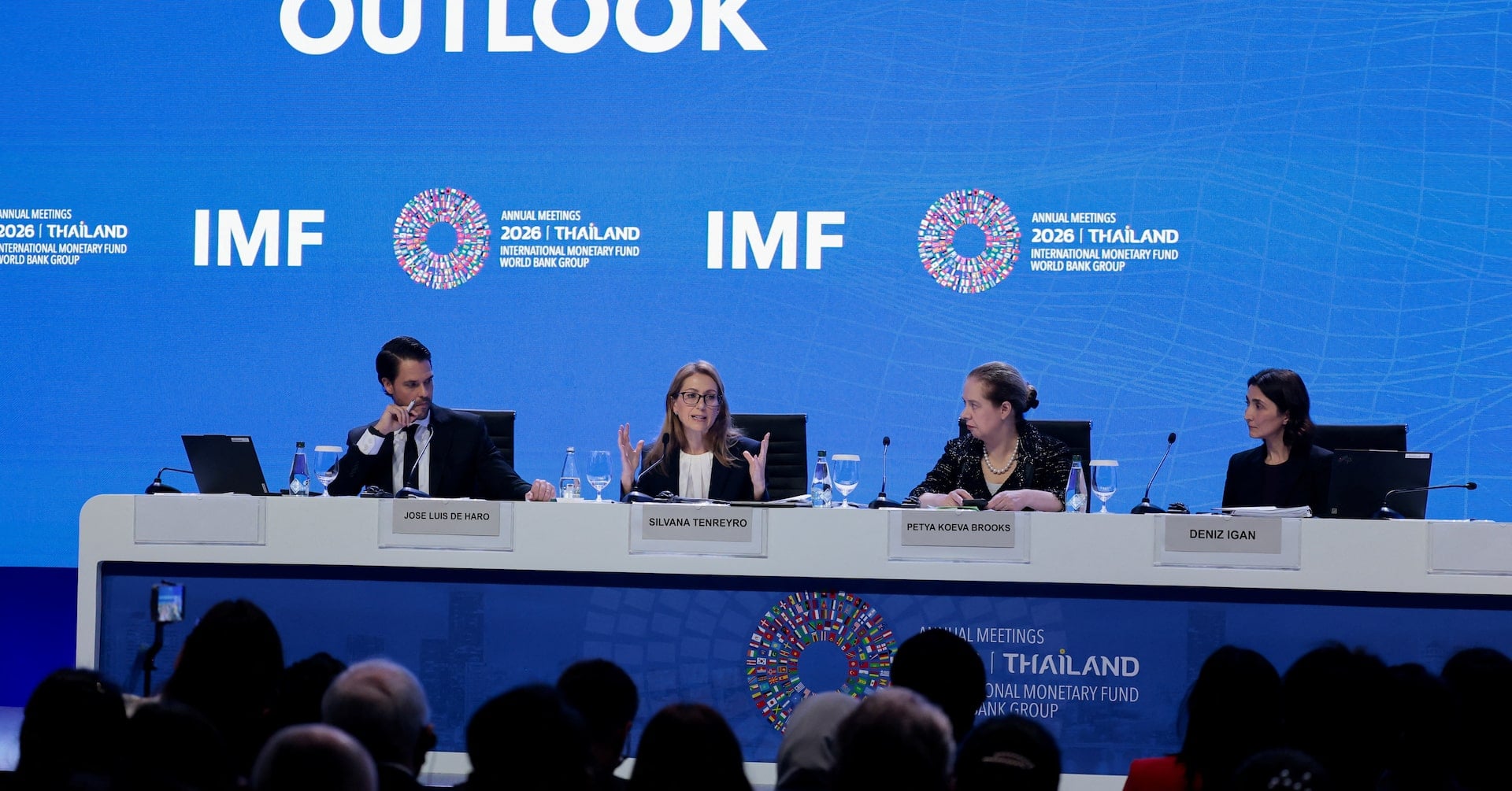
Global financial stability faces threats from artificial intelligence market corrections, rising government bond yields, and cyberattacks, the International Monetary Fund warned in its twice-yearly report published on Tuesday, October 13, 2026.
Athanasios Vamvakidis, deputy director in the IMF’s Monetary and Capital Markets Department, stated at a press briefing in Bangkok that an artificial intelligence market correction will affect the real economy. The International Monetary Fund cautioned global markets against complacency, pointing to strong risk sentiment that remains underpinned by solid earnings and optimism surrounding artificial intelligence. However, the agency warned that such resilience does not equal safety. Policymakers must monitor plausible near-term catalysts, including a sudden sell-off in AI-related assets, spiking sovereign bond yields, and major cyberattacks that could tighten financial conditions and trigger market turmoil.
Hyperscalers Drive Rise in Global Bond Issuance
Hyperscalers building foundational infrastructure now account for 10% of global investment-grade bond issuance, marking a sharp rise from less than 1% in 2024. The IMF highlighted sky-high valuations for technology companies alongside surging debt piles as core vulnerabilities in the modern financial architecture. While AI investments have helped offset economic drags from policy uncertainty and conflict in the Middle East, growing evidence suggests that successful rollout capabilities may not require investment on the massive scale being undertaken by hyperscaler firms, and potential economic gains might fall short of expectations.
The seven major tech stocks often designated as the magnificent seven—Alphabet, Amazon, Apple, Meta, Microsoft, Nvidia, and Tesla—now account for more than 35% of the S&P 500 index in the United States, compared to 12% a decade ago, with their total market capitalization increasing by over 50% in the past two years. The sector’s heavy reliance on debt and interconnected financing arrangements amplifies the danger. The report also identified hundreds of billions of dollars in circular financing transactions linking stronger AI companies to weaker partners, which could worsen the impact of any market downturn.
“The consequences of an AI correction could be global.”
International Monetary Fund, Global Financial Stability Report
Increasing debt spans hedge fund positioning and retail investors borrowing to speculate on tech equities.
High Sovereign Debt Increases Systemic Vulnerabilities
Bond market risks have intensified since the April report as higher energy costs drive government bond yields upward. Athanasios Vamvakidis, deputy director in the IMF’s Monetary and Capital Markets Department, addressed reporters at a press briefing in Bangkok, noting that while each specific risk might be manageable independently, they could combine to trigger systemic vulnerabilities. Historically high sovereign debt levels and unresolved fiscal deficits across major economies add further pressure while central banks reduce their balance sheets.
“An AI market correction will affect the real economy.”
Athanasios Vamvakidis, deputy director in the IMF’s Monetary and Capital Markets Department
Geographically, exposure to United States assets and artificial intelligence stands at an all-time high. While this reliance currently supports the global economy via wealth effects, a U.S. market correction carries broad international implications. Asian markets face the highest exposure outside the U.S., whereas the United Kingdom and the euro area remain comparatively insulated, though investors holding American assets would still absorb losses.
Software Providers Struggle to Patch Cyber Vulnerabilities
In over 70% of recorded cases, software providers had virtually no time to patch vulnerabilities before exploitation occurred—marking a 20 percentage point jump compared to the previous year. Cybersecurity vulnerabilities represent the third major pillar of systemic risk highlighted by the agency. Emerging markets face heightened threats due to limited resources and an over-reliance on a small cohort of critical technology providers. Although artificial intelligence can assist defense strategies, sophisticated actors are simultaneously utilizing models to launch more complex assaults.
Even so, lenders holding 22% of global banking assets displayed weak capital levels during evaluations, up from 18% in the 2025 assessment, signaling localized pockets of vulnerability that require strict regulatory oversight. Despite these combined pressures, IMF stress test models indicate that broader banking sectors retain capital cushions against a hypothetical downturn driven by bond market strains and an AI slowdown.

Frasers Group Increases Stake in Burberry to 7.42 Percent
Frasers Group has increased its stake in Burberry to 7.42 percent through put options, marking its second purchase...


Mary Chia Holdings Admits Disclosure Lapses Over Subsidiary CPF Arrears
Cash-strapped Singapore beauty group Mary Chia Holdings has admitted to disclosure lapses, omitting court proceedings and Central Provident...

Assessment: China Local Government Debt Hit 10 Trillion RMB by End of 2024
Municipal financial obligations reached 10 trillion RMB (US$1.37 trillion) at the close of 2024, representing about 7 per...