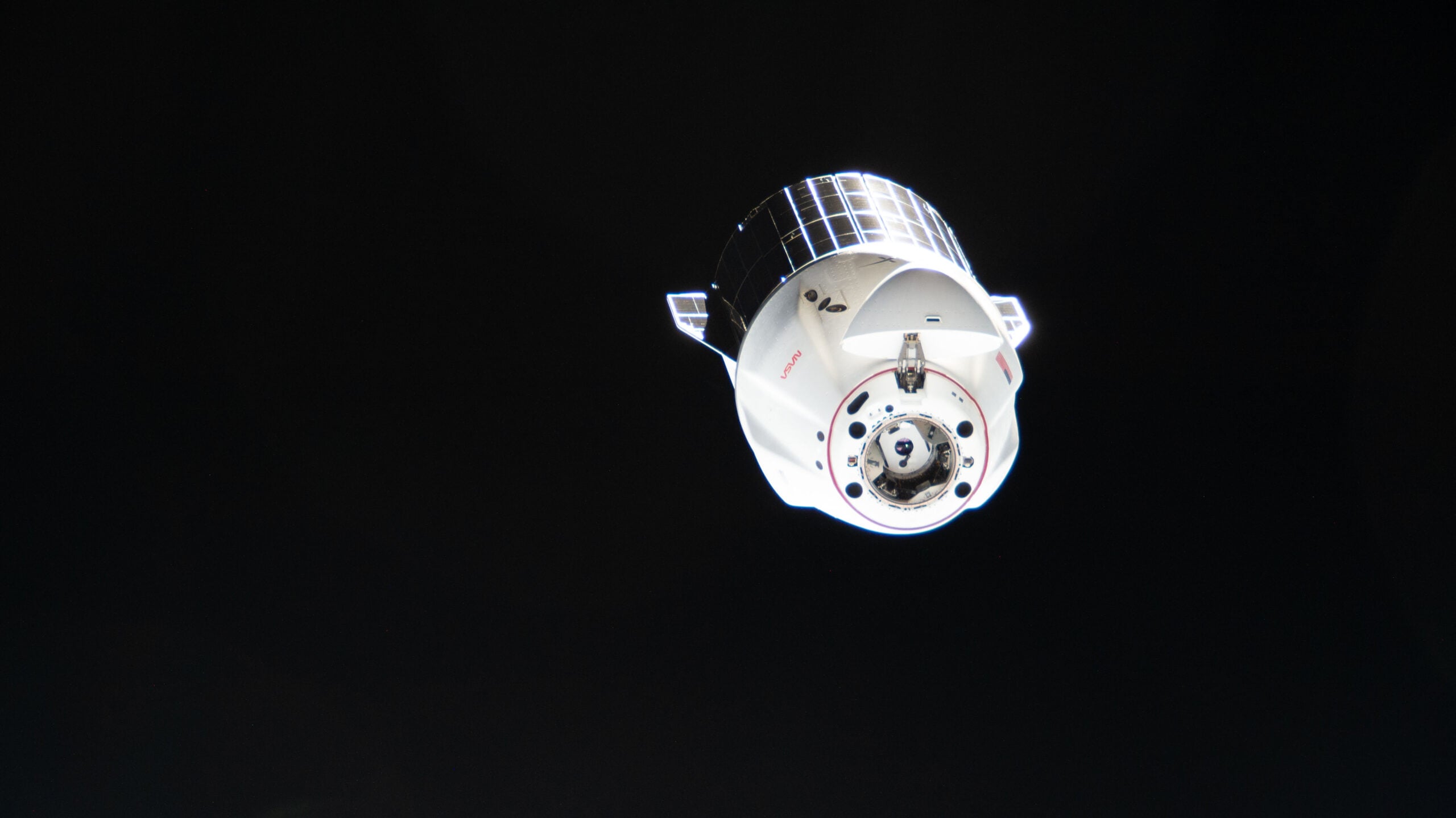
NASA and SpaceX are targeting Tuesday, October 13, for the launch of the 35th commercial resupply mission to the International Space Station. A Falcon 9 rocket will carry over 6,300 pounds of scientific research and hardware, including the final set of solar arrays intended to boost the station’s long-term power capacity.
CRS-35 Targets October Liftoff from Cape Canaveral
The CRS-35 mission is scheduled to lift off from Space Launch Complex 40 at Cape Canaveral Space Force Station in Florida. Liftoff is targeted for 6:33 a.m. EDT, with a backup opportunity available on Wednesday, October 14, at 6:08 a.m. EDT. Following a successful launch, the Dragon spacecraft will spend approximately 52 hours in transit before its scheduled arrival at the orbiting laboratory. NASA will host a teleconference on Thursday, Oct. 8, to preview the cargo flight and provide an update on the agency’s SpaceX Crew-12 mission, which is scheduled to return to Earth that morning. A follow-up teleconference will be held on Thursday, Oct. 15, at 1:15 p.m. EDT, featuring representatives from NASA, SpaceX, and the European Space Agency (ESA) to discuss the mission’s progress.
Dragon is expected to perform an autonomous docking with the space-facing port of the station’s Harmony module at approximately 11 a.m. EDT on Thursday, October 15. The spacecraft will remain docked for about a month, allowing the Expedition 75 crew to unload the cargo and reload the vehicle with completed research and hardware for return to Earth. The mission is set to conclude with a splashdown off the coast of California in mid-November. NASA astronaut Anil Menon and Canadian Space Agency (CSA) astronaut Joshua Kutryk are assigned to monitor the spacecraft’s arrival at the orbital complex.
Cargo Includes Research on Artificial Retinas and Organoids
The cargo manifest includes a variety of research aimed at advancing medical science and in-space manufacturing. Among the key payloads are hardware components for the production of artificial retinas in microgravity, which researchers believe could lead to improved implants for treating retinal diseases on Earth. The spacecraft is also transporting brain organoids that could reveal treatment targets for neurodegenerative diseases, including Alzheimer’s, Parkinson’s, and multiple sclerosis. Materials to study how a new type of glass forms in microgravity are also included in the shipment.
“Additional equipment we’re launching includes a dose pump for our toilet, some pre-treat quality sensors, a robot microcontical tool used for space station maintenance and utilization tasks with external replacement units and impairments,” said Bill Spetch, the deputy manager of Commercial for NASA’s Low Earth Orbit Program. “We also have a wealth of science experiments on board, including studies to manufacture artificial retinas, understand how microgravity affects the growth of 3D heart tissue models, study how glass forms when made with non-traditional elements, and better understand how inflammation is linked to neurodegenerative diseases.”
Bill Spetch, deputy manager of Commercial, Low Earth Orbit Program
Finalizing the International Space Station Roll-Out Solar Arrays
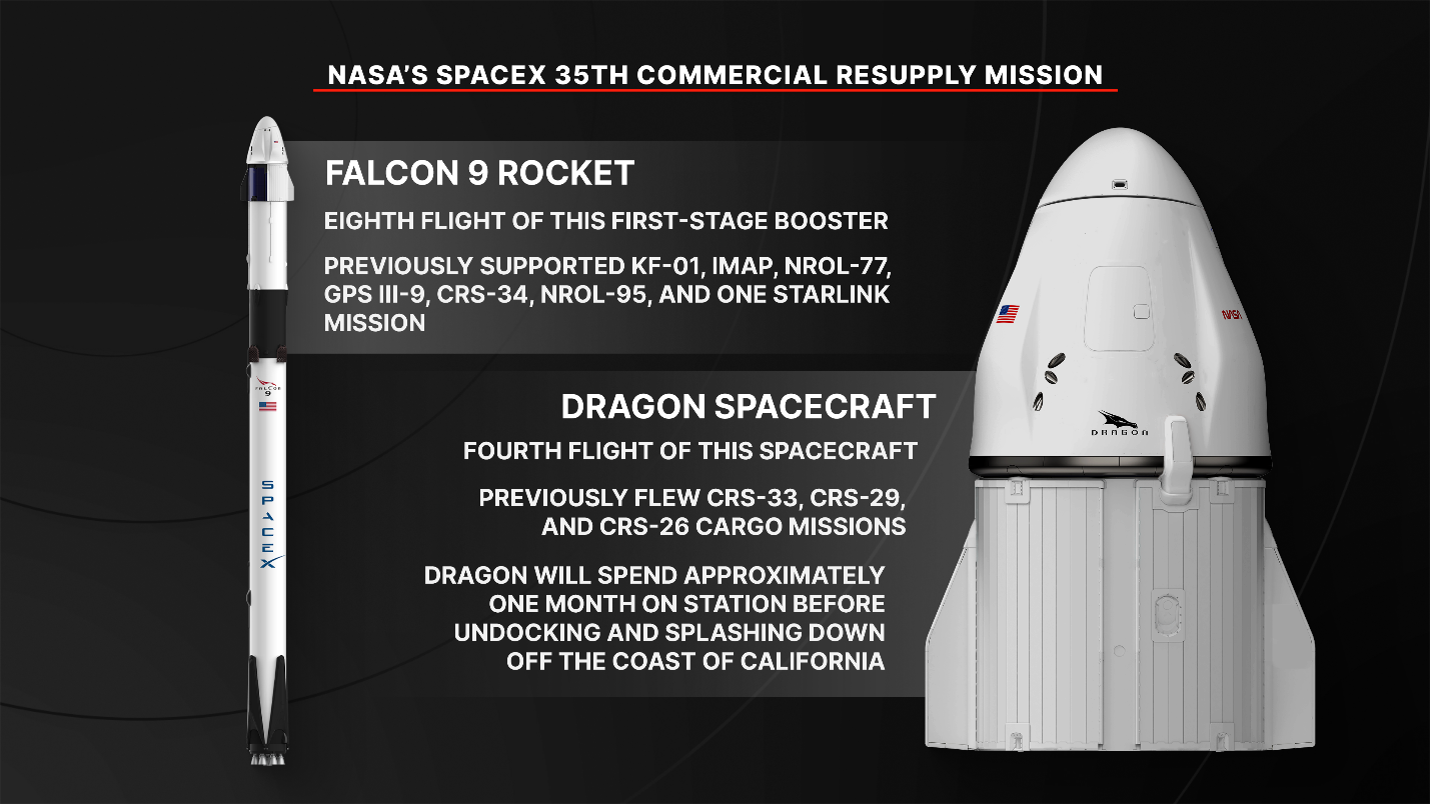
A central objective of this flight is the delivery of the final pair of International Space Station Roll-Out Solar Arrays (iROSAs). These arrays are designed to augment the station’s existing power system, ensuring the laboratory maintains sufficient energy to support critical operations through its planned deorbit in 2030. The hardware is stowed in the unpressurized trunk of the Dragon spacecraft, tail number C211, which is making its fourth flight to the station, having previously supported CRS-26, CRS-29, and CRS-33.
The mission also serves as a logistical conduit for station maintenance. Dragon will carry a large foam clamshell apparatus intended to house a failed Canadarm2 robotic arm joint, which was removed during a spacewalk on June 30.
SpaceX Uses Falcon 9 Booster for 35th Resupply Flight
SpaceX is utilizing the Falcon 9 first-stage booster B1096 for this mission, which has previously supported seven launches, including the CRS-34 resupply flight and several national security missions. The mission itself represents the 35th time SpaceX has flown a cargo resupply flight under its contract with NASA. Dragon remains the only currently operational freighter capable of returning cargo to Earth, as other logistics vehicles such as Japan’s HTV-X, Russia’s Progress, and Northrop Grumman’s Cygnus XL are expendable and burn up upon reentry.
https://x.com/NASA/status/2107939889954029913
More on Bill Spetch
https://x.com/NASA/status/1667222372804378633
Keep reading
ESA’s Hera Spacecraft Spots Target Asteroid Didymos
Two years after launch, the European Space Agency’s Hera spacecraft has successfully spotted its target binary asteroid system...
Delegates to Vote on Abolishing Leap Second to Protect Systems
Delegates meeting near Versailles this week will vote on abolishing the leap second, driven by Earth's recent speed-up.
Researchers find quantum systems retain statistical traces of initial states
Researchers at Harvard University, Tampere University, and TU Dresden published findings in Physical Review X on October 11,...
NASA Releases Artemis II Lunar Science Data and Farside Images
NASA released nearly a terabyte of Artemis II science data and reports on Wednesday, featuring 11,000 images, audio...